
Digital standards: from fragmentation to interoperability

With the arrival of information technology, the economy found a key ally for management, control and process automation. Activities that previously required long execution times came to be completed in a few hours, with much greater precision than that achieved by a human operator. Moreover, the emergence of the Internet opened up a new range of possibilities by enabling the transmission of data in real time from the devices themselves, transforming the way organizations operate and make decisions.
Despite these advances, compared to other sectors, the transport sector shows a lower degree in terms of levels of technology adoption. To this day, it is still common to find printed documents, telephone calls or radio transmissions being used to make requests, carry out procedures or control goods.
If we focus on ports, despite the rise of automated terminals, we find a very uneven implementation that also tends to depend largely on the level of local development. As a result, a highly fragmented landscape has emerged, in which the absence of standards becomes the general norm.
In this context, both industries and institutions have decided to take a step forward. To pioneers such as Electronic Data Interchange for Administration, Commerce and Transport (UN/EDIFACT) and the barcode have been joined by initiatives such as the Digital Container Shipping Association (DCSA), the European Union’s Digital Transport and Logistics Forum (DTLF), the Open Logistics Foundation (OLF)and the Terminal Industry Committee 4.0. Although they all cover different areas, they share the same objective: to promote the creation and adoption of common standards and regulations that facilitate the implementation of digital standards in the logistics and transport sectors.
This analysis aims to shed light on the current landscape of standardization in transport and how different initiatives can collaborate with each other to face the major challenge of the digitalization in the maritime-port sector.
Analysis
Currently, technological advances make it possible to hold natural, fluid conversations, generate images, and automate tasks using artificial intelligence through almost any medium. However, the transport sector still has a limited degree of digitalization compared to other areas. Indeed, even today, in many environments, telephone calls, radio communications, email exchanges and even paper documents are still relied upon to convey information about routes, goods or service reservations.
Furthermore, the implementation of digital systems has proceeded at a very uneven pace, usually driven by investments in large port facilities or terminal operators, which have acted as an ‘incentive’ for other modes of transport to adopt these systems. According to the joint study by Boston Consulting Group and TIC 4.0 (2025), those ports that have reached a critical mass in terminal capacity or ecosystem ‘have a significantly more mature degree of digitalization’ (Parlongue et al. 2025).
Within the port context, the adoption of technologies such as the Internet of Things (IoT), artificial intelligence, big data, blockchain and high-speed networks (such as 5G) enables more efficient management of resources, greater traceability of the flow of goods and optimisation of operational processes. These innovations help to reduce waiting times, streamline cargo handling and minimise internal congestion, resulting in a substantial improvement in productivity and the experience of all actors in the logistics chain. In addition, digitalization promotes environmental sustainability by enabling the monitoring and control of emissions.
Regarding terminal automation and according to Drewry (2024), in 2024, only 72 of the 850 container terminals worldwide were fully or partially automated (Port Economics, Management and Policy 2024). Besides being costly, the automation of a port facility, whether newly built or adapted, involves the deployment of software and hardware solutions to “weave” the communications network between machines and operators. With good implementation, the latter can use the data generated to evaluate the performance of the facilities.
However, there is a wide variety of solutions adopted, as these tend to depend on the nature of the investment: the fact of whether the investment is in brownfield or greenfield, the machinery manufacturer, country of implementation, and company are important factors, in addition to the type of systems used by the port authorities. However, the transition to digital systems is not without its challenges.
One of the main challenges is the high initial cost of implementation, which can be a barrier, especially for smaller ports or regions with fewer resources. Investment in digital infrastructure, IoT sensors, 5G networks and automated systems requires sound financial planning and sometimes public-private partnerships or green financing instruments.
Finally, there are also cultural and organizational barriers: many organizations in the logistics-port sector are accustomed to traditional processes and require a change in mindset, staff training and change management to fully adopt digital technologies. This human aspect is as important as technological investment; without the active participation of key decision-makers and proper training, advanced systems will not be able to realise their full potential.
Fortunately, the industry has responded by driving advances in the regulatory framework and promoting international collaboration initiatives around digitalization and common standards. In this area, the International Maritime Organisation (IMO 2022) is promoting the adoption of digital standards, whose technical deployment and alignment are reinforced by the International Association of Marine Aids to Navigation and Lighthouse Authorities (IALA) standards register, which facilitates their consistent implementation by maritime authorities, ports and technology providers.
Beyond the port, the digitalization of transport as a whole — from road to rail — is driving a more transparent and efficient logistics chain. These strategies connect different modes of transport, facilitate the synchronisation of data in real time and open up new opportunities for efficient and sustainable multimodal travel. The aim is to reduce congestion, increase road safety and lower emissions, while creating a more accessible and competitive environment for users and operators.
At the political level, the European Union (EU) is promoting the homogenization of procedures and the mutual recognition of documents, as evidenced by initiatives such as the European Maritime Single Window Environment (EMSWe) and the Electronic Freight Transport Information (eFTI). In this context, the Digital Transport and Logistics Forum (DTLF) has been created, a group of experts established by the European Commission whose mission is to advise and support the digitalization of transport and logistics throughout the EU. More specifically:
- The DTLF brings together public and private representatives from different modes of transport and links in the logistics chain with the aim of facilitating dialogue, coordinating technical aspects and promoting the adoption of interoperable technologies. As part of this task, the Forum works together with the European Commission to identify barriers to digitalization and propose solutions that promote harmonization and data exchange between countries and operators. Additionally, it plays a key role in the implementation of projects such as eFTI and EMSWe, ensuring that regulatory frameworks translate into practical tools that benefit the entire sector.
- The eFTI regulation seeks to eliminate the obligation to carry paper documents in freight transport through the adoption of digital equivalents with the same legal validity. In practice, this allows carriers, freight forwarders and authorities to access freight information electronically, thus reducing bureaucratic burden, streamlining control procedures and improving traceability. By favoring data exchange through certified platforms, eFTI aims to eliminate redundancies, strengthen regulatory compliance and facilitate the seamless flow of goods and vehicles across borders within the European Union.
- EMSWe constitutes a digital platform that centralizes and standardizes the submission of information related to ships, cargo and passengers arriving at or leaving European ports. This initiative seeks to simplify the reporting of maritime transport operations, eliminating the need to provide repetitive data to different authorities or Port Community Systems. By integrating multiple national systems into a single European digital window, transparency, efficiency and compliance with regulations are increased, while promoting interoperability between member states and optimizing administrative processes.
As for initiatives that promote cooperation, the DCSA and IPCSA (2023) stand out in the maritime field. Unlike TIC 4.0, whose approach will be described below, the DCSA focuses particularly on port and cargo documentation, such as the Electronic Bill of Lading, as well as on the modelling of maritime processes. For its part, IPCSA brings together port operators, single window managers, port authorities and even airport authorities, with the aim of promoting, advising and facilitating the electronic exchange of information between the different actors in the logistics chain.
TIC 4.0
TIC 4.0 is an international non-profit association with a presence on all continents. It was founded in 2018, when the Federation of European Private Terminals (FEPORT) and the Port Equipment Manufacturers Association (PEMA) decided to establish it in order to respond to the challenges posed by the adoption of new technologies in the port sector. Both organizations created it with the aim of establishing unified digital standards geared towards the adoption of Industry 4.0 technologies by the port community.
In this way, it seeks to bridge the technological gap in the port sector in order to introduce these advanced solutions. It currently has 70 active members, including major terminal operators such as DP World, APM Terminals and TiL, machinery manufacturers such as Konecranes and Kalmar, and service providers such as Kaleris and DSP. Thanks to this diversity of members, TIC 4.0 is able to bring together the vision of all the players involved in the port logistics chain, giving its standards great quality and relevance.
Similar to the functioning of international standardization committees such as ISO or CEN experts designated by companies meet in working groups that address different topics such as terminal automation, digital twins and machinery maintenance, among many others. Since its inception, TIC 4.0 has continuously published new versions of its standard; to date, it has compiled hundreds of definitions of key concepts in 18 publications.
All of these are available for download on the Internet, while, in a key milestone for the Association, the standard will acquire ‘Publicly Available Specifications’ (PAS) status from the British Standards Institute. This recognition is a preliminary step towards its transformation into an official international standard by the ISO, a goal set for 2029.
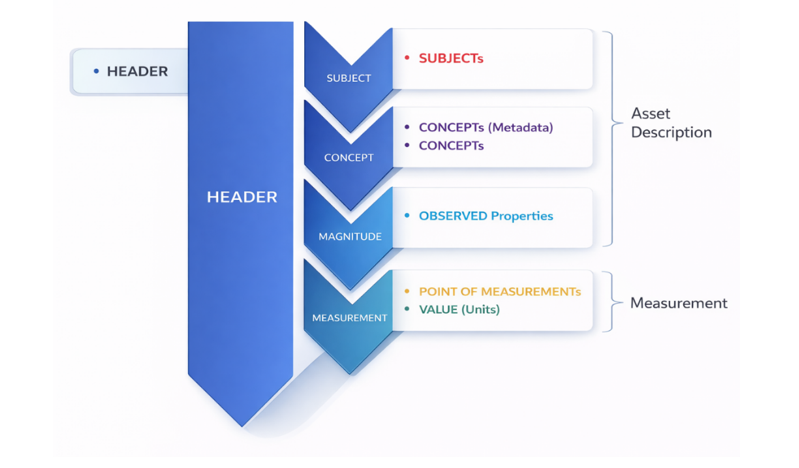
TIC 4.0 digital standards employ common semantics, derived from the ‘Resource Description Framework’, which emulates, the structure of human language (subject –> predicate –> object). Through this the user can model ‘any reality’ they need to represent in a digital environment, even beyond port terminals, thanks to its flexibility; the data model generated is only a ‘basic structure’ that acquires meaning once the user applies the ‘dictionary’ of their field.
As an example, in the European FOR-FREIGHT project an experimental application was successfully carried out in the field of air transport, modelling the movement of cargo between the port terminal in Piraeus (Athens) and Athens airport.
Illustration 1. Structure of TIC 4.0 semantics
Source: Terminal Industry Committee 4.0
Although the implementation of a unified digital standard may seem distant, it is already a reality in several locations. Ports such as Malta and Hamburg have effectively implemented this standard. In the former case, a monitoring system has been deployed that allows, on the one hand, real-time supervision of machinery movements and status and, on the other, the generation of a database for the analysis of the terminal’s operational performance.
TIC 4.0 is also part of the official ISO ‘Ports and Terminals’ subcommittee as an associate entity. Founded in 2025 on the direct initiative of China, this body promotes the creation of global standards in the field of port logistics. In addition to TIC 4.0, the official standardization bodies of countries such as the United States, Germany, Norway, France, Saudi Arabia, Korea, Japan and Azerbaijan participate, reinforcing its authority and universality.
Finally, the Association is also active in the European innovation ecosystem, where it has participated in the FOR-FREIGHT, SEAMLESS and MISSION projects and has been accepted into Waterborne, the European innovation platform for the maritime and river transport sector.
Conclusions
The digitalization of transport offers clear advantages in terms of efficiency, competitiveness and sustainability. The use of real-time data, information exchange platforms and interoperable systems makes it possible to optimise routes, reduce waiting times, improve the traceability of goods and facilitate coordination between the different actors in the logistics chain. All of this translates into lower operating costs, greater reliability in operations and better planning capacity for operators, shippers and public authorities alike. Furthermore, digitalization is a key enabler for advancing environmental objectives by reducing emissions through more efficient transport management and better multimodal integration.
However, this transformation faces significant structural difficulties. The transport sector is highly fragmented, with a large number of small and medium-sized enterprises that have little financial muscle and limited human resources to bear the costs of investing in technology, adapting systems or training staff. Added to this is the coexistence of legacy systems that are not very compatible with each other, which hinders interoperability and reduces the real impact of digital solutions when they are not applied in a coordinated manner throughout the entire chain.
Another significant challenge is the business culture of the sector, which has traditionally been very focused on day-to-day operations and has little scope for strategic innovation. In many cases, there is still a certain resistance to change, motivated by the perception that digitalization means more administrative complexity or an increase in workload in the short term. Without proper change management, accompanied by clear incentives and tangible benefits, there is a risk that digital tools will not be fully utilised or will become mere formal requirements.
In addition to the internal transformation of transport companies, European digital initiatives are a decisive factor in overcoming the structural challenges of the sector. Projects and frameworks such as the EU’s eFTI are laying the groundwork for replacing paperwork with standardized, secure electronic data exchanges between operators and authorities, which will reduce administrative costs and facilitate cross-border and multimodal interoperability.
The DTLF also plays a key role in this effort, coordinating public and private actors to promote data interoperability and the technical implementation of these frameworks. Beyond regulatory projects, cooperation platforms such as TIC 4.0, which bring together innovative industry companies and service providers, help to transfer advanced solutions (e.g. IoT, data analysis, automation) to the heart of logistics and transport.
This not only makes digitalization accessible to organizations with less economic capacity, but also fosters collaborative ecosystems that reduce market fragmentation and facilitate the cultural transition towards more efficient, resilient and sustainable transport models.
Finally, digitalization poses cross-cutting challenges such as cybersecurity, data governance and the need for common standards, especially in multimodal and cross-border environments. Overcoming these obstacles requires not only technological investment, but also public-private coordination, clear regulatory frameworks and a shared vision at European level, enabling the digitalization of transport to be a real driver of competitiveness and resilience, rather than an additional source of fragmentation.
References
- PARLONGUE, David et al. 2025. Digital transformation and the next wave of port efficiency. Boston: Boston Consulting Group; Terminal Industry Committee 4.0. Available at: https://web-assets.bcg.com/pdf-src/prod-live/digital-transformation-next-wave-port-efficiency.pdf [Accessed: 21/01/2026].
- PORT ECONOMICS, MANAGEMENT AND POLICY. 2024. Fully and semi-automated container terminals. Available at: https://porteconomicsmanagement.org/pemp/contents/part6/terminal-automation/fully-semi-automated-container-terminals-total-hectares/ [Accessed: 19/01/2026].
- BOSTON CONSULTING GROUP; TERMINAL INDUSTRY COMMITTEE 4.0. 2025. Digital maturity of ports and terminal ecosystems. Paris: BCG.
- DIGITAL CONTAINER SHIPPING ASSOCIATION. 2024. DCSA. Available at: https://dcsa.org [Accessed: 19/01/2026].
- DREWRY MARITIME RESEARCH. 2024. Container terminal automation annual review 2024. London: Drewry.
- *See the downloadable document for the complete list of bibliographical references.
*Disclaimer: This English version has been generated with the support of AI-based translation tools. In case of discrepancies, the Spanish original prevails.