
A New Digital Framework for European Transport: Regulation, Interoperability and the eFTI4LIVE Project

Spain’s Ministry of Transport and Sustainable Mobility is coordinating the major European eFTI4LIVE project to validate the eFTI architecture, while promoting the mandatory use of the electronic Administrative Control Document (DeCA) as a key step in the digitalisation of road transport in Spain.
Introduction: The Regulatory Landscape of Transport Digitalisation under the Electronic Freight Transport Information (eFTI) Regulation
Freight transport in the European Union is undergoing its most significant transformation in document management with the implementation of the eFTI Regulation (EU 2020/1056). The legislation imposes a legal obligation on all public authorities in the Member States to accept transport information in a standardised, interoperable digital format from July 2027.
At European level, the Commission has consolidated the implementing legislation, with the exception of regulatory provisions relating to the certification of eFTI service providers and platforms:
- Common dataset (Commission Delegated Regulation (EU) 2024/2024): Defines the single, interoperable data structure.
- Inspection procedures (Commission Implementing Regulation (EU) 2024/1942): Governs the protocols used by authorities to request and access information.
- eFTI platform requirements and certification (Commission Implementing Regulation (EU) 2025/2243): Specifies the operational and cybersecurity requirements to be met by eFTI platforms and their service providers.
In Spain, this European roadmap intersects with the national digitalisation strategy through the recent Ministerial Resolution of the Directorate-General for Road and Rail Transport (dated 5 June 2026), adopted within the framework of the Sustainable Mobility Act. This measure makes the electronic Administrative Control Document (DeCA) mandatory for all domestic public road freight transport operations.
The Ministerial Resolution on DeCA: The End of Paper Documents in Spain
The Ministerial Resolution governs the technical specifications that electronic administrative control documents and the applications used to produce them must meet:
- Mandatory use of DeCA: From October 2026, under the Sustainable Mobility Act, the road transport control document in Spain will be exclusively electronic. Replacing it with digitised or scanned paper documents is expressly prohibited.
- Native generation and format: DeCA documents must be native PDFs generated from structured data, with a maximum file size of 5 MB and metadata recording their creation and modification dates and times.
- Accessible repository and unique URL: Companies must store documents in a secure repository with a unique URL (HTTPS/TLS 1.2+) and an embedded QR code enabling inspection authorities to download them directly without manually entering a username or password.
- Electronic amendments: Any change during the journey must be made digitally to the file, preserving traceability. Handwritten annotations on printed copies have no legal validity.
The Connection Between the DeCA Resolution and the eFTI Regulation
The Resolution itself provides a bridge to EU legislation: if transport information is managed through platforms within the eFTI framework (using structured data in accordance with the European CMDS standard), it will not be necessary to comply with the specific PDF/QR format required under the national rules. The electronic DeCA is thus designed from the outset to be integrated seamlessly into the eFTI ecosystem.
The eFTI Architecture: How do the Technical Components Interact?
The decentralised eFTI model ensures that data remain under the control of private operators until a competent authority requests them as part of an administrative inspection. This functional infrastructure rests on four essential technical pillars:
1.Consignment Movement Datasets (CMDS):
These are standardised data structures that replace physical documents. Each transport operation is represented through a CMDS: a single interoperable set of fields relating to the movement of goods that brings together European and national regulatory requirements (consignor, carrier, route, goods, vehicle and other details).
2. eFTI Platforms:
These are technological environments (developed by software providers or large transport companies) responsible for processing data, managing signatures and storing CMDS records. They ensure that information is available in real time and provide the unique link (URL/QR code) presented by the carrier during an inspection.
3. eFTI Gates:
These are access points or interoperable nodes managed by the public administrations of each Member State. The eFTI Gate acts as a secure router: it receives an inspection authority’s request, locates the relevant eFTI Platform hosting the requested CMDS and forwards the validated data automatically and confidentially.
4. Certification of eFTI Platforms:
To join the eFTI network, platforms must undergo an audit and certification process performed by Conformity Assessment Bodies (CABs) recognised in the EU. Certification validates compliance with requirements for data protection, cyberattack prevention, tamper-proof storage and continuous operational availability.
Data Flows in the eFTI Ecosystem
To understand how the ecosystem works in practice, information exchange follows a sequence of three distinct phases:
Flow 1: Registering the Transport Operation and Generating the UIL
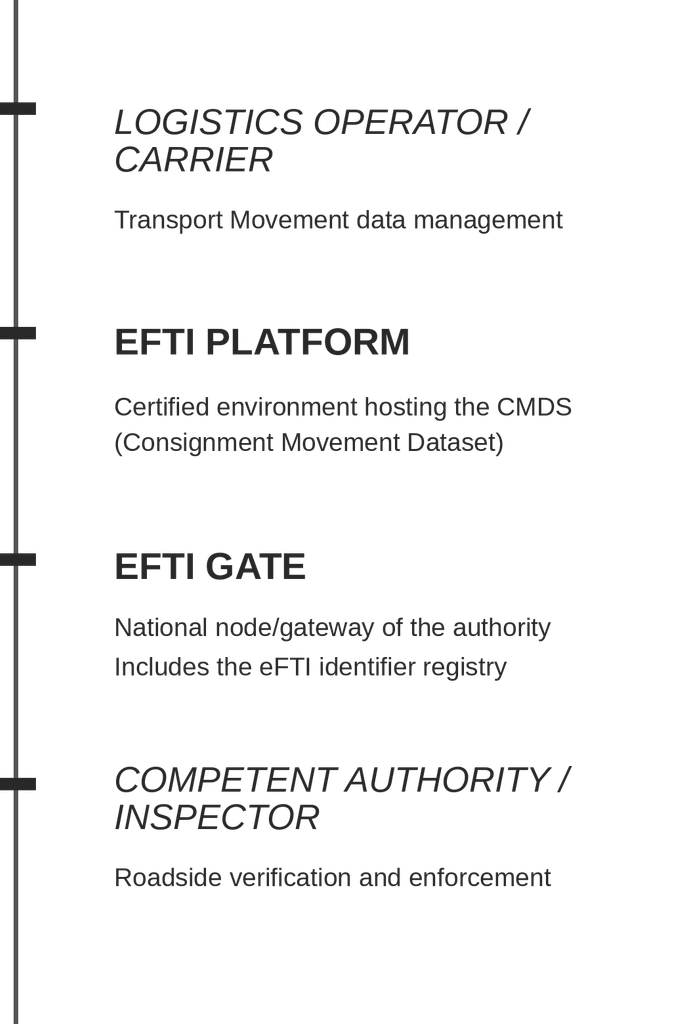
1. The logistics operator creates the transport declaration and registers it on its eFTI Platform (for example, by generating the DeCA).
2. The platform, structured according to the CMDS standard, generates a globally unique identifier (UIL – Unique Identifier Location).
3. The platform notifies the eFTI Gate in its country of the UIL registration, together with other identifying information.
4. The eFTI Gate’s Registry of Identifiers indexes this code together with the platform identifier. The information on the movement of goods remains on the eFTI Platform.
Flow 2: Presentation at the Inspection Point
1. During a roadside inspection, the driver presents the code (via a QR code or digital link).
2. This code contains the shipment’s UIL.
Flow 3: Routing, Verification and Data Delivery
1. The inspector’s device reads the UIL and sends a request to the eFTI Gate in its country.
2. The eFTI Gate immediately consults the Registry of Identifiers. The eFTI Gate in the country where the inspection takes place determines whether the request must be routed to eFTI Gates in other countries through a secure, standardised Europe-wide communication system known as eDelivery.
3. The eFTI Gate confirms the validity of the eFTI Platform holding the information and verifies that its technical certification is current.
4. The eFTI Gate requests only the authorised CMDS data from the relevant eFTI Platform.
5. The eFTI Platform returns the encrypted data to the eFTI Gate, which displays them in a readable format on the inspector’s screen.
6. The inspector may send a communication that is routed through the eFTI Gate to the eFTI Platform, where it must be recorded.
Key requirements for eFTI Platforms
To ensure the highest levels of cybersecurity, data integrity and interoperability, eFTI Platforms (whether solutions developed by software providers or in-house systems operated by major logistics companies) must incorporate specific features required by the EU:
- Direct machine-to-machine (M2M) communication: The connection to the eFTI Gate for providing data to authorities must operate strictly machine-to-machine, through secure web interfaces and robust encryption protocols.
- Granular access and registry management (Authorisation Registries): The platform must maintain separate authentication components to manage user profiles, ensuring that each operator or authority can access only the data subsets for which it has authorisation to process information.
- Immutability and traceability (audit log): Every creation, modification or retrieval of information must be recorded in an indelible log. The platform must ensure timestamping and non-repudiation mechanisms.
- Dual formats (machine-readable and human-readable): The platform must process native, structured data (JSON/XML under Regulation (EU) 2024/2024) for automated access by public administrations, while also enabling the information to be rendered in a format understandable to drivers and inspectors.
- Strict GDPR compliance: Personal data must be automatically deleted or anonymised once the statutory retention period required by transport legislation has expired.
- Availability and business continuity: Contractual guarantees of high availability (24/7) and contingency plans to maintain operations if a network outage occurs during a roadside inspection.
As public authorities will base their inspections and administrative decisions on information processed by these systems, trust depends on mandatory certification. After successfully completing the audit, the platform obtains an official eFTI certificate and is entered on the European Union’s public list of certified platforms. eFTI Gates will automatically reject any request originating from a system not listed as verified in that register.
The eFTI4LIVE Project: Leadership by Spain’s Ministry of Transport and Sustainable Mobility
To test in practice how national rules are integrated with the European framework, the European Commission has selected the eFTI4LIVE project, funded with EUR 47 million through the Connecting Europe Facility (CEF).
The project is led and coordinated directly by Spain’s Ministry of Transport and Sustainable Mobility, placing the country at the forefront of European logistics innovation:
- The project brings together 55 organisations (ministries, port authorities, technology providers and logistics operators) from 19 EU Member States.
- Main objective: To deploy, validate and test the decentralised eFTI architecture on real logistics corridors and in multimodal operations before the legislation becomes mandatory in 2027.
In the first operational phase of eFTI4LIVE led by the Ministry of Transport, the focus is on digitalising DeCA. ADIF, Puertos del Estado, Fundación Valenciaport, the Port Authority of Valencia and the Port Authority of Huelva also participate in the project. Fundación Valenciaport aims to provide technical and project-management support to MITMS and to collaborate with the Port Authority of Valencia in transforming its Port Community System into an eFTI Platform.
The project tests:
- Mapping the mandatory data in the national DeCA to the European CMDS standard.
- Deploying the Spanish eFTI Gate within the SIMPLE platform, in which the Ministry of Transport and Sustainable Mobility, ADIF and Puertos del Estado participate.
- Testing automated administrative information requests from roadside inspections to eFTI Platforms.
- Integrating with Port Community Systems (PCS) at key port nodes (such as the Valencia port community), so that DeCA generation in line with eFTI regulations and technical specifications is fully integrated digitally with other transport processes occurring in ports, including customs controls, obtaining terminal access authorisations, and the pick-up and delivery of containers and goods.
Conclusion: Preparing Logistics for 2026 and 2027
The combined impact of the Ministerial Resolution on DeCA (with an October 2026 deadline) and the rollout of the eFTI4LIVE project led by the Ministry of Transport shows that document digitalisation is no longer a future promise. Transport companies and IT providers must adapt their systems to comply with national legislation this year, and integration into the European eFTI ecosystem will be possible from 9 July 2027. In principle, however, adaptation to the eFTI ecosystem will not be mandatory for transport companies, although this situation may change two years after the ecosystem is launched.
References
1. European Union Regulatory Framework (eFTI Regulation)
- Regulation (EU) 2020/1056 of the European Parliament and of the Council of 15 July 2020 on electronic freight transport information (eFTI). Official Journal of the European Union (OJ L 249/33).
- Commission Delegated Regulation (EU) 2024/2024 establishing the common eFTI dataset and corresponding data subsets (CMDS). Official Journal of the European Union.
- Commission Implementing Regulation (EU) 2024/1942 laying down common procedures and access specifications for inspection authorities under eFTI. Official Journal of the European Union.
- Commission Implementing Regulation (EU) 2025/2243 laying down functional, operational and cybersecurity specifications for the conformity assessment and certification of eFTI Platforms. Official Journal of the European Union.
2. National Regulatory and Strategic Framework (Spain)
- Ministry of Transport and Sustainable Mobility. (2026). Resolution of 5 June 2026 of the Directorate-General for Road and Rail Transport regulating the technical specifications for electronic administrative control documents (DeCA). Spanish Official State Gazette (BOE).
- Spanish Parliament (Cortes Generales). (2023/2024). Sustainable Mobility and Transport Financing Act (9/2025). Head of State.
- Ministry of Transport, Mobility and Urban Agenda. (2021). SIMPLE Multimodal Service Integration Platform (Simplification of Transport Processes). Joint project of MITMS, ADIF and Puertos del Estado.
3. European Projects, Technical Documentation and Logistics References
- European Commission – DG MOVE. (2024). eFTI Architecture Specifications and Implementation Guidelines: Functional Specifications for eFTI Gates, Registry of Identifiers, and Platforms. European Commission.
- eFTI4LIVE Project. (2025). Grant Agreement No. CEF-T-2023-eFTI4LIVE. Connecting Europe Facility (CEF) – European Climate, Infrastructure and Environment Executive Agency (CINEA).
- UN/CEFACT. (2022). Multi-Modal Transport Reference Data Model (MMT-RDM). United Nations (reference semantic standard on which the CMDS is based).
*Disclaimer: This English version has been generated with the support of AI-based translation tools. In case of discrepancies, the Spanish original prevails.