
Flexible IoT Architectures for Smart Ports
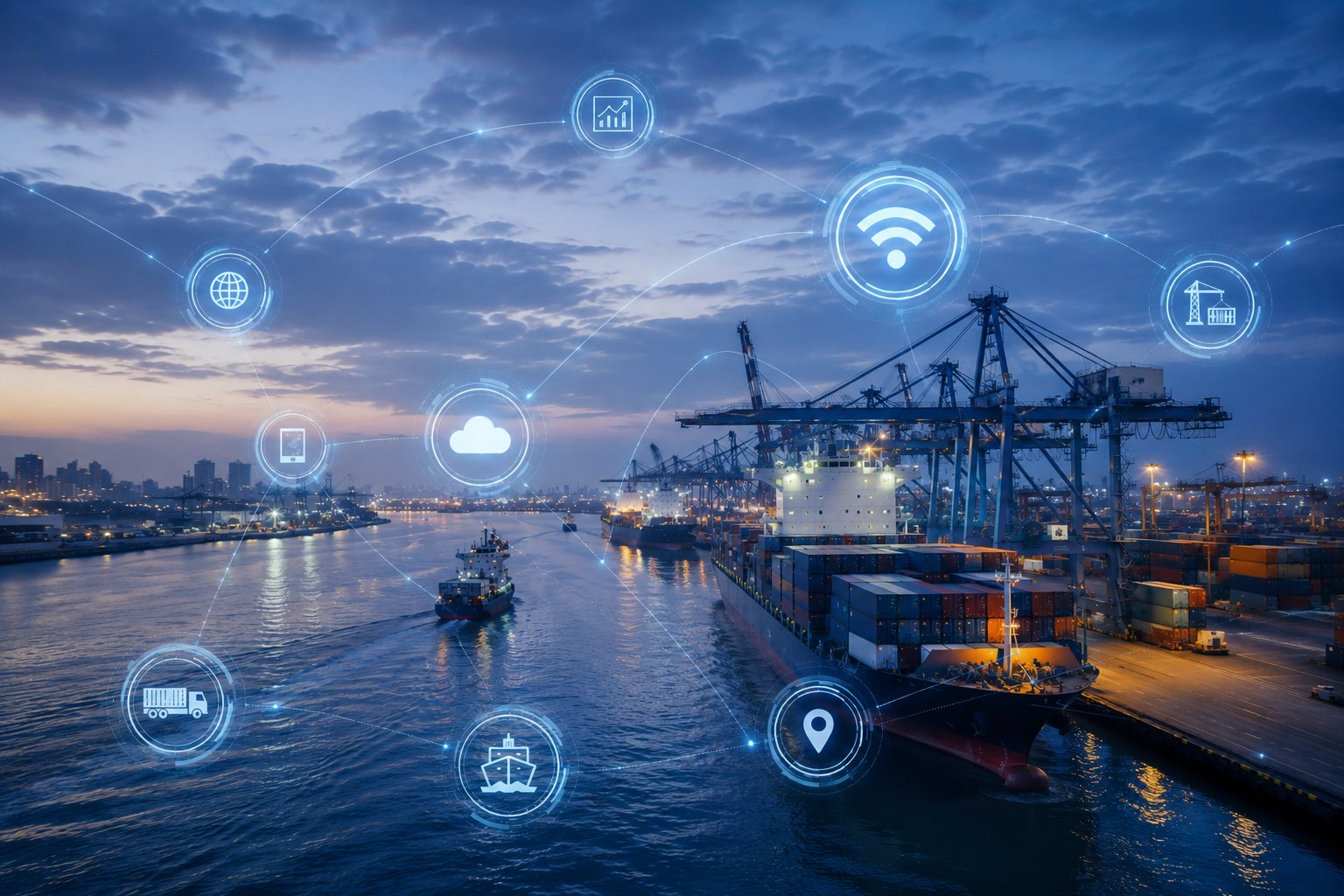
The article Flexible Multi-Domain IoT Architecture for Smart Cities explores how multi-domain IoT architectures make it possible to build interoperable and federated ecosystems. Based on an architectural approach built on edge computing, programmable networks, and semantic models, the paper identifies the main challenges and opportunities for integrating multiple operational domains in scenarios characterized by high requirements for automation, security, and efficiency.
Today’s ports operate as highly dynamic logistics nodes, where every action — from a vessel’s arrival to a container’s dispatch — depends on accurate data and a digital infrastructure capable of reacting in real time. In this context, digital transformation is no longer optional; it has become a critical factor for competitiveness, resilience, and sustainability for port authorities and logistics operators.
The growing automation of cranes, automated guided vehicles (AGVs), positioning systems, and environmental monitoring demands reliable communications, low latency, and smooth coordination among multiple public and private stakeholders. To meet these needs, distributed processing through edge computing becomes essential, since it allows artificial intelligence to run directly at the point where operations take place: machinery control, video analytics for security, container flow optimization, or facility energy management. Combined with private 5G networks, it provides a high-capacity communications substrate that enables advanced automation, autonomous decision-making, and operational continuity even during congestion or partial failures.
The article Flexible Multi-Domain IoT Architecture for Smart Cities introduces an emerging architecture that is gaining traction as a useful, validated initiative for the advanced digitalization of port infrastructure. The proposed platform establishes a flexible, multi-domain ecosystem designed to overcome the technological fragmentation that characterizes modern port environments, where multiple operators coexist with different policies, security requirements, and governance models. Its main contribution is enabling a collaborative “system of systems”, in which every actor — port authority, terminals, shipping lines, or customs services — can interoperate without giving up sovereignty over its critical resources.
This initiative responds to the need to evolve toward automated, context-aware, and coordinated real-time operations. To that end, the architecture tackles three fundamental challenges. First, interoperability, through standardized semantic models that allow equipment and systems from different vendors to work coherently together. Second, automation, thanks to policy-based orchestration mechanisms that replace manual processes with adaptive, dynamic workflows. Third, security, by incorporating a programmable overlay network that isolates inter-domain traffic and guarantees operational resilience in critical environments.
Taken together, this technology offers a solid foundation for ports to collaborate efficiently without sacrificing autonomy, ensuring operational continuity, regulatory compliance, and reliable integration within a shared digital ecosystem. Compared with traditional monolithic architectures, this federated approach allows existing systems to evolve progressively, reducing risk and favoring the gradual adoption of new digital capabilities.
Concrete benefits for the port sector (Smart Ports)
One of the main benefits is interoperability among heterogeneous systems. A port brings together terminal management platforms, environmental sensors, security systems, energy control, maritime operations, and logistics applications. The multi-domain architecture makes it easier for all of these to exchange data in a standardized, secure way, avoiding ad hoc integrations, reducing dependence on specific vendors, and lowering maintenance and integration costs.
Another key aspect is improved operational efficiency through edge computing. Processing information close to its source reduces latency in critical operations such as automated crane control, autonomous vehicle (AGV) guidance, video analytics for security or traceability, and infrastructure monitoring. This enables faster decisions, greater responsiveness to incidents, and more proactive resource management, in line with the edge-computing principles promoted in 5G environments.
Scalability is another decisive factor. Ports are evolving toward increasingly sensor-rich environments: digital twins, full yard automation, energy optimization, advanced environmental control, or predictive maintenance. The flexible architecture allows new devices, domains, or services to be added without redesigning the core system, making it easier to adapt to future technological and regulatory requirements.
In terms of reliability and security, domain segmentation and federated data control make it possible to share operational information without compromising system integrity. This is especially relevant for critical infrastructure, where different stakeholders — port authority, concession holders, shipping lines, or security forces — must collaborate while keeping control over their own assets and access policies. The architecture thus strengthens protection against cyberthreats and improves incident response capacity.
Finally, support for real-time services is essential in operations where every second counts, such as berth management, detection of internal congestion, stevedoring activities, or emergency coordination. Low latency and local processing capacity make it possible to build critical applications with quality-of-service guarantees, something fundamental in highly complex logistics environments.
The transition toward smart ports requires much more than sensors and connectivity: it depends on the ability to integrate and coordinate a distributed digital ecosystem. Flexible, multi-domain IoT architectures are establishing themselves as a key enabler for smart, resilient, data-driven port operations. By combining edge computing, advanced 5G connectivity, and federated interoperability, they make it possible to overcome current fragmentation and facilitate secure collaboration among stakeholders without losing control over critical assets. This approach not only improves operational efficiency, but also introduces a paradigm shift: ports turning into adaptive, competitive, and sustainable digital platforms.
References
- Crespo-Aguado, M., Martínez-Palomo, L., Molner, N., Torrealba-Ferrer, A.-J., Higón-Sorribes, J.-M., Blasco, C., Ravelo, C., & Gomez-Barquero, D. (2026). Flexible multi-domain IoT architecture for smart cities. Applied Sciences, 16(3), 1534. https://doi.org/10.3390/app16031534
*Disclaimer: This English version has been generated with the support of AI-based translation tools. In case of discrepancies, the Spanish original prevails.