
Predicting the future is always a dangerous business. We scientists should probably leave it to astrologers, gurus and other modern-day charlatans, but the subject of new quantum technologies speaks directly to us: who, if not a physicist, could say just how far the quantum computers just around the corner will go? Admitting, then, that however much one knows about science, we are not much better at unravelling the threads of destiny, let us see if, from the perspective of physics, we can say anything about that future we would all like to glimpse.
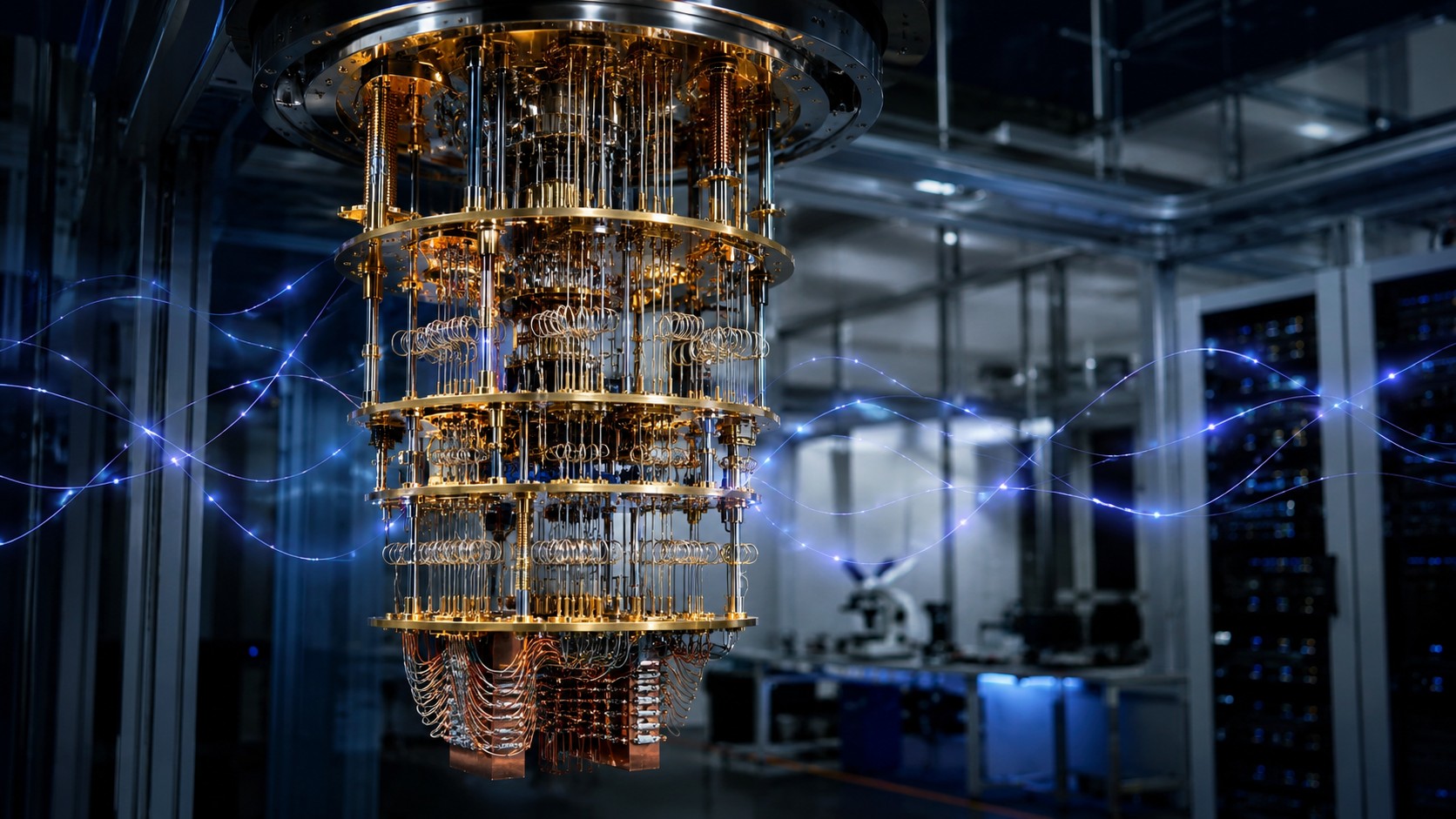
To tread on safe ground, we must start by understanding what we are dealing with. What is a quantum computer, and what problems is it supposed to be able to solve? At present, quantum computers are little more than prototypes. It is true that major tech companies are investing in them, and the machines themselves fill an entire room and are visually spectacular, but their computing power is still limited. None of these computers can tackle a problem of practical relevance. Let’s imagine them, if you like, as the first computers that were unveiled to the world eighty years ago: enormous, promising, but still very limited.
The phase we are in right now is one of refining the technology, ensuring that we understand it properly and that it is scalable. In that future where quantum computers solve important problems, the machines will have to be a hundred times more powerful than the ones we have now, perhaps a thousand times more powerful. Will those machines use superconducting circuits, like the ones we use now? The first classical computers used vacuum tubes, but the arrival of transistors rendered them obsolete. Finding the right technology is key.
And what do we expect from this technology? As we explained at last week’s conference, the power of quantum computing lies in the fact that the various elements of a ‘quantum memory’ can share information with one another.
It is as if every byte on our computer’s hard drive contained information not only about itself, but also about the bytes surrounding it, or perhaps about some that are far away within the hard drive. In the jargon of quantum physics, we call this maintaining coherence. The elements of these quantum devices have to ‘know something’ about their neighbours. The difference that quantum technology brings is this ability for information to be ‘distributed’ throughout the hard drive.
Unfortunately, that famous coherence is very easy to lose. The components of a quantum computer must be kept at very low temperatures, below -270 °C, otherwise the ‘bytes’ in my quantum memory lose track of what their neighbours are doing, and the advantage we had gained disappears. They also need to be very well insulated: the hot, chaotic outside world is the enemy of quantum computing. Anything that penetrates the machine can destroy the much-sought-after coherence. These are some of the challenges facing the technologists who are developing the devices that power quantum computers.
Another important question is what problems these computers will be able to tackle. We tend to think of a computer as a machine that can do virtually anything: video games, mathematical calculations, browsing the internet. Quantum computers will not be like that: they will be super-specialists. Because of their unique way of processing information, they will be very good at certain problems, much better than ordinary computers. For other problems, they will be more or less as good as traditional computers. And for some, they will actually be worse. So, given that they are extremely expensive machines, we will surely use them initially only for those tasks at which they are truly good.
What are these tasks? The truth is that nobody knows yet. We are aware of a few problems where quantum computers are particularly powerful: factoring numbers into their prime factors or searching through a list are just a couple of examples. Generally speaking, these are tasks where it is advantageous to have ‘all the information at a glance’, something that can be achieved through the distribution of information we mentioned above. But for now, these are just a few tasks.
It is true that some of them are highly relevant to public life, because internet security relies heavily on prime factorisation. The community of theoretical physicists and computer scientists is very active in the search for new algorithms that will broaden this ‘range of applicability’ for quantum computers.
With all this in mind, what can we expect from the future of quantum computers? At this stage, it seems clear that they will coexist peacefully with traditional computers. At least in their early years, quantum machines will be specialists used for cryptography or the security of online communications. Perhaps we will find some other task at which they excel.
But we won’t be using a quantum computer to play Candy Crush. Nor will we be using it to post photos of kittens. Traditional computers have the advantage of history: they have been refined, miniaturised and mass-produced for decades. They will remain competitive for many decades to come. The future will surely consist of quantum computers in large companies and government departments, and traditional computers—ever faster and ever cheaper—in our homes and in our pockets.
When will that future arrive? It’s hard to say. The technology is at least 10 years away. More likely 25. That’s assuming we continue to live in a peaceful world where raw materials flow from producing countries to consumers. But the latter has nothing to do with physics, and it’s up to others to explain it better.
*Disclaimer: This English version has been generated with the support of AI-based translation tools. In case of discrepancies, the Spanish original prevails.