
The metro as a logistical ally: reivinting the last mile in cities
The rise of e-commerce is not only transforming consumption patterns, but also reshaping urban mobility and the associated logistics. In this context, last-mile delivery has become one of the main operational challenges for cities, driven by the growing demand for fast deliveries, increasing traffic congestion, and the need to transition towards more sustainable models. This article analyses how the integration of existing transport infrastructures —such as metro networks— together with advanced planning and tracking systems can offer an innovative solution to optimise routes, reduce emissions, and improve operational efficiency, strengthening the connection between ports, urban environments, and consumers.
The rise of e-commerce has transformed not only consumption patterns but also how cities move. This revolution is reshaping supply chains, bringing port operations and urban Logistics into closer alignment (UNCTAD, 2024). On a daily basis, millions of orders must be transported along these corridors to reach consumers in a timely, flexible and sustainable manner. Withing this framework, the last-mile, the final stage between logistics centres and the end customer, has emerged as one of the most significant operational challenges, as urban congestion and the pressure for immediate delivery place considerable strain on traditional road-based transport models (European Commission, 20211; ITF, 2024).
The simultaneous growth of e-commerce and urban population is concentrating logistics demand in densely populated areas, where space is limited and mobility is further constrained by traffic and by essential emissions-reduction policies aimed at mitigating climate change (Sales et al., 2024; UN, 2024). More than half of the global population currently resides in urban areas, and this proportion is expected to continue rising, intensifying pressure on urban transport networks (World Bank, 2024).
Under these conditions, conventional systems based on lorries and delivery vans are facing increasing challenges in terms of efficiency, cost-effectiveness and sustainability. This is driving operators to explore solutions that integrate digital innovation, operational efficiency and environmental and social responsibility (Dampier et al., 2015; Athanasopoulos et al., 2024; Zhang et al., 2018).
A promising alternative lies in the strategic utilization of existing transport infrastructure to move goods efficiently, directly linking the port-hinterland supply chain with urban areas. This approach combines multimodal transport with a more sustainable and resilient last-mile capable of withstanding disruptions and congestion.
The European FOR-FREIGHT project has explored this concept in depth, investigating the integration of multimodal networks with advanced digital tools to optimise urban logistics. The proposal is both simple but transformative: to utilize underused empty early-morning metro services for the transportation of parcels from logistics-enabled metro depots to strategic stations.
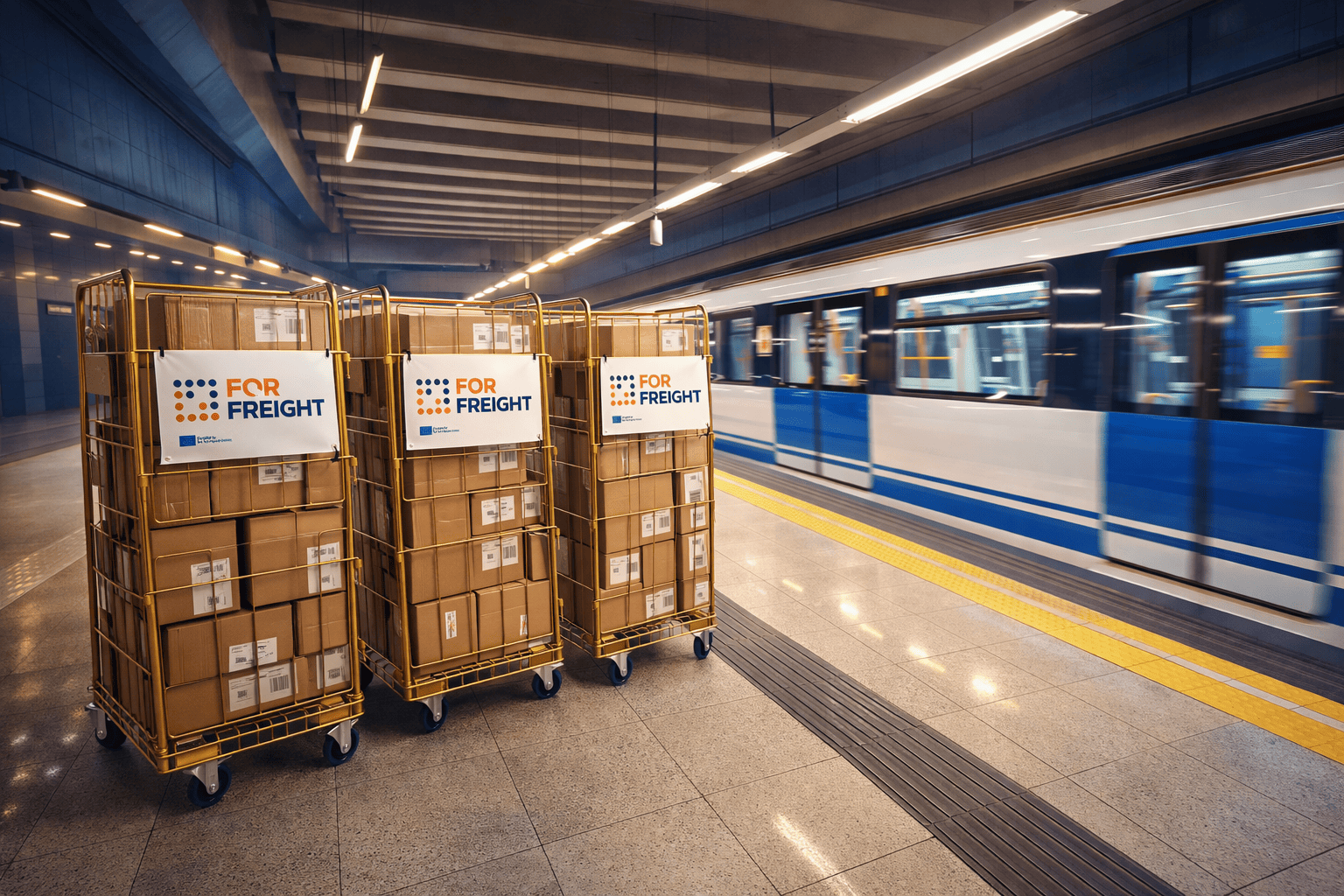
The proposed model is based on three key principles: the reuse of existing resources without the need for new vehicles or infrastructure, the prioritisation of passenger transport and the avoidance of structural modifications to the metro network. In operational terms, parcels are consolidated in roller cages at logistics operators’ warehouses and transported by lorries or delivery vans to metro depots. From there, they travel on empty trains to stations equipped with smart lockers for collection (FOR-FREIGHT, 2024).
The main value of the systems resides in the suite of solvers developed, digital tools designed to optimise the entire operation. The demand forecasting solver estimates parcel volumes per station on a daily basis over a seven-day planning horizon, taking into account purchasing patterns, metro user density and the seasonality of both shopping behaviour and ridership.
A blockchain-based locker reservation platform ensures availability and coordination between operators and locker managers, while QR codes and mobile application tracking points enable full traceability of each parcel and roller cage, recording the entire journey in real time from the warehouse to the final locker. Finally, the route optimization solver determines efficient routes in terms of costs, time and CO2 equivalent emissions, integrating transport from the port to urban logistics centres and the last mile.
The results derived from the FOR-FREIGHT project’s simulations and pilot tests demonstrate clear and measurable benefits. The use of metro systems for urban freight transport leads to a significant reduction in road kilometres travelled, helping to alleviate congestion and lower CO2 equivalent emissions. The combination of demand forecasting, optimised route planning, a blockchain-based locker booking platform and QR-based tracking of parcels and roller cages enhances operational efficiency, improves traceability and ensures real-time coordination between logistics operators and locker managers (FOR-FREIGHT, 2024).
Furthermore, as the model does not require modifications to metro networks or stations, it can be readily replicated in other cities with established metropolitan systems. It may also be complemented by sustainable last-mile solutions, such as electric cargo bikes or urban microhubs, which facilitate the consolidation of goods prior to final delivery. These findings indicate that both the sustainability and efficiency of logistics systems can be improved without the need for new infrastructure, through the intelligent utilization of existing resources and the reinforcement of connections between ports, hinterlands and the urban last mile.
In light of the continued expansion of e-commerce and the increasing pressure on urban environments, this multimodal freight approach, supported by advanced planning and coordination systems, emerges as a strategic pillar for the development of more sustainable, resilient and efficient urban logistics systems, better aligned with contemporary urban needs. It contributes to the optimisation of urban flow management and delineates a clear pathway towards the future of urban logistics.
References
- Enríquez Manilla, A., Feliu Escagüés, J., Luong, N. Q., Denis, H., & Villa Martínez, R. (2025). Last-mile delivery in the e-commerce era: Leveraging urban metro networks in the FOR-FREIGHT Project. 16th ITS European Congress, Sevilla (España), 19-21 de Mayo de 2025.