
Ports in the energy transition: from traditional nodes to green hubs

Ports play a fundamental role in global energy trade. Maritime transport moves more than 80% of the volume of global trade in goods, including a substantial share of energy products such as oil, natural gas and coal, reflecting the heavy dependence of maritime logistics on global energy supplies (UNCTAD 2024; 2025). This role is further complemented by the presence of refining facilities in port areas, both directly on port land and in the surrounding areas.
In this sense, the crucial role of the maritime-port sector in the energy market is directly related to logistical factors, where the efficiency and low cost of maritime transport are essential in a market characterised by large distances between production and consumption centres (UNCTAD 2024; IEA 2023). For this reason, the refining industry tends to be located in or near port areas, which means that many ports are not simply logistics hubs, but also industrial hubs specialising in the energy sector (IEA 2023).
In this context, the strategic location of the world’s major refineries in port areas (Table 1) not only facilitates the transport of energy products, but also reinforces the role of ports within the global fossil fuel-based energy chain. This proximity and integration with efficient logistics infrastructure are decisive factors in ensuring the continuous flow of these resources.
Table 1. Location and characteristics of the world’s main refineries
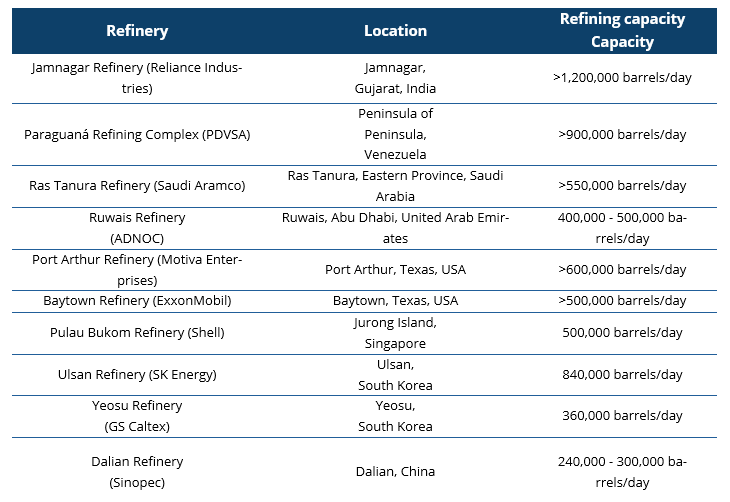
Source: Own elaboration based on IEA (2023), Oil & Gas Journal (2024) and corporate data from Reliance Industries, PDVSA, Saudi Aramco, ADNOC, Motiva Enterprises, ExxonMobil, Shell, SK Energy, GS Caltex and Sinopec.
This entire ecosystem, or at least a substantial part of it, can also be exploited for the transport and management of renewable alternatives to fossil fuels. It is this capacity to adapt existing infrastructure and dynamics that is likely to position ports as crucial elements in the transition to a more sustainable energy matrix, as discussed in the rest of this analysis.
An important part of the energy transition process is based on electrification and increased self-production, which is expected to reduce the relevance of certain commercial energy flows and, with it, the strategic role of some traditional industrial hubs (IEA 2023; International Renewable Energy Agency-IRENA 2022). However, it is unrealistic to assume that all applications that currently use fossil fuels can be electrified, especially in sectors that are difficult to decarbonize, such as heavy transport, maritime shipping and certain industrial activities (IEA 2023). Renewable fuels — solid, liquid and gaseous — will therefore also be required, together with their associated production and distribution chains (IRENA 2022).
Although ports that currently function as energy hubs enjoy a significant advantage in participating in this future trade — as many of the costly infrastructures used to handle fossil energy sources can be repurposed, at least partially, for certain renewable fuels (IEA 2023) — some alternatives will nevertheless require the development of new dedicated infrastructure.
On the one hand, producing regions will change: although some areas have both fossil and renewable potential, this is not the case in all instances (IRENA 2022). On the other hand, the storage and transport conditions of certain renewable fuels differ significantly from those of traditional fossil fuels, which requires the adaptation of existing infrastructure or the construction of new facilities for the distribution of these alternatives (IEA 2023).
To illustrate this paradigm shift, it is particularly useful to consider the case of ammonia, a substance that is expected to play a key role in a renewable energy system. Ammonia can be produced from raw materials that are available virtually anywhere, such as electricity, water and air. Furthermore, together with molecular hydrogen, it is the only renewable fuel that does not contain carbon in its composition, meaning that it does not release CO2 when burned. Added to this is its high hydrogen content, which gives it great potential as an energy carrier in a future hydrogen market.
Currently, ammonia is mainly used as a raw material for the production of fertilisers, which is why there are already numerous production facilities around the world, as well as a large fleet of ships for its transport. However, most of the ammonia produced today is obtained from natural gas, known as grey ammonia. For this reason, its production depends on access to low-cost natural gas, and many of the most important plants are located in natural gas-producing countries or in countries with access to these resources on advantageous terms (Table 2).
Table 2. Main ammonia production plants
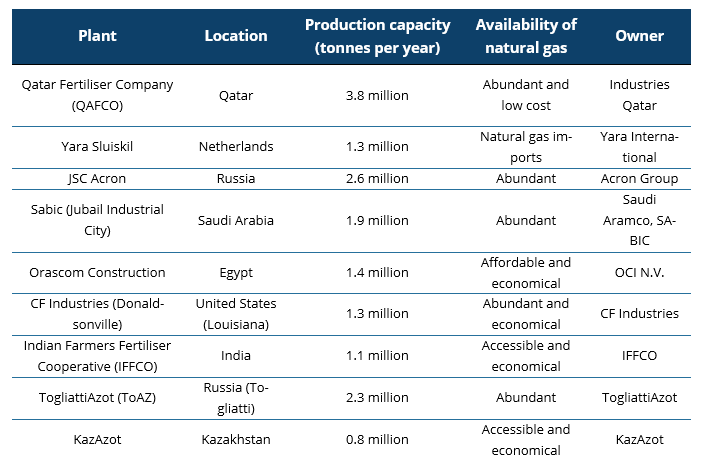
Source: own elaboration based on data from IEA (2023), IRENA (2022), Fertilizer Europe, Oil & Gas Journal and corporate websites of QAFCO, Yara, Acron, SABIC, OCI, CF Industries, IFFCO, TogliattiAzot and KazAzot
Grey ammonia is not a suitable option for a renewable and decarbonized future, as its production relies on fossil fuels, resulting in higher CO₂ emissions than those associated with the direct use of other fossil alternatives. However, when produced using alternative pathways — such as green hydrogen and renewable electricity — it becomes a fully renewable substance with no associated CO₂ emissions, commonly referred to asgreen ammonia. Producing this ammonia at low cost requires access to large volumes of low-costrenewable electricity and water.
As the use of seawater does not entail significant additional desalination costs when production facilities are located along the coast, the key limiting factor will be the availability of renewable electricity. Regions with high renewable potential do not necessarily coincide with fossil fuel–rich areas, which will open up new opportunities for ports located in these regions.
A clear example is Chile, which, despite producing limited amounts of fossil fuels and lacking large-scale ammonia production plants , has substantial renewable energy potential. Major projects such as the HyEx Project in the Mejillones area or the Magallanes Project in southern Chile (Illustration 1) are creating new opportunities for ports such as Mejillones or Punta Arenas.
Illustration 1. Chile’s potential for renewable energy generation
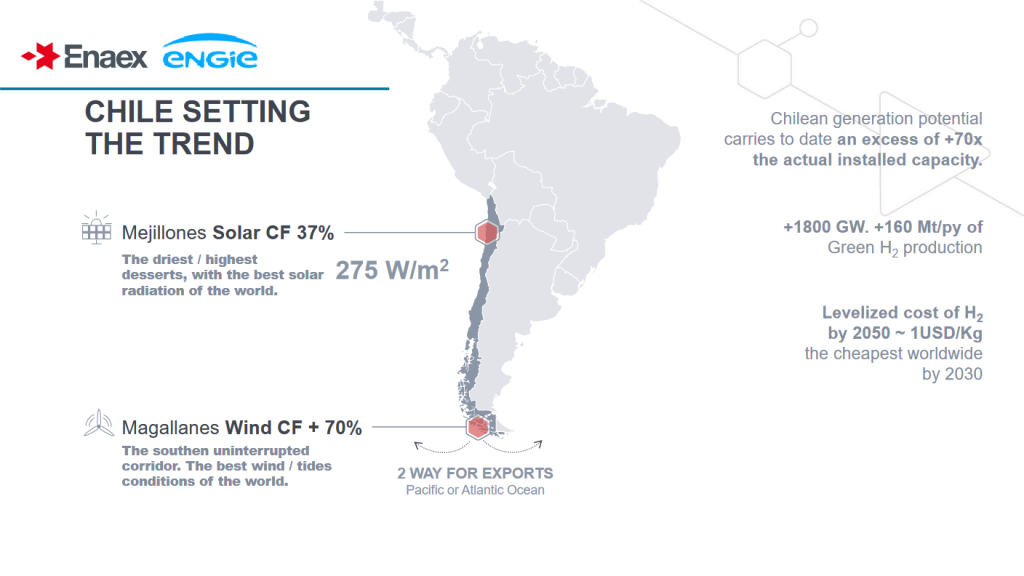
Source: Borràs, A. y Wallach, P. (2023). HyEx: Green Ammonia. “Chile’s huge potential for renewable energy generation”.
In addition to ammonia, many other renewable fuels, energy carriers and compounds will generate opportunities for ports, such as biofuels from waste raw materials, renewable methanol, solid biomass, hydrogen carriers and captured CO₂. To implement this new energy model, the deployment of green corridors will play a key role by facilitating the construction of production and supply infrastructure in the ports that form part of them.
In this regard, ports, which have historically been strategic hubs for the distribution of fossil fuels, must be transformed into essential logistics centres within these corridors. By integrating infrastructure adapted for the handling and distribution of clean fuels—such as green methanol, renewable ammonia, or biofuels—ports can play a crucial role in reducing emissions in maritime and land transport.
Furthermore, the electrification of port operations and the integration of renewable energies in these enclaves reinforce their role as active hubs in the energy transition, reducing the carbon footprint of the logistics chain itself and ensuring that green corridors not only transport clean energy, but also operate in accordance with sustainability criteria. Illustration 2 summarises the green maritime corridors active at the end of 2024 (62 in total), showing their geographical distribution and the incipient nature of a global network aimed at the decarbonization of maritime transport.
Illustration 2. Active green corridors by the end of 2024

Source: Getting to Zero Coalition – Global Maritime Forum (2024, p.10)
The ports that form part of these corridors will thus have opportunities for development as energy hubs, driving innovation in infrastructure, the use of sustainable fuels and attracting investment in clean technologies.
A key element in this transformation is port infrastructure specifically designed for recharging and supplying clean energy-powered ships. In this regard, some ports are already working on the future supply of renewable fuels, such as the initiatives led by the Port of Singapore. This port has been a pioneer in the development of infrastructure for recharging ships with LNG and is exploring solutions based on green hydrogen and renewable ammonia as part of its strategy to reduce emissions from the maritime sector.
In addition, the digitalization and automation of logistics processes along these corridors will optimise transport efficiency and minimise the environmental impacts associated with port operations. International partnerships between ports, shipping companies and governments will be key to standardising practices and developing regulatory frameworks that promote the growth of these green corridors, facilitating global trade in renewable energy and ensuring a coordinated and effective energy transition.
Beyond the opportunities associated with the development of corridors and/or alternative fuel production and distribution chains, other opportunities for ports will emerge in the coming years as a result of the massive deployment of renewable energy. The evolution of these renewable energy sources will generate new logistics opportunities, both in terms of supply chains for materials and in the installation, operation, maintenance and recycling of the associated systems.
In the context of photovoltaic energy, for example, the expansion of solar installations is driving the creation of specialised logistics infrastructures for the handling, transport and installation of solar panels. The demand for materials such as silicon, glass and rare metals requires efficient logistics management, not only to ensure a continuous supply, but also to reduce the costs associated with the global distribution of these components.
Similarly, the transport of solar panels, which must be handled with care due to their fragility and size, presents additional logistical challenges. The installation of photovoltaic systems, both on large solar farms and in smaller areas, requires a logistical approach that optimises the time and resources involved, ensuring efficiency in the construction of solar parks.
In this regard, the solar energy market is expected to reach 1,840 gigawatts (GW) in 2024 and grow at a compound annual rate of 28.82% to reach 5,080 GW in 2029 (Mordor Intelligence 2024). In addition, the global solar panel recycling market is projected to be worth $274.21 million in 2024 and reach $2,489.52 million in 2032, exhibiting a compound annual growth rate of 31.75% during the forecast period (Fortune Business Insights 2024). These figures reflect significant growth in both the adoption of photovoltaic solar energy and the growing importance of solar panel recycling, aspects that have direct implications for the logistics associated with the handling, transport, installation and recycling of these components.
On the other hand, wind energy, both onshore and offshore, also faces similar logistical challenges. The installation of onshore wind turbines requires the transport of large components such as towers, blades and generators. Due to their size and weight, these elements require specialised transport, using optimised logistics routes and heavy machinery. Installations in remote or difficult-to-access areas require the construction of additional infrastructure, such as temporary roads, to allow access for transport equipment and cranes.
Offshore wind energy, although it presents greater logistical challenges due to the conditions of the marine environment, is undergoing considerable expansion. The installation of wind turbines at sea requires specialised vessels to transport the components to offshore locations, as well as floating platforms and large-capacity crane equipment for assembly. In addition, the operation and maintenance of offshore wind farms involves complex logistics, including the use of vessels and helicopters to ensure rapid access, especially when repairs or component replacements are necessary.
According to Global Market Insights (2024), the onshore wind energy market was valued at $77.9 billion in 2023 and is expected to grow at a compound annual rate of 11.3% between 2024 and 2032. For its part, the global offshore wind energy market was valued at $32.414 billion in 2024 and is expected to reach $38.151 billion in 2025, with an annual growth rate of 17.7% until 2033.
Finally, the management of waste generated by the decommissioning of offshore wind turbines also requires detailed logistical planning. This waste must be transported to ports for recycling or proper disposal. The logistics of this process, which involves specialised equipment and large cranes, must be efficient in order to minimise environmental impacts and reduce operating costs.
In this context, ports play a key role in the energy transition, with the potential to establish themselves as strategic hubs for the distribution of renewable fuels and the logistics of new energy sources. In this framework, green corridors are a fundamental level for this transformation, as they facilitate the infrastructure necessary for the supply of these fuels. However, renewable fuel logistics is not the only opportunity opening up for ports.
The growth of the renewable energy sector is generating new demands, such as the expansion of solar and wind energy, which requires efficient logistics chains for the installation, maintenance and recycling of equipment. All of this points to an increase in activity in those ports that are able to position themselves and prepare adequately for a future without fossil fuels, consolidating their role not only as logistics hubs, but also as key players in the energy transition and the resilience of global supply chains.
References
- BORRÀS, Asunción; WALLACH, Pablo. 2023. HyEx: Green Ammonia.
- FORTUNE BUSINESS INSIGHTS. 2024. Solar panel recycling market size, share & trends. Pune: Fortune Business Insights. Available at: https://www.fortunebusinessinsights.com [Accessed: 19/01/2026].
- GETTING TO ZERO COALITION – GLOBAL MARITIME FORUM. 2024. Green corridors map 2024. Copenhagen: Global Maritime Forum. Available at: https://www.globalmaritimeforum.org [Accessed: 19/01/2026].
- GLOBAL MARKET INSIGHTS. 2024. Wind energy market size report. Selbyville: Global Market Insights. Available at: https://www.gminsights.com [Accessed: 17/01/2026].
- INTERNATIONAL ENERGY AGENCY. 2023. Renewables 2023: Analysis and forecast to 2028. Paris: IEA. Available at: https://www.iea.org/reports/renewables-2023 [Accessed: 19/01/2026].
- *See the downloadable document for the complete list of bibliographical references
*Disclaimer: This English version has been generated with the support of AI-based translation tools. In case of discrepancies, the Spanish original prevails.