
Megawatt-scale battery charging (MCS) arrives in the maritime sector
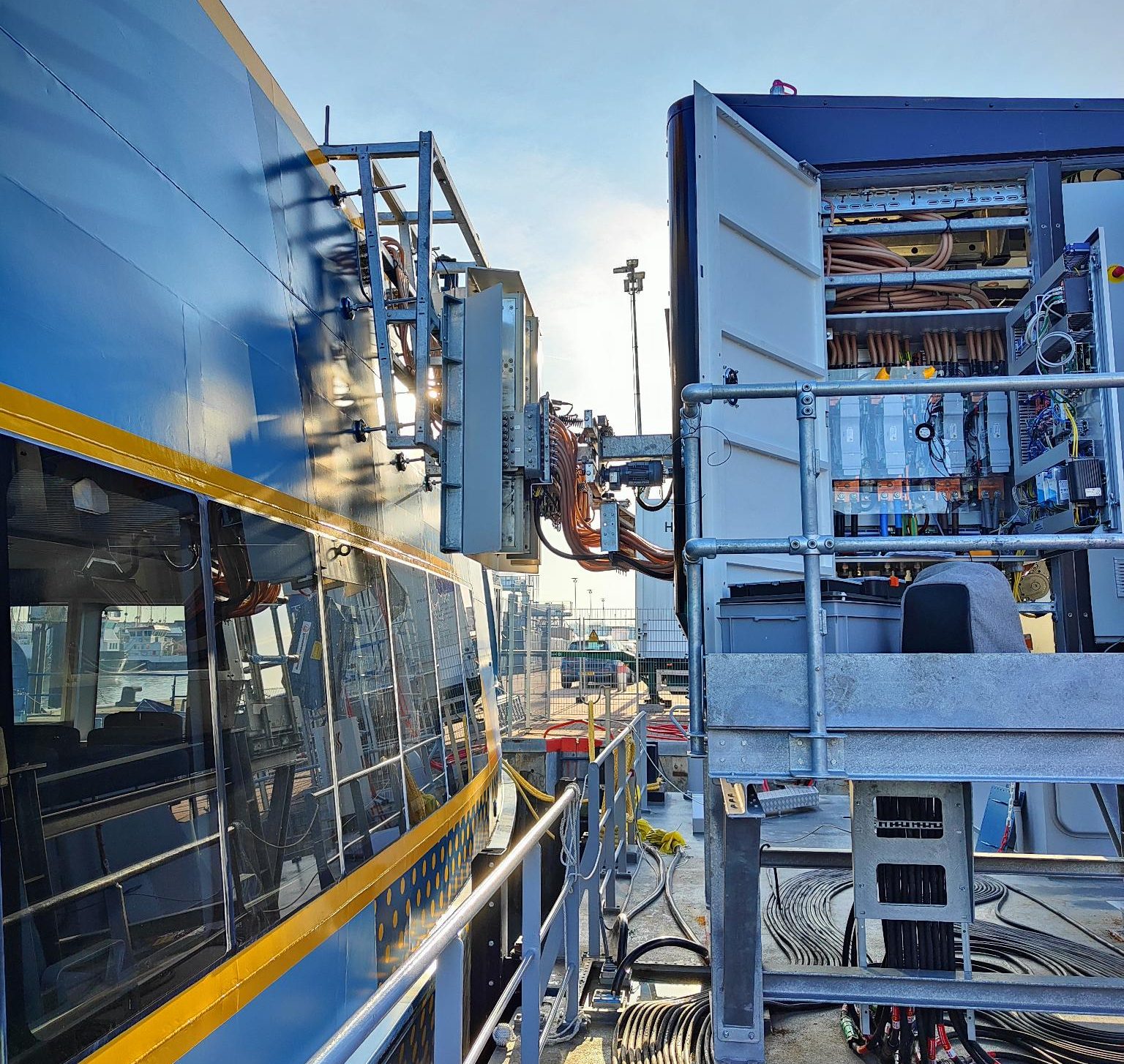
Maritime electrification requires systems capable of transferring several megawatts during short port calls while maintaining safety and port operations. The Whitepaper “Maritime Automated Charging System”, developed within the HYPOBATT project, presents the M-MCS concept, which adapts the MCS standard to the maritime environment through modular architectures. The tests carried out in Frisia confirm its technical feasibility and reinforce the need to move towards interoperable, scalable and standardised solutions.
The electrification of ships poses a different challenge from other modes of transport: transferring large amounts of energy during port calls. A vessel stays in port for relatively short periods, often just a few hours. This time constraint calls for systems capable of transferring a great deal without compromising operating times. Otherwise, port calls would have to be extended or alternative solutions, such as battery swapping, would be needed.
In this context, the HYPOBATT project has worked on developing and validating high-power maritime charging solutions based on the Megawatt Charging System (MCS). Its main technical conclusions and lessons learned have been gathered in the Whitepaper Maritime Automated Charging System, drafted as a reference document for industry, ports and standardisation bodies. The resulting concept, called the Marine Megawatt Charging System (M-MCS), adapts the principles of MCS to the maritime environment, incorporating the specific requirements arising from vessel motion, environmental conditions and connection safety.
The idea is not to create an entirely new charging system, but to build on the principles already established for MCS (power transfer, communications and safety) and add only those functions needed to operate safely between a vessel and a quay. Compared with an onshore installation, the differences are significant. A ship does not remain completely still while charging: waves, wind, tides or changes in load can cause it to move relative to the quay. Added to this are greater distances between the electrical equipment and the connection point, space constraints at the berth, and a particularly harsh environment due to salinity, humidity, rain and sun exposure.
From an electrical standpoint, M-MCS is designed to integrate with ports’ medium-voltage grids. Possible power sources include OPS configurations of 6.6/11 kV AC and 50/60 Hz. The power is then converted to direct current, operating in a range of approximately 500 to 1,500 V DC. The system can be built modularly, with several conversion units in parallel, to adapt the power to each vessel’s needs and reach several megawatts.
This modularity is especially relevant for fully electric vessels, which may have two independent Battery Energy Storage Systems (BESS) to maintain the redundancy of their energy systems. The M-MCS architecture can replicate this separation through two independent charging circuits, so that both BESS can be charged without losing their electrical isolation. As a reference architecture, connections of up to 3 MW per circuit are envisaged, allowing up to 6 MW through 2 × 3 MW.
When handling such power levels, safety is part of the charging sequence itself. Energy transfer can only begin after communication between the vessel and the infrastructure has been verified, along with the correct connection and the various safety interlocks. During charging, parameters such as electrical insulation, temperature, contact quality and communications are monitored.
Vessel movement must also be monitored. If the ship begins to drift away from the quay unexpectedly, power transfer must stop before the contacts physically separate. This prevents electric arcs, cable breakage and damage to equipment.
The connection can be made in two ways. The first is manual, using MCS cables and connectors adapted to the maritime environment. However, as power and distance increase, so do the weight, stiffness and cooling requirements of the cables. For this reason, support systems may be needed to make them easier to handle and reduce the strain on the operator. Furthermore, for connections at MCS Level 3, between 1.5 and 3 kA, the manual solution requires active liquid cooling.
The second option is to automate the connection using an Automated Connection Device (ACD). In this case, the shore-side system locates the vessel’s position, aligns with it, establishes the connection and compensates for its movements during charging. When the operation is complete, disconnection can also be carried out automatically.
This automation reduces connection times, makes it possible to handle heavier cables and higher currents, and avoids some of the limitations of manual handling. However, it does not mean that every port must use exactly the same mechanical design. What matters is standardising the interfaces, communications, connection sequences and safety requirements.
This technology has already been tested under real maritime conditions in Frisia, a port in northern Germany, using a fully electric ferry. Both manual MCS connections and an automated solution were tested on the same vessel. The installation made it possible to charge the ferry’s two battery systems independently, keeping both electrical circuits separate. The demonstration used two independent systems at 995 V and 875 A each, with MCS and T1S-SPE communications active. The experience shows that different physical connection solutions can work on a common electrical and communications architecture.
For ports, however, deploying these systems involves much more than installing a charger next to the quay. It is necessary to plan grid capacity, equipment location, power availability and the joint management of the different loads. Energy Management Systems (EMS) can coordinate vessel charging with other electricity users in the port and limit the simultaneous occurrence of large power peaks.
In addition, the infrastructure can be complemented with BESS and renewable generation, and can even share part of its electrical equipment with trucks, terminal tractors or other high-power vehicles. Increasing the utilisation of these assets may also be decisive in improving their economic viability.
The next step will be to ensure interoperability. One of the Whitepaper’s main conclusions is that M-MCS should be developed as a maritime application of MCS itself, taking IEC/IEEE 80005-4 as the reference for DC connections in port and relying on standards such as IEC 61851 and ISO 15118. The ultimate goal is simple but essential: that a vessel can connect safely to infrastructure in different ports and from different manufacturers. This interoperability will be the foundation for megawatt-scale maritime charging to become a scalable and replicable port infrastructure.
References
*Disclaimer: This English version has been generated with the support of AI-based translation tools. In case of discrepancies, the Spanish original prevails.