
Electricity on the water: electric barges for ships in port
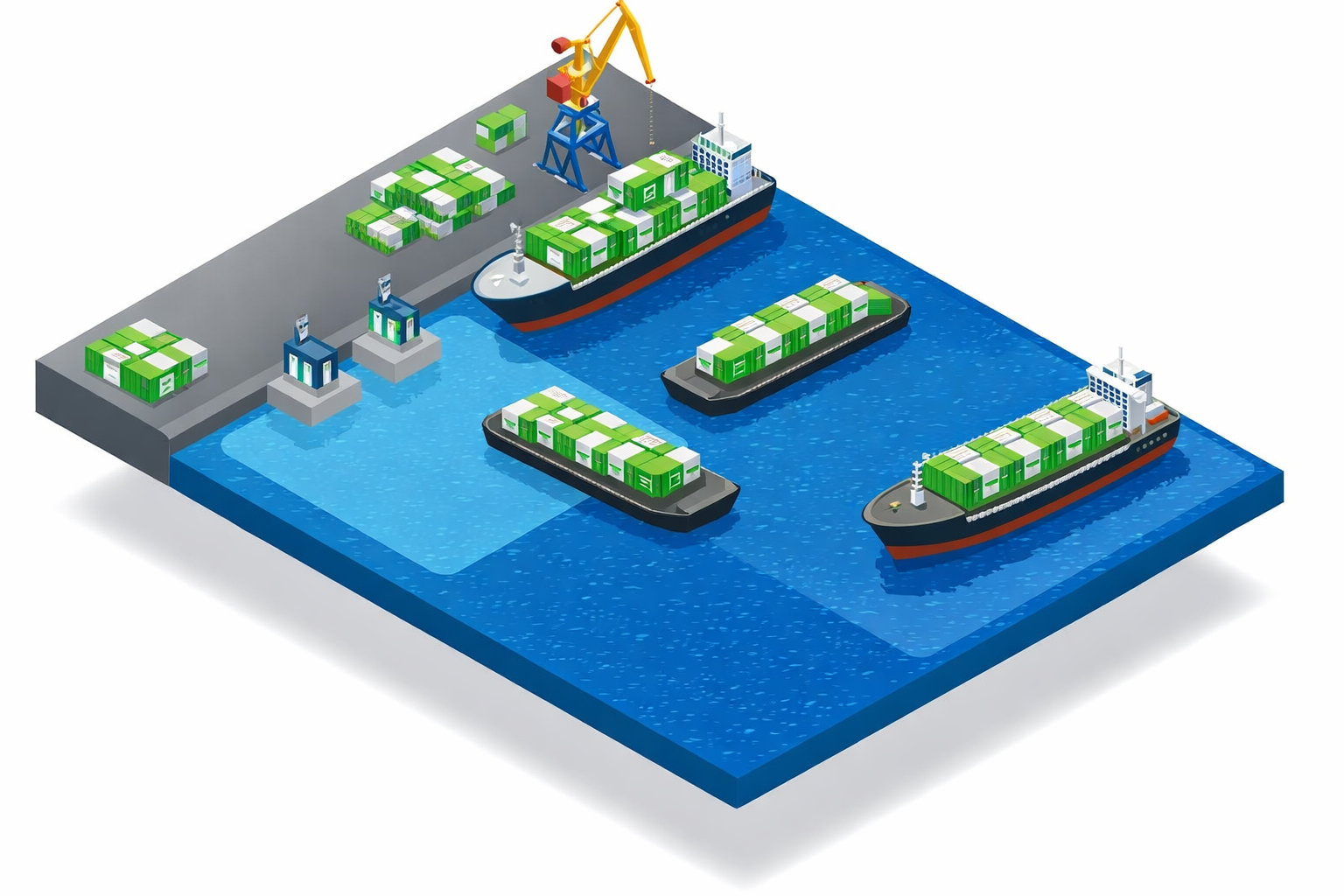
Ports are now at the heart of the energy transition in maritime transport, in a context marked by increasingly ambitious climate targets and growing regulatory pressure on ship emissions. The electrification of port operations through shore-side electricity (SSE) is progressing steadily, but there remains a technological gap in the supply of electricity to ships at anchor or berthed at quays without access to the electricity grid. In this scenario, the article ‘Tools to assess from different perspectives the feasibility of power barge solutions to supply electricity to vessels’ addresses this challenge by proposing a methodological framework to assess the feasibility of power barge solutions as a flexible alternative for reducing emissions in port and offshore environments.
International shipping activities consume about 300 million tonnes of fuel annually, relying on fossil fuels, representing approximately 1,076 million tons of CO2. The world fleet is powered mainly by marine diesel engines for both propulsion and auxiliary loads, fuelled by marine fuels. Heavy fuel oil (HFO) is the dominant fuel in international shipping, powering main ship engines.
However, in recent years, policies, and legislation, mainly focusing on environmental sustainability, have pushed international shipping toward the process of its decarbonization. Regulatory bodies are pressing on the maritime world by adopting ambitious targets and by introducing initiatives that will facilitate the transition to a sustainable future.
One important aspect in the decarbonization efforts of the shipping industry is the provision of electric energy to vessels at port, which is already a mature technology. Shore Side Electricity infrastructures are not only continuously multiplying, covering more and more port facilities, but also tend to become mandatory for certain ship types.
For instance, FuelEU states that the container ships and passenger ships will be required to use cold ironing (on-shore power supply or equivalent zero-emission technology) with the requirement from 2035 and onwards that vessels generally are no longer allowed to pollute when berthed at ports.
In ports, ship emissions are of increased concern, especially for SOX, NOX, and PM for the local population, as well as CO2 at a local level. The term “Cold Ironing”, or Shore-Side Electricity (SSE), or Onshore Power Supply (OPS), refers to an electrical power supply system that replaces onboard generated power while a ship remains docked at the port. Thus, the vessel’s hotel-related emissions are eliminated locally and reduced globally, depending on the energy mix of the shore supply, while also addressing noise and vibrations produced by auxiliary engines when vessels are docked.
While SSE is gradually adopted in many ports, the provision of electric energy to anchored vessels has not been investigated, mainly due to the unavailability of technological solutions and the lack of financial incentives. However, the necessity of limiting emissions at anchorage exists.
On average and depending on the ship size, ships spend between 4 to 6% of their operational time, around 15-22 days per year, waiting at anchor outside ports before being given a berth, producing gaseous emissions such as CO2, SOx or NOx while running auxiliary engines and boilers, which consumes up to 10-15% of marine fuel.
As an example of innovative solutions to provide electricity to ships at anchorage area, or moored at quays where there isn’t access to the port’s power grid, the innovation project BlueBARGE addresses the design, development, and demonstration of an optimum power-barge solution to support offshore power supply to moored and anchored vessels, limiting local polluting emissions and global GHG footprint, following a modular, scalable, adaptable, and flexible design approach.
BlueBARGE introduces a novel hybrid concept that combines the higher energy density of lithium (Li-ion) batteries with the innovative Vanadium Redox Flow Battery (VRFB) solution, which introduces increased safety and lifespan.
Inverters, power distribution units and interfacing systems will be crucial for the power-barge alternative design and promoted solution, covering approximately the 20% of the available barge space considering only a single level of containers, along with other barge utilities, such as additional mooring and berthing equipment. The remaining 80% (approximately) will be covered by power supply modules, as containerised units. The design follows a modular and scalable approach to support different use cases, ship types and power requirements.
The different alternative designs are assessed in a framework as a two-step loop. First, the ranking and assessment of alternative designs is conducted against predefined Key Performance Indicators, and then an optimization toolkit refines the evaluation of the designs by providing optimal sizing options from the point of view of the service and operation. Finally, the promoted selection is studied following a detailed cost-benefit analysis. The following paper presents this assessment framework in detail and its possibilities to be used in assessing similar solutions or products designed to provide electricity to vessels offshore as their main use case.
References
- Benítez, I., Lara, J., Tzanos, P., Annetis, M., Koimtzoglou, M., Oikonomou, F., Bintevinou, E., Kaklis, D., Gao, F. & Zadeh, M. Tools to assess from different perspectives the feasibility of power barge solutions to supply electricity to vessels – The BlueBARGE Project concept. Zenodo (2024). Available at: Tools to assess from different perspectives the feasibility of power barge solutions to supply electricity to vessels | Zenodo
*Disclaimer: This English version has been generated with the support of AI-based translation tools. In case of discrepancies, the Spanish original prevails.