
Spain as a global maritime super hub in a shrinking system

In the 2006 picture of the global liner shipping network, Spain already clearly stood out as one of the most connected countries on the planet. With 102 direct partners offering liner services, the country was well above the global average at that time, which was barely 28. On average, almost twelve shipping companies participated in each connection between Spain and another country, almost double the global average. These figures already made Spain an essential hub in the global maritime system, ranking fourth in the world in terms of direct connectivity and among the countries with the highest density of services.
Illustration 1. Comparison of the global liner shipping network in 2006 and 2026
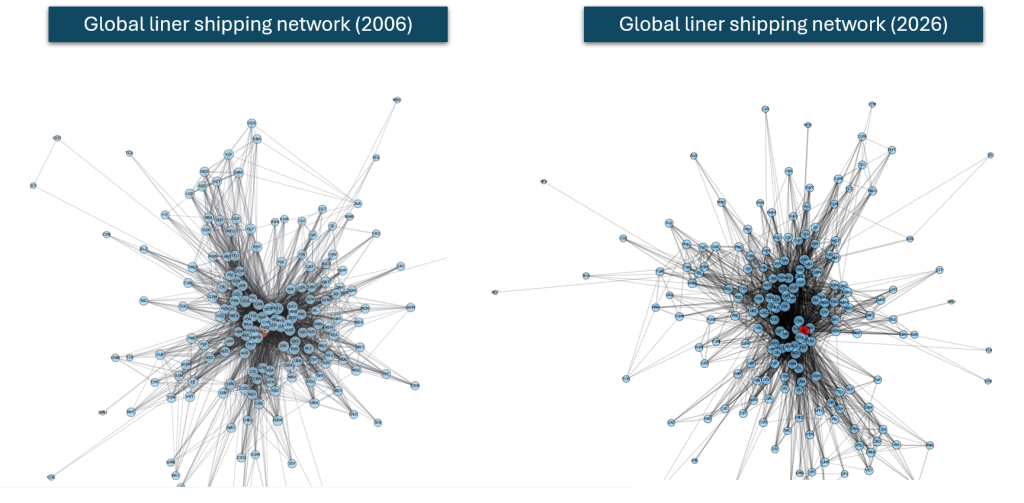
Twenty years later, the picture of 2026 shows a very different global landscape, but confirms one key conclusion: Spain’s relative importance not only remains unchanged, but is reinforced. In absolute terms, the country experiences a slight decline. The number of direct partners falls from 102 to 97. Between 2006 and 2026, the global maritime network enters a phase of structural contraction: the average number of partners per country falls from 28 to 25 and the median falls from 22 to 17. Routes are refined and most countries lose connections, operators, or both.
In 2026, Spain ranks first in the world in direct connectivity, with no other country having more direct connections. Even with a reduction in the indicator of shipping companies per link (from 11.9 to 9.8), Spain remains well above the global average, remaining one of the most intensively served hubs on the planet.
Seen in perspective, the history of Spain between 2006 and 2026 is that of a persistent super hub in a shrinking system. While the global network is becoming thinner and less dense, Spain’s structural footprint remains almost intact. Where most countries are losing links, Spain is maintaining most of its own; where others are drastically reducing the presence of shipping companies, Spain continues to concentrate international connections. This structural resilience explains why, despite small absolute losses, Spain emerges in 2026 as the most connected country in the world in terms of direct links.
Network maps visually reinforce this narrative. In 2006, Spain already appears as a large red node, intensely connected, located at the heart of a dense global mesh. In 2026, although large areas of the global network are refined and lose links, Spain remains a clearly recognizable center of gravity. Its mass of connections appears almost unchanged in the face of a reduced environment, underscoring how internal numerical declines are largely offset by much larger declines in other countries.
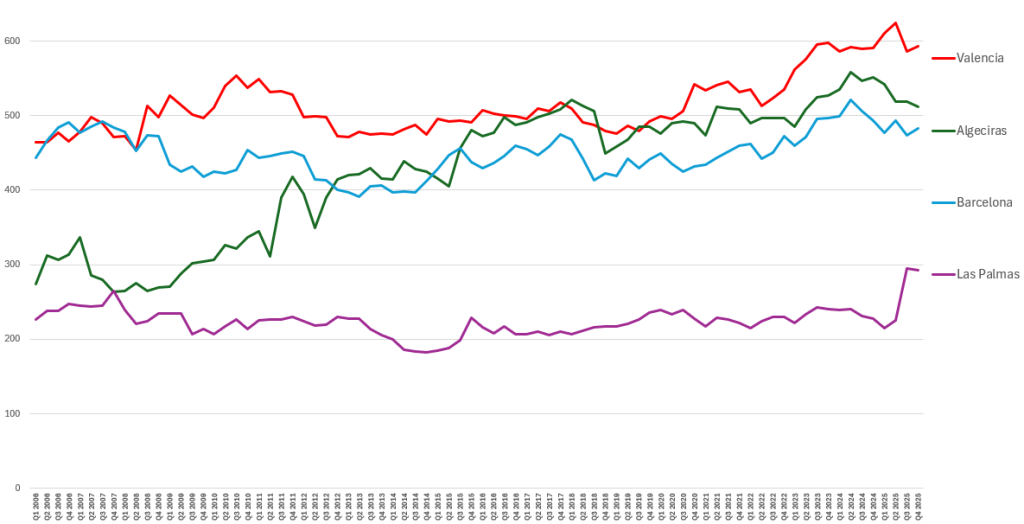
This strength is the result of improved connectivity at Spanish ports. The four main Spanish ports have strengthened their position in the global network over the last two decades, as reflected in the evolution of UNCTAD MDST’s Liner Shipping Connectivity Index (LSCI).
Valencia has consolidated its leadership as the main hub port in the Spanish system. Algeciras shows the strongest long-term growth, reinforcing its role as a transshipment center. Las Palmas stands out for its recent upturn, confirming its growing importance in Atlantic and transshipment routes. The LSCI trend graph, accompanied by images of these four ports, illustrates how Spain’s strength is based on multiple high-performance port nodes, rather than a single dominant point.
Illustration 2. Container Shipping Connectivity Index: main Spanish ports (Q1 2006 to Q4 2025)
In narrative terms, Spain’s evolution can be described as the persistence of a super hub in a more austere maritime world. Although its routes are becoming slightly less dense, the level of service remains exceptional. These dynamics explain why, in 2026, Spain reaches the top of the ranking in terms of the number of direct connections and remains among the leaders in all key structural indicators of liner shipping. In a shrinking global system, Spain is not only holding its own: it is gaining centrality.
*Disclaimer: This English version has been generated with the support of AI-based translation tools. In case of discrepancies, the Spanish original prevails.