
Is ammonia a real opportunity to decarbonise maritime transport?
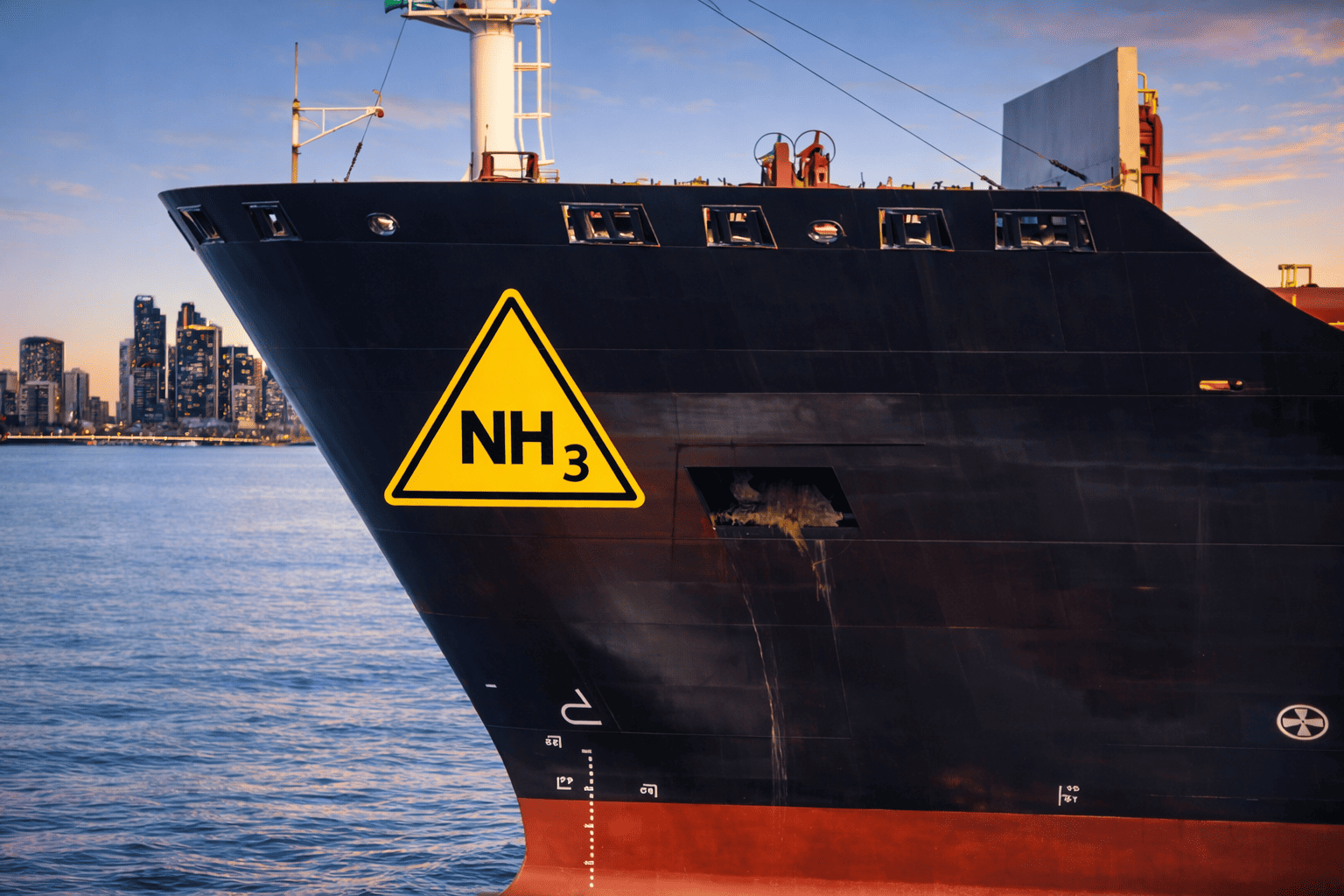
The decarbonization of maritime transport has become one of the major challenges facing the sector on a global scale. Regulatory requirements, driven by the International Maritime Organisation (IMO) and reinforced at European level, are accelerating the search for alternative fuels capable of significantly reducing greenhouse gas emissions. In this context, ammonia is emerging as one of the options with the greatest potential, although its adoption raises key questions from a technical and operational point of view.
From an environmental perspective, the main appeal of ammonia is clear: when produced from renewable sources—known as green ammonia—its combustion does not generate direct CO₂ emissions. Furthermore, unlike other alternative fuels, ammonia has an existing global supply chain, with decades of experience in its production, storage and transport in the chemical sector. This logistical maturity positions it as a relevant alternative in the debate on the energy future of maritime transport.
However, the leap from industrial use to marine fuel application is not without challenges. Its high toxicity requires particularly strict safety standards, both on board ships and in port operations. Tank design, ventilation systems, leak detection and emergency plans will need to be adapted to the specific characteristics of this fuel.
Likewise, the development of engines capable of using ammonia safely and efficiently is still evolving, with particular attention being paid to mitigating emissions such as unburned ammonia and nitrous oxide, the latter being a gas with a high global warming potential that can significantly neutralise its decarbonization potential.
From an operational point of view, the introduction of ammonia involves profound changes in the way ships operate. Crews will need to receive specific training, maintenance procedures will become more demanding, and bunkering operations will require dedicated infrastructure and clearly defined protocols. In the port environment, where multiple activities and actors coexist, coordination between shipowners, terminals, port authorities and regulatory bodies will be a determining factor in ensuring the safety and viability of these operations.
Recent studies conducted at European level show that ammonia should not be seen as an immediate or universal solution, but rather as an alternative with medium- and long-term potential, especially for certain types of ships and routes.
As is the case with passenger ships, where the challenges take on an additional dimension: the high toxicity of ammonia and its pungent odour, perceptible even at low concentrations, can cause alarm. For this reason, its implementation will depend both on technological developments and on the sector’s ability to integrate this fuel into daily operations.
In conclusion, ammonia represents a real opportunity to contribute to the decarbonization of maritime transport. However, its implementation will not depend solely on new technological developments, but also on the sector’s ability to integrate regulatory, operational and safety aspects, especially in the most sensitive contexts such as passenger ships and terminals located in urban environments, where the high toxicity of the fuel and the potential scope of dispersion scenarios in the event of a leak require reinforced preventive planning, the definition of safety zones and coordination with local authorities.
In this scenario, ports and maritime operations are at the heart of the energy transition, as key points for ensuring that decarbonization progresses in a safe and socially responsible manner.
References
- SAFETY OF AMMONIA FOR USE IN SHIPS. 2025. Available at: https://emsa.europa.eu/publications/reports/item/5264-study-investigating-the-safety-of-ammonia-as-fuel-on-ships.html. [Accessed 26-02-2026].
- GREEN AMMONIA: THE SUSTAINABLE REVOLUTION IN THE CHEMICAL INDUSTRY. Avaliable at: https://www.iberdrola.com/conocenos/nuestra-actividad/hidrogeno-verde/amoniaco-verde. [Accessed 26-02-2026].
- AMMONIA BUNKERING AND SIMULATION RELEASE SCENARIOS. 2021. Available at: https://www.maritimeinstitute.sg/wp-content/uploads/2023/06/1600-Dr-Liu-Ming.pdf. [Accessed 26-02-2026].
*Disclaimer: This English version has been generated with the support of AI-based translation tools. In case of discrepancies, the Spanish original prevails.