
The use of biofuels for the rapid decarbonisation of the maritime sector
The maritime sector has been undergoing a process of profound transformation as a result of both the decarbonisation strategy and current and future environmental restrictions. A highly significant initiative that set important developments in motion within the sector and paved the way for new legislative measures was the introduction of more stringent sulphur limits, an initiative known as the Sulphur Cap. In that instance, shipping companies largely opted for technologies that represented a continuation of existing practices.
Compliance with more restrictive sulphur limits is achieved in most cases either by using low-sulphur fuels or by installing scrubbers, and neither option involves radical changes to the ships’ power plants. In some cases, the decision was made to use Liquefied Natural Gas (LNG), a less conventional option with greater future potential; however, this necessarily required significant efforts, not only on the part of shipping companies to adapt their vessels, but also from all elements of the fuel supply chain to adapt to a new fuel with characteristics very different from conventional ones.
The Sulphur Cap marked a significant step up in the requirements placed on the sector, which have become increasingly restrictive over the years, as exemplified by the designation of the Mediterranean as an ECA (Emission Control Area) in 2025. If we compare this with road transport, the current limits in the maritime sector are of the same order of magnitude as those for road diesel 30 years ago (0.2% in 1994), which were progressively reduced to limits 200 times stricter (10 ppm) in just 15 years.
As for other emissions, from the Euro 0 standard in force from 1989 to the present day, limits have been reduced by a factor of 40 in the case of nitrogen oxides (NOx), and restrictions have been introduced on the quantity of particulate matter emitted, not only in terms of total mass but also in terms of particle count. Although a direct comparison cannot be made, as the timelines in both sectors differ, this does suggest that environmental legislation in the maritime sector will continue to tighten significantly in the coming years.
However, the most important factors for the sector are likely to be decarbonisation strategies, both at European level through the Green Deal and ‘Fit for 55‘ and via the International Maritime Organisation’s (IMO) roadmap with the Net Zero Framework. Both share the objective of achieving near-carbon neutrality by 2050. This cannot be achieved through energy efficiency measures alone, so zero-emission technologies will be necessary for the maritime sector. Furthermore, these technologies must be introduced soon; given that ships have a lifespan of approximately 30 years, the first significant deployments of zero-emission vessels should begin by 2030 at the latest, which means that mature and cost-effective technologies for the sector must be available in less than five years.
Biofuels
Biofuels can play a significant role in this transition towards a globally zero-emission maritime sector and are attracting considerable interest from some shipping companies. In fact, between 2021 and 2024, the supply of biofuels at the world’s main bunkering hubs (Singapore and Rotterdam) has quadrupled, rising from 0.3 to 1.3 million tonnes of biofuel blends (Sekkesæter and Henriksen 2025).
From a technological perspective, the use of certain biofuels requires only minor changes, both to the vessels themselves and to the fuel supply chain, meaning their use could be rolled out easily. One advantage shared by all biofuels is that they are very low in sulphur, meaning they comply with both current and future regulations. On the other hand, they are not zero-emission fuels; they are more expensive; distribution channels have not yet been established; and there are doubts regarding their availability on a large scale.
The term ‘biofuels’ encompasses a range of fuels derived from plant or animal sources, although this spectrum includes substances with very different characteristics and properties. Strictly speaking, both landfill biogas and synthetic gas—which are produced through the gasification of biomass and are both gaseous fuels—would be classified as biofuels and have properties that are completely different from, for example, any liquid biofuel used as a diesel substitute.
However, it is very common to reserve the term for liquid fuels, and the remainder of this text will focus on this subgroup. Synthetic liquid fuels (produced from renewable hydrogen and, in most cases, carbon dioxide) have not been included either; although they share many similarities in properties with some biofuels, their specific characteristics make it advisable to exclude them from this analysis.
Among liquid fuels, the range of compounds covered by the term ‘biofuels’ is very broad, including substances as diverse and with such different properties as alcohols, esters and paraffins. Illustration 1 summarises the main groups of biofuels and illustrates the possible pathways, taking into account the origin and processing methods of the raw materials, which gives an idea of the wide variety of possibilities.
Illustration 1. Different conversion pathways for raw materials into biofuels, including conventional and advanced biofuels
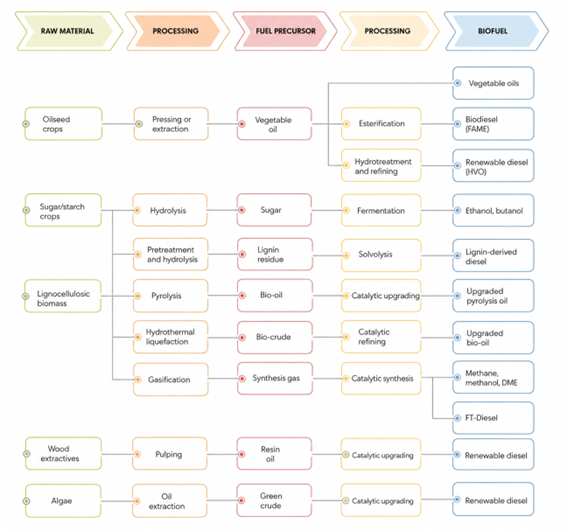
Source: Own elaboration based on the work of (Hsieh and Felby 2017)
Within the range of biofuels, there is a subgroup that can serve as an almost direct substitute for fossil fuels using the current fleet and existing supply chains. These fuels have characteristics similar to those of diesel fuel, which is why they are known as ‘drop-in’ fuels. The most common are those produced from fats and oils, the two main categories being esters (Fatty Acid Methyl Esters or FAMEs) and hydrotreated vegetable oils (HVO). In the case of FAMEs, regulatory limits mean that they are currently most commonly consumed in blends with fossil fuels; however, HVO is virtually indistinguishable from traditional fuels and is regulated under the same regulatory framework.
Generally speaking, and with the exception of sulphur oxides, the other emissions from the use of diesel-type biofuels, measured from the tank (Tank to Wheel in land-based applications or Tank to Wake in maritime applications), are similar to those obtained when using their fossil-based equivalents.
For example, if we compare the performance of the same engine running on a fossil-derived marine distillate or on FAME biodiesel (fatty acid methyl ester), we find only modest variations in emissions of CO2 , particulate matter (PM) and nitrogen oxides (NOx); this is partly due to the properties of the fuel (e.g. FAME is an oxygen-containing compound, which results in lower PM emissions) and partly due to the tuning of the engines, which are optimised for diesel but not for biodiesel. The benefits are greater when compared with residual fuel oils, but these could already be achieved through the use of distillates.
The major advantage in terms of emissions when discussing biofuels becomes apparent when the full picture is considered, that is, when emissions are compared across the entire production and distribution chain – a concept known as ‘well-to-wheel’ (or ‘well-to-wake’) emissions.
In the case of biofuels, it is assumed that the CO₂released during combustion was previously captured during the production of the raw material (e.g. the CO₂is absorbed by a sunflower plant to produce the seeds from which the oil will be extracted), thus resulting in a net zero balance. Consequently, the carbon dioxide emissions from a biofuel depend on how it is produced (the nature of the raw material, how that raw material is produced, and the type of processing used to obtain the fuel) and how it is transported.
Given that, as we have seen above, there is a wide variety of possible combinations, their emission factors will also vary considerably. In the legislation, these CO₂ emission factors are set out in Directive (EU) 2018/2001 (OJEU, 2018) on the promotion of the use of energy from renewable sources for a considerable number of combinations.
Annex V sets out typical greenhouse gas reduction values, as well as default values for 37 types of biofuels currently in production, and estimates for a further 14 possible types that have been tested on a pilot but not on a commercial scale. The data have recently been revised in a study by the Joint Research Centre (Hurtig et al 2026), although they have not yet been incorporated into the regulatory framework. Illustration 2 shows the proposed values for biofuels for which actual values are known, with default reduction values ranging from 19 per cent (FAME produced from palm oil with an open effluent pond) to 98 per cent (pure used cooking oil).
Illustration 2. Greenhouse gas emission reductions for fuels for which commercial production already exists
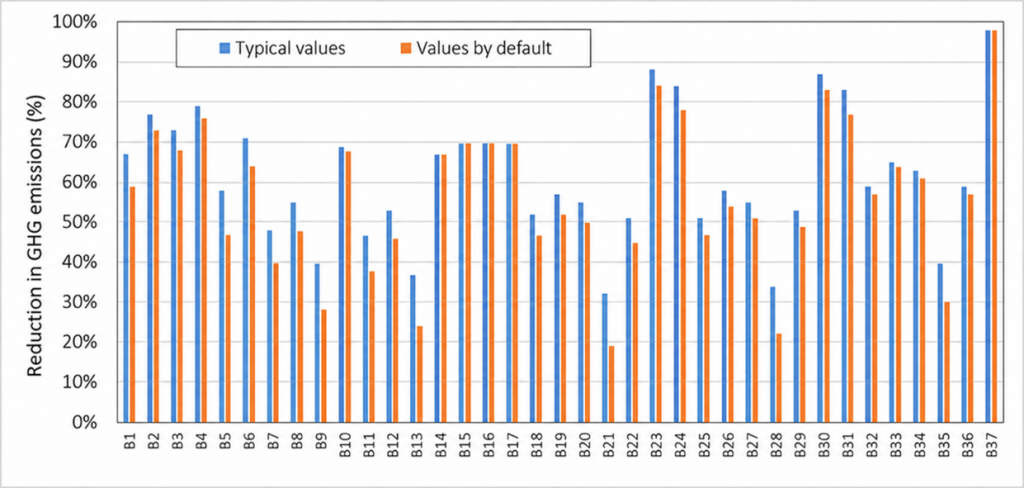
Source: Own elaboration based on data from Directive 2018/2001
The greatest reductions are those corresponding to fuels derived from waste materials (from used oils or rendered animal fats), regardless of their processing method, with the largest reductions achieved when using untreated oil, followed by hydrotreated oils (HVOs) and finally those produced via transesterification processes (FAMEs).
As shown in Figure 2, there are many examples with default values above 62 per cent; therefore, from a technical perspective, it is currently possible to meet the Fuel EU Maritime requirements for 2045 simply by switching fuels. However, from an operational and economic perspective, there are certain considerations that will define the role of biofuels in the sector.
The type of processing not only has a significant impact on their greenhouse gas reduction potential, but also on the quality of the biofuel. Oils and fats used directly as fuel present problems such as lower calorific value, reduced cetane number, excessive viscosity and difficulty in long-term storage. The transesterification process used to produce FAME addresses many of these issues, although the resulting fuels still have a (relatively) low calorific value per unit volume and may present problems in cold conditions.
Furthermore, the characteristics of the product obtained from this treatment depend heavily on the raw material used. The type of treatment will also be a very important factor in the final price of the substance, alongside the cost of the raw material and logistical costs. Some of these costs will vary both locally and over time, making it impossible to gain a comprehensive picture of their potential and necessitating a case-by-case analysis of each business case, taking all factors into account.
In general, biofuel prices are higher than those of traditional fuels, and their economic viability depends primarily on the price of oil and/or the carbon tax. The most notable exception to this general rule is ethanol produced from sugarcane in certain regions of Brazil, which can be competitive without subsidies or a carbon tax; this has driven the widespread adoption of its use in that country for many years.
In all other cases, their viability will depend largely on whether the fuel price includes a levy on carbon emissions, as set out in the regulations of the ‘Fit for 55’ package (Fuel EU Maritime and EU ETS) or the IMO’s Net Zero Framework. The carbon levy is also a way of incorporating the social cost of CO₂into its market price, which is fully in line with the ‘polluter pays’ principle.
Another factor to bear in mind is the future availability of fuel. Although there are combinations that are viable from both a technical and economic point of view, they are only applicable on a small scale, as they are fundamentally limited by the availability of raw materials. Furthermore, it is necessary to take into account the potential conflict that may arise from the raw materials used also being traded in markets entirely separate from the energy sector (such as food or cosmetics), both in terms of their social impact and the effects this may have on their future price.
An example of a particularly interesting use case is the use of waste materials, such as used oil, which makes a great deal of sense for specific local projects, although a scenario in which this type of substitute is considered on a global scale is unrealistic. One potentially interesting application could be found in ports, where there are captive fleets (e.g. terminal machinery or land transport) that facilitate supply logistics, or for the decarbonisation of certain specific routes and services.
A more widespread deployment is limited by the quantity of waste oils generated and which can be collected appropriately. The greatest potential for production lies in advanced biofuels derived from lignocellulosic material, which are estimated to be capable of meeting the entire fuel requirement for maritime and land transport (Table 1). There are several routes for utilising this feedstock, with the production of biomethane and pyrolytic fuels being of particular interest. In the case of the latter, there are mature production technologies for drop-in fuels with competitive production costs; therefore, the key in the short term will be the development of collection and logistics chains for this raw material.
Table 1. Comparison of fuel consumption in the maritime and aviation sectors with current and
potential biofuel production based on existing crops and raw materials from agriculture and forestry
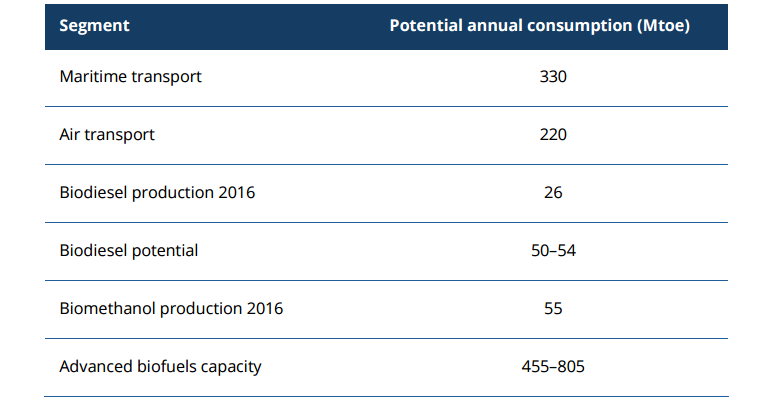
Source: Own elaboration based on the work of Hsieh and Felby, 2017
Conclusions
In the short to medium term, biofuels represent another option for reducing emissions – both greenhouse gases and pollutants – in the transport sector as a whole. To achieve this, it will be necessary to choose between various options, including electric vehicles, bio-LNG, renewable hydrogen and ammonia. The major advantage of biofuels over other low- or zero-emission alternatives lies in their volumetric energy density which, although generally lower than that of fossil fuels, is significantly higher than that of other alternatives such as ammonia or methanol.
This makes them the most attractive alternative for air transport and a promising option in the short term for road and maritime transport, as well as for the logistics sector. The role they will play in each of these sectors is uncertain and, amongst other factors, will depend on developments in the other sectors (e.g. high demand in the aviation sector would drive up their prices, making them unviable for use in the maritime sector), although it is not too risky to predict that their presence will continue to grow in the short term.
References
- CC Hsieh and C Felby (2017) Biofuels for the marine shipping sector. IEA Bioenergy report. 2017
- Directive (EU) 2018/2001 of the European Parliament and of the Council of 11 December 2018 on the promotion of the use of energy from renewable sources. Official Journal of the European Union. 2018
- Hurtig, O., Bouter, A., Besseau, R., Buffi, M. and Scarlat, N., Updating GHG emission values of biofuels and biomass fuels in Annexes V & VI of Directive (EU) 2018/2001, Publications Office of the European Union, Luxembourg, 2026
- Øyvind Sekkesæter and Per Einar Henriksen (2025) BIOFUELS IN SHIPPING. Current market and guidance on use and reporting. DNV white paper
*Disclaimer: This English version has been generated with the support of AI-based translation tools. In case of discrepancies, the Spanish original prevails.