
Marine nuclear power: back to the future
Energy needs and the capacity to meet them have shaped the development possibilities of societies, from primitive societies that relied on wood for cooking and heating to today’s societies, which use a variety of energy sources and vectors. Energy is not just another commodity; its availability determines the production and use of all other commodities, hence its importance in the functioning and development possibilities of societies.
A large part of the energy we consume is obtained from combustion processes which, in addition to energy, generate a series of by-products (such as carbon dioxide, nitrogen oxides and particulate matter) that have been proven to be harmful to human health and the environment.
Since humanity became aware of this fact, attention has been focused on the use of energy technologies that make it possible to reduce the associated emissions. Achieving this requires reducing and limiting the hydrocarbon combustion processes that currently account for the majority of propulsion in vehicles, aircraft, and ships. In the decarbonization process, light-mobility applications (automobiles) have begun the transition toward electric-based technologies, which would decarbonize the activity provided that the electricity used is generated from renewable sources. Heavy applications (aircraft and ships) require amounts of energy that are difficult to store in electrical systems (batteries) and therefore call for other types of technological solutions.
Focusing on maritime mobility, the solutions that are currently most developed are synthetic fuels such as hydrogen and its derivatives (methanol and ammonia). However, these fuels have certain limitations compared to conventional fuels that condition their applicability to the sector.
During the early stages of the deployment of nuclear energy, applications of this type were considered, but the practical and immediate advantages of using fossil fuels and a general moratorium on the technology limited these applications to very specific cases such as the propulsion of submarines and military aircraft carriers and a few civilian applications. This article analyses the advantages and limitations of this technological solution.
Maritime decarbonization and the return of a long-delayed debate
In December 1953, the President of the United States delivered a speech to the United Nations General Assembly known as Atoms for Peace, in which he proposed an international framework to promote the civil use of nuclear energy as an instrument of economic progress, international cooperation and peaceful development, as opposed to its exclusive association with military applications.
More than seven decades later, the commercial maritime sector faces a challenge of a different nature but comparable in magnitude: achieving deep decarbonization without compromising the operational efficiency or economic viability of international trade. In this context, nuclear energy reappears in the maritime debate not as a new technological development, but as a historically known option that has remained on the sidelines of civil maritime transport development for primarily regulatory, political and social reasons.
Given that the goal is complete decarbonization of global maritime transport, is it reasonable to exclude in advance a technology that offers zero emissions in operation, an energy density far superior to any chemical fuel and a range compatible with the demands of ocean transport? The question does not imply immediate or widespread adoption, but it does force us to reconsider the current limits of the technological debate.
Nuclear propulsion in the maritime sector has operational experience in specialised naval and civil applications. In addition, the recent development of modular reactors, characterised by intrinsically safe designs and passive protection systems, has rekindled interest in their potential use in commercial applications other than power plants. However, its incorporation into civil maritime transport poses significant challenges in terms of international regulation, civil liability, social acceptance and port management, which to date have not been addressed in a systematic and detailed manner.
The energy challenge of large-scale maritime transport
International maritime transport is one of the fundamental pillars of the global economy, channelling around 80% of world trade in terms of volume. This centrality explains why any transformation of its energy base has systemic implications that transcend the sector itself, affecting supply chains, food security, market stability and industrial competitiveness on a global scale.
From an energy perspective, maritime transport is characterised by a structural dependence on high-energy-density sources capable of sustaining continuous, high-energy-consumption operations over long periods, in isolated environments and with high reliability requirements. Large ocean-going vessels account for a substantial share of the sector’s energy consumption and, correspondingly, its emissions.
This context makes it necessary to recognise that the decarbonization of maritime transport cannot be addressed through a single technological approach. The diversity of ship types, operational profiles and trade routes requires a wide range of solutions, adapted to the specific characteristics of each segment. In this context, the a priori exclusion of certain energy options (for historical or psychological reasons) may unnecessarily limit the sector’s ability to achieve its medium- and long-term climate goals.
The main response to this challenge has been centred on the development and deployment of alternative fuels from renewable sources or low carbon sources, such as methanol, ammonia or hydrogen. While these options represent significant advances over the use of conventional fossil fuels, their widespread application in large-scale maritime transport presents significant physical and operational limitations that cannot be ignored.
Firstly, the volumetric and gravimetric energy density of these fuels is significantly lower than that of traditional marine fuels. This characteristic translates into the need to devote more space on the ship to fuel storage, with a direct impact on the ship’s design, available payload and economic efficiency of operation.
By way of illustration, a 24,000 TEU container ship on a single voyage between Shanghai and Valencia consumes approximately 5,500 tonnes of marine fuel (occupying around 5,600 m3), which is equivalent in energy terms to more than 1,800 tonnes of hydrogen (which in its liquid form occupies about 25,400 m3), about 11,000 tonnes of methanol or ammonia (which occupy about 13,900 m3 and 16,200 m3 respectively). As a reference, an Olympic swimming pool holds about 2,500 m3 of water. The equivalent mass of uranium would be 3 kilograms, which would occupy approximately 0.00014 m3, or less than half a soft drink can.
Secondly, the adoption of new fuels requires the existence of global supply chains that are not yet developed. Large-scale production of renewable synthetic fuels requires significant amounts of clean energy, complex industrial infrastructure and international coordination, which is still in its early stages.
From a port perspective, this implies very significant investments in new storage, handling and security infrastructure, with long payback periods and high levels of economic and regulatory uncertainty. The absence of uranium reloading requirements during the ship’s operational life makes fuel reloading facilities in ports unnecessary. The fuel would be loaded either at the reactor manufacturer’s facilities or at the shipyard where the ship is built. It should be remembered that the fuel elements have low radioactivity prior to use, which allows for a transport and installation process that is not overly complex, applying the appropriate safety standards already in place.
Added to these limitations is the question of the energy efficiency of the system as a whole. In many cases, alternative fuels involve long energy conversion chains — renewable electricity, hydrogen production, fuel synthesis, transport and end use — with significant cumulative losses.
For certain operational profiles, these losses can compromise the economic and environmental viability of the solution when analysed from a full life cycle perspective. Uranium exists in nature and is extracted from it. An enrichment process is necessary to increase the isotopic percentage of the fissile material. This process is the same as that required for conventional nuclear power plants and would therefore be integrated into existing chains.
It is precisely in this space, defined by the physical limitations of alternative fuels in large-scale maritime transport, that nuclear propulsion begins to take on strategic relevance. Its potential does not lie in replacing other technologies across the board, but in offering a specific solution for those cases where energy density, autonomy and operational stability are design requirements.
Nuclear propulsion in the maritime sector: state of the art and recent developments
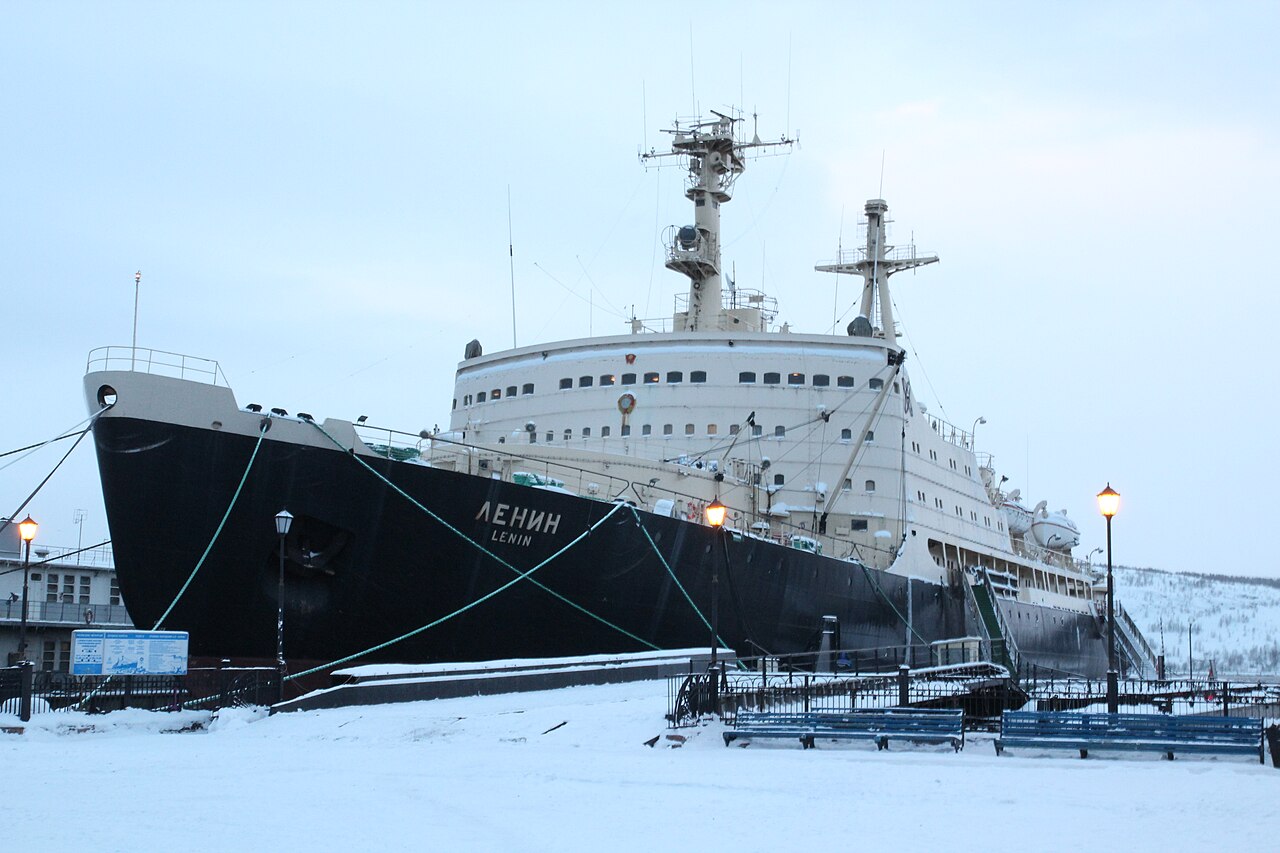
Nuclear propulsion applied to maritime platforms is not an experimental development or an emerging technology in the strict sense. Since the mid-20th century, nuclear reactors have been used continuously in naval applications, especially in submarines and aircraft carriers, as well as in specialised civilian fleets such as icebreakers operating in the Arctic. These applications have demonstrated, over decades of cumulative operation, high levels of reliability, availability and safety, even in demanding and isolated operating environments.
Table 1. Operational experience of civil nuclear-powered ships
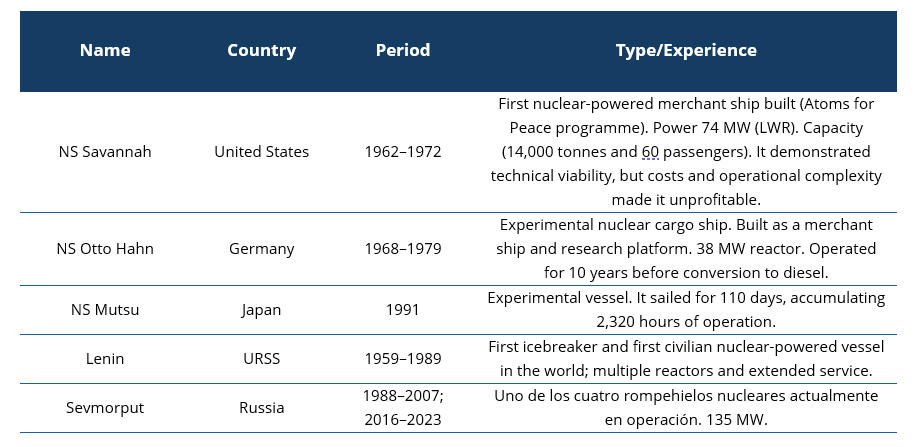
Source: Historic survey on nuclear merchant ships, Nuclear Engineering and Design, 2015 y Rosatom.
However, the direct extrapolation of these experiences to civil commercial maritime transport is not immediate. Traditional naval reactors have been designed according to specific defence criteria, in many cases using highly enriched fuel and operating regimes that would not be acceptable (or necessary) in a civil context.
This difference partly explains why the first attempts at commercial application of nuclear propulsion—such as the NS Savannah in the United States or the NS Otto Hahn in Germany—although successful from a technical point of view, failed to establish themselves as economically competitive solutions in an environment dominated by cheap and abundant fossil fuels.
The current technological context, however, differs substantially from that which existed during those early experiments. Over the last two decades, the nuclear sector has undergone a significant evolution towards the development of small modular reactors (SMRs) and micro reactors, characterised by lower power outputs, standardised designs and a growing emphasis on passive and intrinsic safety. These developments have been driven both by the need to reduce construction costs and timeframes and by the search for more flexible applications, including remote or off-grid environments.
Analyses by the Maritime Nuclear Application Group (Maritime Nuclear Application Group, 2022) identify precisely these advanced reactors as a potential opportunity for the commercial maritime sector, as they allow for configurations that are more compatible with the requirements of civilian ships in terms of size, weight and continuous operation.
From a nuclear safety perspective, advanced reactors incorporate design principles that seek to minimise the probability of radiological releases, even in severe accident scenarios. The elimination of the need for active cooling systems, the existence of intrinsic safety systems and the integration of the reactor into compact and robust containments are recurring elements in the concepts evaluated for maritime applications. These characteristics are particularly relevant in an environment such as the maritime sector, where operational simplicity and resilience to adverse external conditions are very important factors.
The Idaho National Laboratory report (Idaho National Lab, 2025) emphasises that, from a strictly technical perspective, there are no fundamental barriers preventing the use of advanced reactors for the propulsion of large commercial vessels, provided that the intrinsic safety design criteria are adapted to the maritime environment. Nuclear reactors are designed to have a specific probability of core damage, taking into account a range of situations that include site variables. These variables are different from those for land-based sites, and updated safety criteria will be required to be included in the design basis for reactors.
Classification societies have begun to play an important role as a technical interface between the nuclear and maritime sectors. Lloyd’s Register (Lloyd’s Register, 2025), among others, has developed preliminary guidelines for assessing the risks, design requirements and certification processes associated with civil nuclear propulsion, highlighting the need to adapt traditional classification approaches to a technology that introduces new vectors of risk and responsibility.
Despite these advances, the degree of technological maturity should not be confused with immediate readiness for commercial deployment. Marine nuclear propulsion is at a stage where reactor technology is advancing faster than the institutional frameworks necessary for its adoption. The lack of demonstration projects, limited recent commercial operating experience and international regulatory fragmentation remain significant obstacles, reflected in the slow progress of civil nuclear energy in other areas.
Nevertheless, the current state of the art allows us to affirm that nuclear propulsion is not a technological hypothesis but a technically viable option, whose materialisation in the commercial maritime sector will depend less on disruptive scientific advances and more on strategic decisions regarding regulation, governance and social acceptance. This observation reinforces the idea that the debate can no longer be limited to the question of whether the technology works, but rather how it could be responsibly integrated into the global maritime industry.
Strategic advantages of nuclear propulsion for certain segments of commercial shipping
The analysis of nuclear propulsion in commercial maritime transport makes perfect sense when approached as a specific solution. As highlighted above, the diversity of the maritime sector (in terms of ship size, operational profile, routes, required speed and operating regime) makes it advisable to select the best technological solution for each area of use.
In this context, the main contribution of nuclear propulsion lies not in its ability to replace other alternatives across the board, but in offering clear advantages in those segments where energy requirements are most demanding. It should be noted that these advantages do not materialise uniformly across the entire fleet. For small or medium-sized vessels, short routes or flexible operational profiles, solutions based on alternative fuels or partial electrification may be more appropriate from a technical and economic point of view.
However, for segments with higher energy consumption and greater operational complexity, nuclear propulsion has attributes that are difficult to replicate with other technologies, which justifies its consideration as a strategic option among the range of available solutions.
The first of these advantages is the virtually total elimination of greenhouse gas emissions during ship operation. Unlike alternative fuels of chemical origin, whose carbon footprint depends largely on production processes, nuclear energy allows the operation of the ship to be directly decoupled from the emissions associated with energy consumption.
A second strategic advantage is extended energy autonomy, which is a distinguishing feature compared to any chemical fuel. The advanced reactors evaluated for maritime applications allow for operating cycles of several years (even the entire operational life of the ship) without the need for fuel reloading, eliminating dependence on bunkering infrastructure, reducing exposure to supply chain disruptions, and simplifying operational planning on long-haul routes.
From an economic standpoint, nuclear propulsion also offers greater stability in energy costs throughout the ship’s life cycle. While fossil and alternative fuels are subject to high price volatility, influenced by geopolitical, regulatory and resource availability factors, the cost of nuclear fuel represents a relatively small fraction of the total cost of generation. This feature reduces the uncertainty associated with the operation of the ship and facilitates long-term financial planning, which is particularly relevant for assets with useful lives exceeding twenty or thirty years.
The Idaho National Laboratory study shows that, under certain capital and operating cost assumptions, nuclear propulsion can be economically competitive with fossil or synthetic fuel-based alternatives, especially when considering scenarios of progressive increases in carbon prices or the introduction of emissions-related tax mechanisms. As a capital-intensive technology, it benefits from the low interest rate environment that characterises the modern economy.
In addition, the integration of nuclear propulsion opens the door to complementary functionalities that go beyond propulsion itself. These include the possibility of supplying electrical power to auxiliary systems, or even exporting electricity to port during stopovers (reverse OPS), which has been identified as a potential vector for creating additional value for certain ship and port profiles. Although these applications require specific regulatory and technical developments, they illustrate the multifunctional nature of nuclear energy in the maritime environment.
Consequently, the discussion on nuclear propulsion in commercial maritime transport should not be framed in terms of total replacement, but rather technological complementarity. Its value lies in covering those niches where conventional alternatives show structural limitations, thus contributing to a more realistic and robust decarbonization that is aligned with the operational requirements of global maritime trade.
Regulatory, legal and operational barriers to the adoption of commercial nuclear propulsion
Despite the strategic advantages identified, the incorporation of nuclear propulsion into commercial maritime transport faces a set of structural barriers beyond the technological sphere. These barriers are mainly regulatory, legal and operational.
From a regulatory perspective, the existing maritime regulatory framework recognises the possibility of nuclear-powered merchant ships, but does so on the basis of instruments developed in a technological and political context very different from the current one. The main reference is the Code of Safety for Nuclear Merchant Ships, adopted by the International Maritime Organisation (IMO) in 1981 (IMO, 1981).
This code, which is non-binding and was developed in a technological and industrial scenario very different from the current one, was conceived primarily as a guiding framework without constituting a complete regulatory regime, including general principles for the design of floating nuclear facilities. The very approach of the code shows that its application is largely subject to the legislation of the flag state of the ship and to bilateral agreements with the countries where the ports involved are located, which reinforces regulatory fragmentation and highlights the absence of a specific harmonised international framework for the commercial operation of nuclear ships.
This regulatory obsolescence is exacerbated by the fragmentation of responsibilities between different levels of authority. Nuclear regulation is the responsibility of national nuclear authorities, which operate under legal frameworks designed primarily for fixed land-based facilities within a single jurisdiction. The mobility inherent in merchant ships therefore introduces a complexity in terms of licensing, supervision and regulatory compliance that is not addressed by the nuclear regulations in force in most countries with regulatory developments on nuclear energy.
Studies and technical documents by the International Atomic Energy Agency (IAEA) (IAEA, 1968) emphasise that, although there is a consolidated international framework for nuclear safety, radiation protection, safeguards and civil liability, these instruments were designed for land-based nuclear facilities or for nuclear-powered ships of a military nature. In particular, the IAEA itself recognises that the operation of nuclear reactors on board merchant ships introduces unique constraints that are not fully covered by existing international conventions, requiring specific assessments and ad hoc agreements between states to ensure equivalent levels of safety and security.
At the port level, the absence of harmonised procedures for authorising port calls, nuclear inspection by states or coordinated emergency management is one of the main sources of regulatory uncertainty. Added to this situation is the issue of civil liability and insurance, which represents one of the most significant obstacles from a commercial viability perspective. The lack of a clear framework articulating the interaction between the maritime and nuclear spheres makes it difficult to structure viable insurance systems for commercial nuclear ships, as pointed out in analyses by Lloyd’s Register and the Maritime Nuclear Application Group.
From an operational point of view, nuclear propulsion poses specific requirements in terms of crew training, qualifications and organisation. The safe operation of a nuclear reactor requires highly qualified personnel with specific training and certification processes that are not currently integrated into maritime training frameworks.
Ports are emerging as relevant actors in this regulatory scheme. The acceptance of nuclear-powered ships implies the adaptation of emergency plans, safety procedures, communication protocols and incident response capabilities, even though the probability of a radiological event is extremely low. The absence of harmonised criteria at the international level can lead to unilateral decisions to restrict access, complicating the operational framework and reducing predictability for shipowners and operators.
Taken together, these barriers should not be interpreted as definitive arguments against nuclear propulsion, but rather as symptoms of an institutional gap between technological evolution and existing administrative systems. As highlighted in the Idaho National Laboratory report, the main challenge for the commercial adoption of nuclear propulsion is not the lack of technical solutions, but the need to develop consistent regulatory frameworks that are predictable and acceptable from a social and economic point of view.
Social acceptance, risk perception and the role of ports
Beyond regulatory and operational barriers, the long-term viability of nuclear propulsion in commercial maritime transport is conditioned by social acceptance and risk perception. Unlike other emerging energy vectors, nuclear power carries a symbolic and political burden that directly influences public decision-making, especially in densely populated port environments with high social visibility.
Numerous studies have highlighted the divergence between the technical risk associated with nuclear operation, particularly in advanced designs with passive safety systems, and the risk perceived by the public. This gap is amplified in the maritime environment by the mobility of ships, their proximity to urban areas during stopovers, and concerns about possible cross-border impacts. The Idaho National Laboratory report emphasises that public acceptance is one of the most decisive factors for the implementation of maritime nuclear technologies, on a par with economic or regulatory viability.
In this context, ports are not only logistical infrastructures, but also spaces for direct interaction between maritime activity, the city and public opinion. The possible presence of nuclear-powered ships in commercial ports requires a redefinition of the role of ports in terms of risk management, communication and institutional coordination. This includes the integration of the nuclear dimension into port emergency plans, specific training for authorities and response services, and the establishment of transparent and comprehensible information channels for the public.
Experience gained in other areas of the energy transition shows that social acceptance is not achieved through isolated technical arguments, but through processes based on transparency, anticipation and the participation of the stakeholders. In the case of nuclear marine propulsion, this logic is even more relevant, given that decisions taken by a limited number of states or ports can have an impact on trade routes and the global competitiveness of the sector.
In a scenario marked by climate urgency, pressure on energy systems and the need to ensure resilient supply chains, the social perception of nuclear energy may undergo significant transformations, especially if it is presented as part of a coherent approach to sustainability and not as an imposed technological exception.
Conclusions
The decarbonization of international maritime transport poses a structural challenge that does not allow for single solutions or technological simplifications. The diversity of operational profiles, ship types and trade routes requires a pluralistic approach, based on the complementarity of solutions and a rigorous assessment of their respective limitations and advantages.
In this context, nuclear propulsion cannot be considered an immediate or universal solution for the commercial maritime sector. However, it is also unreasonable to exclude it a priori from technical analysis. The limitations imposed by the use of alternative fuels in certain large-scale and long-haul segments, together with the technological maturity achieved by advanced reactors, give nuclear energy significant potential that deserves to be evaluated on technical criteria and not solely on the basis of the psychological perception of risk.
The analysis developed in this article shows that the main barriers to the adoption of nuclear propulsion at sea are not technological in nature, but rather institutional, regulatory and social. The lack of alignment between the maritime and nuclear frameworks, uncertainty regarding civil liability and insurance, and the absence of clear mechanisms for port acceptance constitute the real bottlenecks for its eventual development.
Recognising this reality does not imply promoting the immediate adoption of commercial nuclear ships, but rather integrating nuclear propulsion into the long-term strategic thinking of the maritime sector. Doing so would make it possible to anticipate scenarios, develop coherent regulatory frameworks and avoid hasty decisions in a future marked by greater climate restrictions and less technological leeway.
Ultimately, the question is not whether nuclear propulsion should replace other energy alternatives, but whether maritime transport can afford to do without an option that, for certain uses, offers attributes that are difficult to replicate. As has happened at other key moments in energy history, the challenge is to approach the debate with rigour, responsibility and a long-term vision, before circumstances force us to do so under less favourable conditions.
References
- INTERNATIONAL ATOMIC ENERGY AGENCY – IAEA. 1968. Safety considerations in the use and approaches by nuclear merchant ships. Viena: IAEA. Available at: https://gnssn.iaea.org/Superseded%20Safety%20Standards/Safety_Series_027_1968.pdf [Accessed: 28/01/2026].
- IDAHO NATIONAL LABORATORY. 2025. Considerations for maritime nuclear technologies, economic viability and public acceptance. Idaho Falls: INL. Available at: https://nric.inl.gov/content/uploads/34/2025/09/RPT-24-80343-Rev-0-Considerations-for-Maritime-Nuclear-Technologies-Economic-Viability-and-Public-Acceptance.pdf [Accessed: 28/01/2026].
- INTERNATIONAL MARITIME ORGANIZATION – IMO. 1981. Code of Safety for Nuclear Merchant Ships. Londres: IMO. Available at: https://wwwcdn.imo.org/localresources/en/KnowledgeCentre/IndexofIMOResolutions/AssemblyDocuments/A.491(12).pdf [ Accessed: 28/01/2026].
- LLOYD’S REGISTER. 2025. Navigating nuclear energy in maritime. Londres: Lloyd’s Register. Available at: https://www.lr.org/en/knowledge/research-reports/2025/navigating-nuclear-energy-in-maritime/ [Accessed: 28/01/2026]
- MARITIME NUCLEAR APPLICATION GROUP. 2022. Introduction to advanced commercial nuclear for maritime. 2022.
*Disclaimer: This English version has been generated with the support of AI-based translation tools. In case of discrepancies, the Spanish original prevails.