
New course for the global economy: EU and India seal their alliance
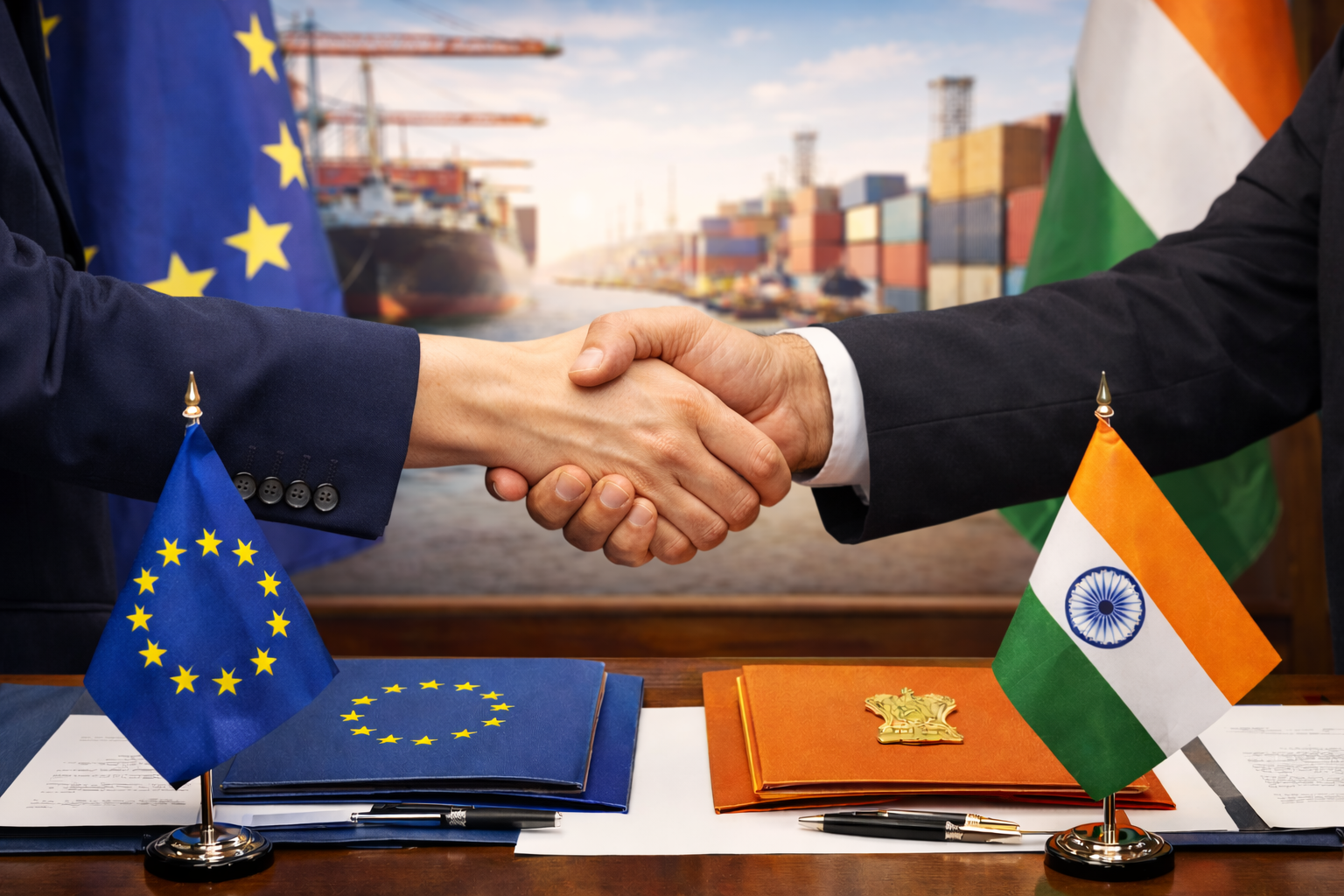
At a time of profound geopolitical realignment and after several attempts at rapprochement, on 27 January 2026 the European Union (EU) and India ended an intense and prolonged period of negotiations by sealing the basis for an ambitious free trade agreement between the two blocs (European Commission 2026a).
The dialogue between the two parties dates back to 2007, in a first attempt to strengthen trade relations through a Bilateral Investment and Trade Agreement (BITA). After a period of deadlock, negotiations were finally suspended in 2013 due to disagreements over the scope of the trade agreement. In this context, while the EU sought a more far-reaching compromise, guided by a substantial elimination of tariffs, India, maintained a more cautious position and a more protectionist approach towards its domestic industry (Bombassi and Nixon, 2025).
The geopolitical friction of the following years reawakened the need to finalise the agreement. Consequently, talks resumed in 2021, with both parties agreeing to address three separate trade agreements: a Free Trade Agreement (FTA), a Geographical Indications Protection Agreement, and an Investment Protection Agreement (IPA) (Ministry of Economy, Trade and Enterprise, n.d.).
Economically, India is emerging as one of the world’s most dynamic emerging economies, with consistently high growth rates since the post-pandemic period, reaching an average GDP growth of over 7%. This trend places India among the economies with the highest structural growth, where sectors such as services and manufacturing play a key role in this expansion (CaixaBank Research 2026).
In the geopolitical arena, stands as the fourth largest economy in the world, a position that has generated growing strategic interest from various global players, including the EU, which seeks to strengthen its presence in the Indo-Pacific region, where India is emerging as a decisive player (European Commission 2026a).
This Free Trade Agreement comes at a highly uncertain and volatile geopolitical and commercial moment and, for the EU, reinforces a message of stability and rules-based economic cooperation on the international stage. On the other hand, for India, it represents an important alliance that can contribute to diversifying sources of supply, attracting investment and consolidating its position as a manufacturing platform in global value chains.
The agreement is currently in the process of ratification, a complex stage in which political debate intensifies, and the text awaits validation by the European Parliament. In subsequent phases, the Council will have to give its approval and, after the formalities in India, the process of entry into force will begin.
Although the process is progressing gradually, the European Commission presents the agreement as a milestone of great scope and economic relevance for both parties (European Commission 2026a). In this regard, the President of the European Commission, Ursula von der Leyen, frames it as a strategic step towards deepening the EU-India economic link. Likewise, among the main measures addressed are:
- The gradual elimination of tariffs on more than 90% of products traded between the two blocs.
- Privileged access to the Indian goods and services market for European companies and investments.
- Consolidation of commitments on trade and sustainable development, strengthening environmental protection and tackling climate change.
- Promotion of strategic collaboration and greater integration of value chains between the two blocs.
In practical terms, the agreement favours European exporters by reducing tariffs on more than 90% of EU goods exports, with a particular impact on sectors such as manufacturing, automotive and agri-food. In the case of the automotive industry, India maintained high tariffs of 110% on European car exports, rates that will be significantly reduced following the entry into force of the agreement . Similarly, high tariffs of up to 44% on machinery and 22% on chemical products will be largely eliminated (European Commission 2026a).
The alliance opens up a large-scale market for European producers in the agri-food sector and may improve their competitive position. However, the reduction in tariffs will be applied selectively, as both sides have expressed their willingness to balance trade liberalisation with the protection of the most sensitive sectors. As a result, European products such as beef, chicken and rice will be excluded from liberalisation under the agreement.
EU-India trade relations
In terms of trade between the two blocs, the EU and India maintain close trade relations. Over the last decade, bilateral trade has strengthened and, in terms of goods, the EU is India’s second largest trading partner, behind only China (European Council 2026). According to consolidated data from 2024, EU exports to India reached one of their highest levels, standing at around €48 billion (Illustration 1). Meanwhile, imports continue to show sustained growth, with an approximate value of €65 billion. The most recent figures, which correspond to the cumulative data from January to November 2025, maintain this trend, with EU exports to India worth €43 billion and imports worth almost €64 billion.
Illustration 1. Exports and imports between the EU and India
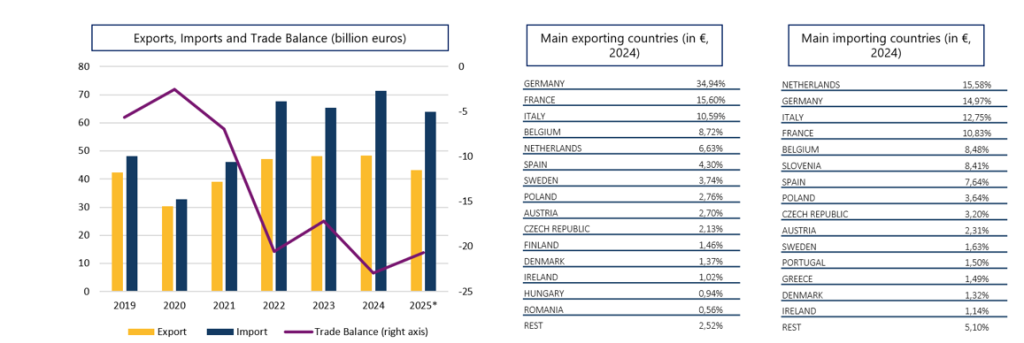
(*) Cumulative data from January to November
Source: own elaboration based on Eurostat data
By country, Germany is consolidating its position as the leading European partner, accounting for around 50% of trade flows with India, mainly in the industrial sector, particularly machinery and capital goods. It is followed by France and Italy, with a combined trade share of 25%.
From a sectoral perspective, in 2024 EU exports to India were mainly concentrated in capital goods (54.4%), followed by semi-manufactures (23.7%) and consumer goods (7.3%). Imports follow a similar pattern, with demand from the European bloc focused on semi-manufactured goods (34.3%), capital goods (27.4%) and consumer goods (17.4%).
Table 1. Main EU-India export and import sectors in 2024 (in thousands of euros)

Source: own elaboration based on data from the Ministry of Economy, Trade and Enterprise
It is undeniable that cooperation between the two blocs not only represents far-reaching trade liberalisation but also opens up opportunities for access to a large-scale market. This potential is particularly relevant for the industrial and agri-food sectors, both of which are strategic for Europe, and in particular for Spain, for which the agreement can help to consolidate and diversify its presence in the Indian market.
Spain-India trade relations
Spain currently ranks sixth among European exporters to India and seventh among importers (Embassy of India n.d. ). Although trade flows between the two countries have continued to evolve positively (Graph 1), Spain continues to record a trade deficit, which stood at around €4 billion in 2024. Looking ahead, the entry into force of the agreement could help to gradually reduce this gap and promote the positioning of products that are relevant to the Spanish export sector, such as wine and olive oil, as well as machinery and capital goods.
Graph 1. Evolution of the value of exports and imports between Spain and India (in billions of euros)
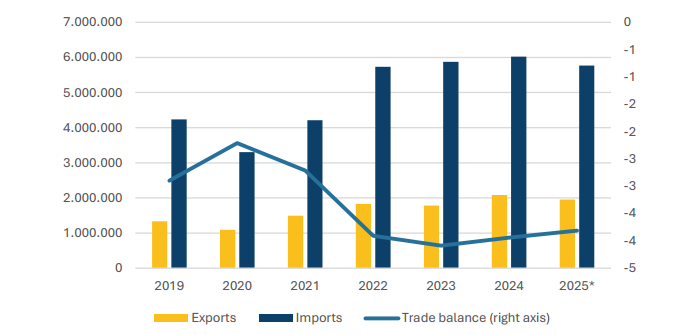
(*) Cumulative data from January to November
Source: own elaboration based on data from the Ministry of Economy, Trade and Business
In this regard, and in terms of sectoral composition, Table 2 shows that Spanish exports to India have mainly focused on capital goods (38.9%) as the main category, followed by semi-manufactured goods (35.9%) and raw materials (9%). In terms of imports, semi-manufactured goods, consumer goods and capital goods once again stand out, with shares of 33.4%, 24.6% and 18.7%, respectively.
Table 2. Main export and import sectors between Spain and India in 2024 (in thousands of euros)

Source: own calculations based on data from the Ministry of Economy, Trade and Business
Although the agreement has been structured on the basis of strategic trade cooperation between both parties, concerns about protecting domestic industry remain, especially in the agricultural sector, in a European context marked by greater social and sectoral scrutiny of trade agreements.
Nevertheless, the European agricultural sector recognises the potential of the new trade agreement and admits that it can bring added value, while stressing the need to maintain effective safeguard mechanisms to ensure the protection of the most vulnerable national sectors (Union of Small Farmers and Ranchers (UPA) 2026). Likewise, for the agreement to be successful, reciprocity in food health and safety standards will be a priority, together with the application of rigorous border controls.
Role of maritime transport in trade between Spain and India
If this scenario materialises, not only could the Spanish economy benefit from the agreement, but it could also translate into a boost in port traffic flows to Spanish ports. According to data from Puertos del Estado, the volume of goods exchanged between the two regions has remained relatively stable (Graph 2). Exports have stood at around 3 million tonnes, although they are expected to rise to 3.6 million tonnes in 2024 . Imports, meanwhile, follow a similar trend and fluctuate between 5 and 7 million tonnes, with a peak in 2023 reaching 8.06 million tonnes.
Graph 2. Evolution of port traffic between Spain and India in millions of tonnes (including transit) (2017–2024)
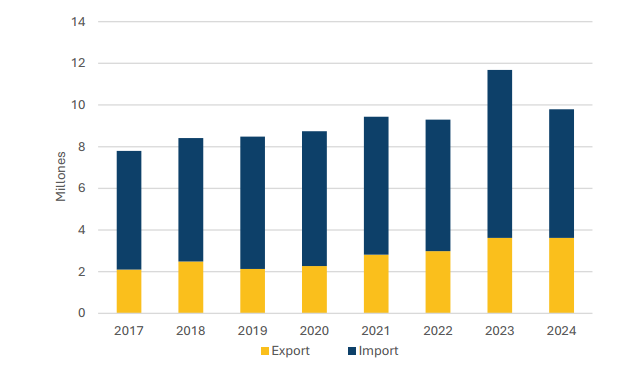
Source: own elaboration based on data from Puertos del Estado
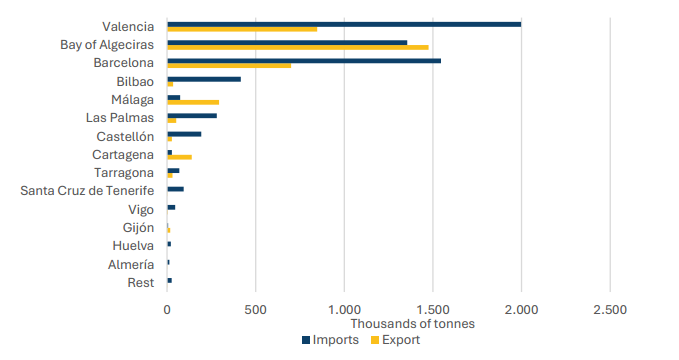
Focusing on the ports in the Spanish port system, the most recent data, corresponding to 2024, indicate that the Port of Valencia maintains its leading position, channelling nearly 30% of the flows with India. It is followed by the Port of Algeciras and the Port of Barcelona, which handled around 1.4 million and 700,000 tonnes respectively.
Graph 3. Main Spanish ports in trade with India in thousands of tonnes (including transit) (2024)
Source: own elaboration based on data from Puertos del Estado
This scenario highlights that trade with India is not concentrated on a single axis, suggesting that, if the agreement comes into force, Spanish ports could strengthen their role as important access points for trade with India. This could translate into improved maritime connectivity, with an increase in port calls and services that would benefit Spanish ports.
In general terms, the agreement addresses several key implications for Spanish ports. Among them, it favours the attraction of strategic trading partners by encouraging investment between the two blocs, a scenario that would optimise the logistics chain and strengthen commercial activity. In this regard, the agreement opens the door to greater integration of Spanish ports into global maritime networks, strengthening the competitiveness and resilience of the Spanish port system and thus consolidating its position as a leading logistics hub in the Mediterranean.
In particular, it is estimated that a significant proportion of the goods exchanged between the two blocs will be concentrated in the manufacturing industry and the agri-food sector (European Commission 2026b). This fact underlines the need to fully comply with the established phytosanitary regulations and the safety and quality standards required by both parties. In this context, operations may require adjustments to the supply chain, especially in the logistics of perishable products, to ensure quality, traceability and compliance with the standards applied.
In short, the free trade agreement between the EU and India is not only an instrument of tariff liberalisation but also reflects the convergence of strategic interests in an international context marked by the fragmentation of supply chains and the need for reliable alliances. According to the European Commission, the agreement could help double EU exports of goods to India by 2032 and generate savings of approximately €4 billion per year in tariffs (European Commission 2026a).
From a maritime-port perspective, the agreement will lead to a foreseeable increase in trade flows between the blocs and, consequently, greater demands in terms of operational efficiency and international competitiveness. This scenario presents a key opportunity to commit to port digitalisation by promoting the integration of Maritime Single Window systems and their interoperability with Port Community Systems (PCS), in order to streamline customs procedures and improve traceability. Similarly, the increase in bilateral traffic will require the consolidation of efficient connections with the hinterland, where intermodality is a strategic element in optimising the transport logistics chain.
However, the success of the agreement will depend largely on its effective implementation and the balance between trade liberalisation and the protection of sensitive sectors. Beyond its economic and commercial dimension, the agreement is part of a strategy to diversify and strengthen trade relations in a changing international environment. In this sense, rather than a simple tariff treaty, it acts as a key framework for deepening economic cooperation and strengthening the EU-India relationship in the medium term.
References
- ASAJA, Agricultural Association of Young Farmers, 2026. ASAJA assesses the EU-India agreement and highlights that pressure from the European countryside has succeeded in protecting sensitive products. [Online]. Available at: https://asaja-andalucia.es/noticias/asaja-valora-el-acuerdo-ue-india-y-destaca-que-la-presion-del-campo-europeo-ha-logrado-proteger-los-productos-sensibles/ [Accessed 17/02/2026].
- CaixaBank Research, 2026. Country Profile: India. [Online]. Available at: https://www.caixabankresearch.com/es/fichas-pais/internacional/india [Accessed 17/02/2026].
- European Commission, 2026a. The EU and India sign a historic free trade agreement. [Online]. Available at: https://spain.representation.ec.europa.eu/noticias-eventos/noticias-0/la-ue-y-la-india-celebran-un-acuerdo-de-libre-comercio-historico-2026-01-27_es [ Accessed 17/02/2026].
- European Commission, 2026b. Questions and answers on the EU-India Free Trade Agreement. [Online]. Available at: https://ec.europa.eu/commission/presscorner/detail/es/qanda_26_185 [Accessed 17/02/2026].
- European Council, 2026. Trade relations between the EU and India. [Online]. Available at: https://www.consilium.europa.eu/es/infographics/eu-india-trade-facts-and-figures/. [Accessed 17/02/2026].
- Embassy of India, n.d. Bilateral Economic and Commercial Relations. [Online] Available at: https://www.eoimadrid.gov.in/commercial-relations.php[ Accessed 17/02/2026].
- *Consult the downloadable document for the complete list of bibliographic references.
*Disclaimer: This English version has been generated with the support of AI-based translation tools. In case of discrepancies, the Spanish original prevails.