
Open innovation in ports: the hackathon as a pathway to technology pilots
Introduction
In recent years, open innovation in the port sector has established itself as a trend within an industry undergoing the dual energy and digital transitions, and characterised by operational complexity, interdependence amongst stakeholders and the need to incorporate specialised technological solutions. Ports are critical infrastructures and complex logistics hubs where innovation requires cooperation between companies, public authorities, knowledge centres, technology providers and start-ups.
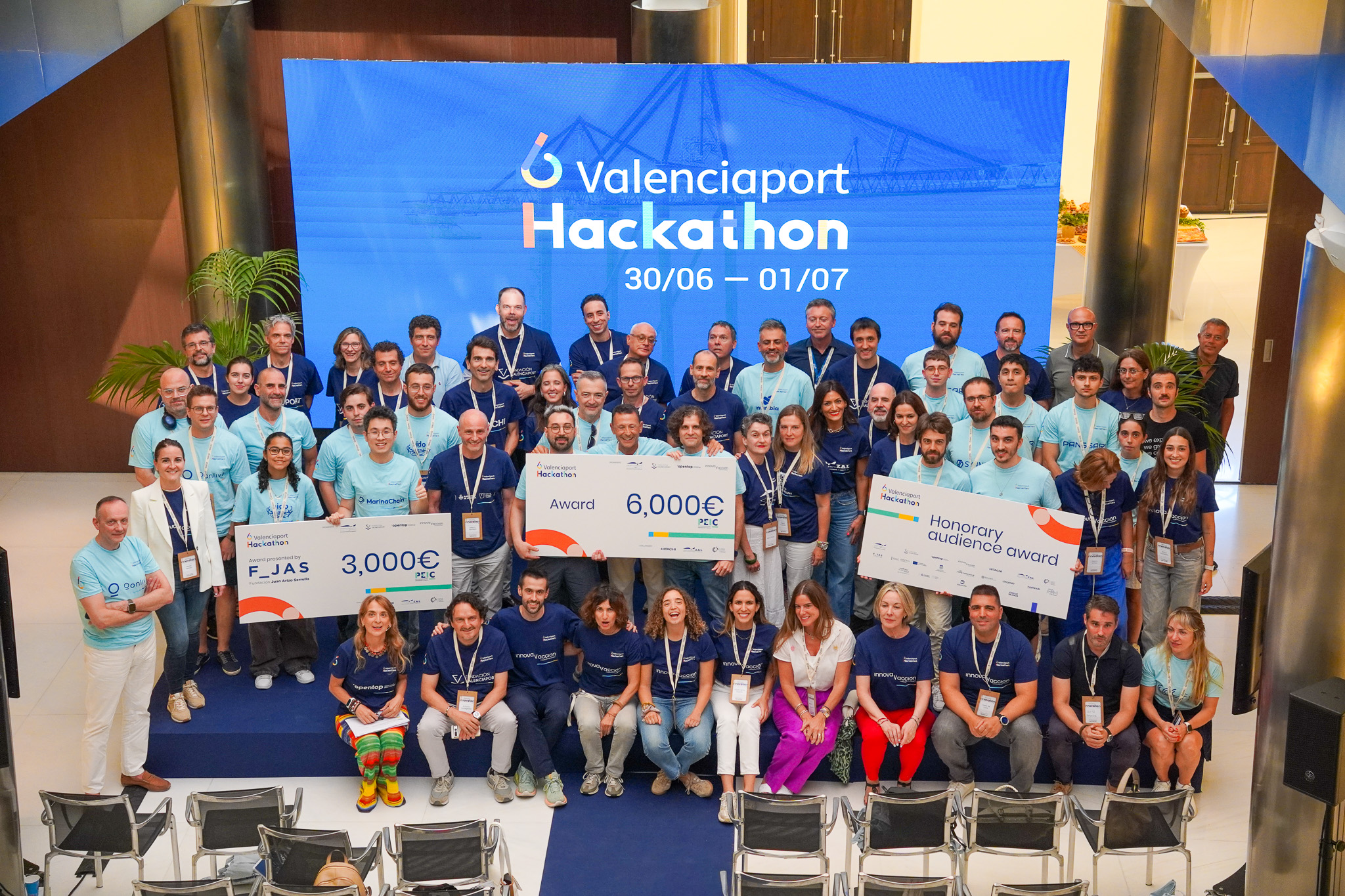
Against this backdrop, the Valenciaport Hackathon has evolved from a format focused on intensive idea generation towards a more sophisticated mechanism for linking real-world challenges with technologies that have the potential for deployment. The sixth edition, held on 30 June and 1 July 2026 at the Edificio del Reloj in the Port of Valencia, exemplifies this evolution: the event was aimed at start-ups, scale-ups and technology-based SMEs with validated solutions or, at the very least, with a sufficient level of maturity to tackle corporate challenges and design pilot project proposals, adopting a competitive format for the prizes on offer and the opportunity to carry out a subsequent pilot project with the challenging company.
This shift in focus is significant because it shifts the Hackathon’s centre of gravity. The value no longer lies solely in producing creative concepts within a limited timeframe, but in establishing a process that enables the identification of external technologies, assessing them against the port’s operational needs, fostering direct interaction with the challenging companies, and building a roadmap towards potential validation in a real-world environment. The Hackathon is thus positioned as a component within a broader framework of open port innovation.
The analysis that follows argues that the Hackathon can drive open innovation at Valenciaport through three main functions: it acts as a mechanism for technology scouting and selection, as a space for co-creation between start-ups and corporations, and as a gateway to technological pilot projects. Its value is not limited to the number of participants or the event’s public visibility; it is expressed, above all, in its ability to bridge the gap between industrial challenges, technological solutions and operational validation.
Open innovation in ports
The open innovation paradigm, formulated by Chesbrough (2003), posits that organisations can no longer innovate effectively by relying solely on their own internal R&D resources. In an environment where knowledge is widely distributed amongst companies, universities, technology centres, start-ups, suppliers and users, organisations must open up their innovation processes to incorporate external ideas, technologies and capabilities.
In contrast to the traditional model of closed innovation, open innovation argues that value is generated by combining internal and external knowledge. Competitive advantage depends not only on possessing knowledge, but on knowing how to connect and integrate it through collaborative networks, partnerships, pilot projects and innovation ecosystems capable of transforming ideas and technologies into practical solutions.
In the port sector, this premise is further emphasised by the diversity of stakeholders involved in the value chain: port authorities, terminals, shipping lines, logistics operators, energy companies, hauliers, port services, public authorities, technology providers and end users. Any solution affecting port operations therefore requires a combination of technical expertise, regulatory knowledge, an understanding of processes and the ability to integrate with existing systems.
Ports also face a characteristic tension. On the one hand, they need to innovate to improve efficiency, sustainability and resilience. On the other hand, they operate in environments where service continuity, safety and reliability are essential. This tension can slow down the adoption of technology if there are no intermediary mechanisms capable of filtering solutions, structuring pilot projects and reducing the risk of implementation. Hackathons focused on pilot projects in controlled environments fulfil precisely this function: they allow experimentation without trivialising operational complexity.
In the case analysed, the Hackathon forms part of the activities of Opentop, Valenciaport’s open innovation hub driven by Fundación Valenciaport with the support of the Valencia Port Authority. This reference is used here to provide context for the case study, not as institutional promotion, and helps to situate the event within a framework of intermediation between port companies, start-ups and organisations within the ecosystem.
This positioning makes the Hackathon more than just an isolated event. It is part of Opentop’s wider range of activities aimed at facilitating interaction between the entrepreneurial ecosystem and the port community. Its role is to translate real needs into manageable challenges, identify external solutions with the potential to fit the bill, organise interaction between start-ups and corporations, and create the minimum conditions required for a proposal to progress to a pilot phase.
Structure of the Valenciaport Hackathon: challenges, start-ups and corporations
The sixth edition of the Valenciaport Hackathon was structured around three real-world challenges set by organisations within the port ecosystem: Hitachi Energy, VPI Logística and the Valenciaport Cluster’s Innovation Committee. Nine start-ups were selected – three for each challenge – following a call for entries that received over 40 applications. This structure enabled the work to be focused on areas with a clear operational link: multi-vector energy management, mobility and access within the logistics activities area of the port (ZAL), and a coordinated response to disruptions.
The approach of three challenges and nine start-ups has methodological value. On the one hand, it prevents an excessive dispersal of efforts and allows each challenging organisation to work with a limited set of solutions. On the other hand, it maintains comparative competition between alternative technological approaches. Open innovation benefits from this tension: the corporation does not receive a single, closed proposal, but rather several approaches that allow for the comparison of technologies, business models, levels of maturity and the ability to adapt to the port environment.
The Hackathon’s design also incorporates an element of active participation by the port community. The event featured challengers, collaborators, mentors, a judging panel and organisations from the ecosystem, as well as support from organisations linked to entrepreneurship and innovation. This composition is significant because it contributes to the creation and strengthening of relationships between stakeholders in the port community, helping to build the community whilst enhancing entrepreneurs’ connections with a wide range of sector stakeholders.
From conceptual prototype to pilot proposal
One of the distinguishing features of the sixth edition was the introduction of a methodology with a dual objective: to ensure the careful selection of projects with the greatest real potential to solve each challenge, and to ensure that every proposal co-created during the Hackathon has a clear path towards validation within the Valenciaport environment.
This approach is particularly important for the port sector. In many open innovation processes, there is a wide gap between initial enthusiasm and actual implementation. Start-ups may present promising technologies, but they do not always have access to the data, processes, users, infrastructure or corporate partners needed to turn the proposal into a structured trial. This new approach aims to bridge that gap right from the event’s design stage, establishing the pilot as the methodological focus from the outset.
The change is substantial. In a traditional hackathon, the outcome is usually an idea, a prototype or a final presentation. In a pilot-oriented hackathon, the expected outcome is closer to a roadmap: which problem is being addressed, with which technology, in which test environment, using which data, under which success criteria, involving which stakeholders, and with which integration risks. The value lies not only in creativity, but in the ability to translate that creativity into a viable experiment.
Table 1. Roles of the Hackathon within the port open innovation process
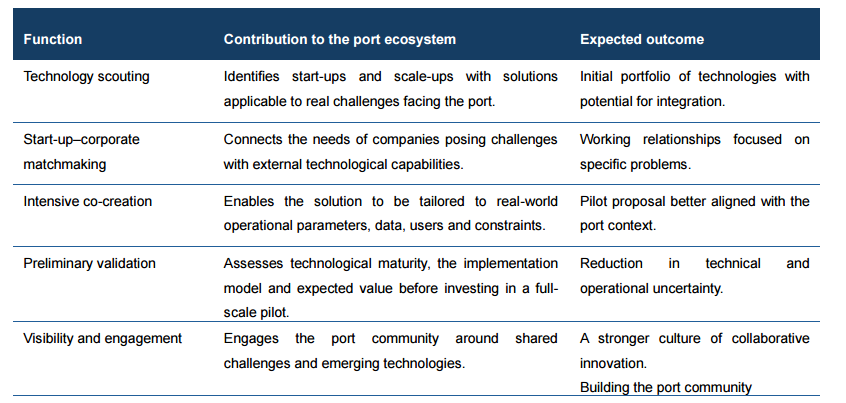
Source: own elaboration
In practice, this evolution requires challenges to be better prepared. The experience of the Hackathon demonstrates the importance of having a dataset and working materials available before the event. In particular, challengers and mentors were advised to define what information would be shared with the start-ups, given that having high-quality baseline data in sufficient quantities would enable teams to develop proposals with greater impact and better tailored to the challengers’ needs. This observation illustrates a critical condition of open innovation: the quality of the solution also depends on the quality of the problem formulated and the information available to solve it.
The start-up–corporate connection as the primary mechanism for generating value
The relationship between start-ups and corporations is often characterised by asymmetry. Start-ups bring agility, technological specialisation and adaptability; corporations bring market knowledge, access to real-world processes, sectoral legitimacy and the potential for scaling. However, these capabilities do not automatically combine. They require a framework for interaction that reduces friction, clarifies expectations and translates technological language into operational language.
The Valenciaport Hackathon fulfils this translation function. By working on challenges set by specific companies, start-ups face real constraints, not abstract problems. At the same time, corporations have the opportunity to observe how an external technological solution responds to their needs, how it adapts to the available information and what level of maturity the entrepreneurial team demonstrates. This dual learning process is one of the format’s most significant contributions.
From the start-ups’ perspective, the Hackathon offers a targeted route into a complex industrial client base. It is not merely a matter of taking part in a competition, but of holding technical discussions with those who understand the problem, receiving operational feedback and adapting the proposal to a specific context. From the corporation’s perspective, the event allows it to explore technologies without immediately committing to implementation, comparing approaches and selecting those with the greatest potential for validation.
This model fosters a more disciplined form of open innovation. The start-up is not limited to presenting a generic solution; it must demonstrate how its solution fits a specific challenge. The corporation does not act as a spectator; it participates in defining the problem, guiding the proposal and, potentially, in the subsequent pilot phase. The collaboration becomes more productive because it is organised around a verifiable need.
Table 2. Distinctive contributions of start-ups and corporations at the Hackathon
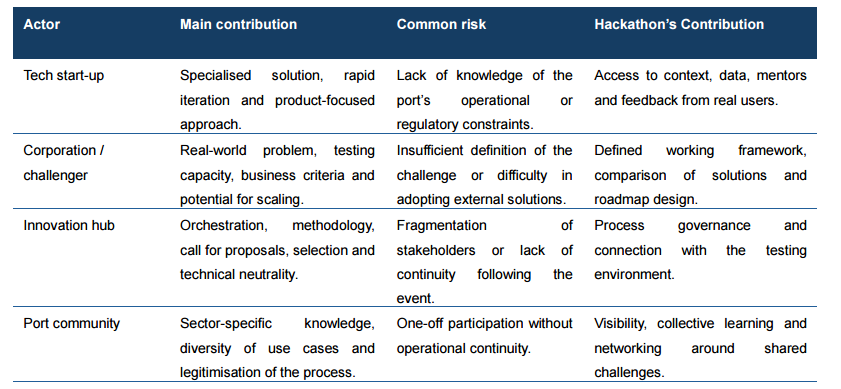
Source: own elaboration
Valenciaport as a validation environment
The ability to generate technology pilots depends on the existence of an environment where solutions can be tested with sufficient realism and control. The sixth edition of the Hackathon was designed so that the resulting proposals could be tested within the Valenciaport environment.
Valenciaport offers a potential framework for testing, in a limited and progressive manner, the viability of certain solutions emerging from the Hackathon. In terms of innovation management, its value lies in helping to reduce uncertainties, generate insights and provide preliminary evidence to decide whether a solution merits further development, adaptation or rejection.
At this stage, the role of the innovation hub is particularly important. Opentop can act as a facilitator for the pilot, helping to structure the relationship between the start-up and the corporation, define the scope, coordinate stakeholders, monitor milestones and support the processing of authorisations where necessary. This intermediation reduces friction and helps to maintain realistic expectations during the validation phase.
For this reason, the Hackathon should not end with the awards ceremony. Its strategic value is measured by the quality of the follow-up: defining pilot projects, identifying those responsible, specifying the necessary data, designing indicators, managing risks, establishing collaboration agreements and monitoring progress. Open innovation matures when the event is linked to a portfolio of experiments and is not reduced to a one-off activity.
Evidences of the drive for innovation: internationalisation, technical quality and a focus on real-world challenges
The 2026 edition offers several signs of the ecosystem’s dynamism. Firstly, the call for entries received over 40 applications and selected nine international start-ups. The selected companies included teams from Singapore, Norway and the Netherlands, as well as Spain, which reinforced the event’s international character and increased the technological diversity available to tackle the challenges.
Secondly, the challenges addressed reflect strategic areas for the development of the port system. Hitachi Energy’s challenge focused on a multi-vector energy management system for port terminals; VPI Logística’s on the smart management of access, security and mobility in the ZAL; and that of the Valenciaport Cluster Innovation Committee on a platform for monitoring, predicting and responding to disruptions. These were not generic topics, but rather problems directly linked to the energy transition, resilience and operational efficiency.
Thirdly, the participating start-ups demonstrate a clear focus on applied validation. Specifically, Urban Alert won first prize with a proposal aimed at validating the model using real data from the port without disrupting existing operations; Marina Chain won second prize with a solution for the continuous monitoring of signals, action protocols and the traceability of actions; and Synnect received the people’s choice award with a multi-sensor system and a predictive digital twin for vehicle visibility, early congestion alerts and anomaly detection (Diario del Puerto 2026a).
Finally, there has been interest from the challenging companies and organisations in continuing to work on defining potential pilot projects with several of the participating start-ups, regardless of whether they won a prize or not.
This evidence suggests that the Hackathon can be seen as a mechanism for driving innovation in the sector. The key lies not merely in the existence of winning start-ups, but in the proposals being linked to real-world data, port operations and the needs of companies within the cluster. However, the event gains value when it produces a portfolio of solutions that can be turned into verifiable experiments. Future monitoring of these proposals will enable a more accurate assessment of the initiative’s success in terms of the effective generation of pilot projects.
Capacity to generate pilot projects: critical conditions for success
The Hackathon’s ability to generate technology pilot projects does not depend solely on the intensity of the event. It requires a series of preconditions and follow-up measures. The first is the quality of the challenge. A challenge that is too broad tends to produce generic solutions; one that is too narrow limits creativity. The right balance lies in formulating a specific operational problem, with sufficient contextual information, whilst leaving room for the start-up to propose its own technological architecture.
The second condition is the availability of data and access to context. In fields such as artificial intelligence, monitoring, mobility or energy management, the pilot proposal requires data, operational variables, usage scenarios and integration constraints. Without this foundation, there is a risk of ending up with presentations that are attractive but difficult to implement. The preparation of datasets for the Hackathon demonstrates that this condition was identified by the organising team as an essential element of the process.
The third condition is the appointment of those responsible for ensuring continuity. A pilot requires a problem owner, a technical point of contact, a committed start-up, a minimum framework for collaboration and a monitoring methodology. The hackathon can provide the starting point, but continuity depends on the challenge having an internal sponsor and on the innovation hub maintaining its coordinating role after the event.
The fourth condition is the definition of indicators. Every pilot must address a verifiable question: reduction in response times, improvement in operational visibility, reduction in incidents, optimisation of energy consumption, increased traceability or improved coordination. The absence of indicators turns the pilot into a technological demonstration; their presence turns it into a learning experiment for the organisation.
Strategic contribution to the port ecosystem
The Hackathon adds value to the port ecosystem on several levels. At the technological level, it enables the identification of emerging solutions applicable to specific problems. At the organisational level, it offers companies within the cluster a tool to explore external innovation without having to initiate procurement or contracting processes from the outset. At the cultural level, it helps to normalise collaboration with start-ups and demonstrates that open innovation can be organised rigorously.
From an ecosystem perspective, the event helps to position the port as an environment for technological experimentation. This role is particularly relevant at a time when ports are competing not only for traffic, but also for the ability to attract technology, talent, pilot projects and international partnerships. A port that offers real-world challenges, access to the port community and opportunities for validation can become an attractive hub for start-ups and technology providers, provided there is subsequent governance capable of transforming the initial interaction into applied learning.
However, one should avoid an overly optimistic or promotional interpretation. Open innovation does not in itself guarantee the implementation of solutions. Its main contribution lies in improving the quality of the process of search, selection, learning and validation. The Hackathon energises the ecosystem by creating the conditions for collaboration to take place, but the effective generation of pilot projects depends on subsequent governance, the availability of resources and the organisations’ capacity to absorb external technology.
In this regard, the shift towards a start-up competition format is a coherent decision. By prioritising teams with validated technology or a minimum viable product (MVP), the gap between ideation and implementation is narrowed. The event shifts its focus away from creating solutions from scratch and towards adapting existing solutions to port requirements. This approach shortens the innovation cycle and increases the likelihood that proposals can progress to real-world testing.
Recommendations to strengthen future impact
Based on the analysis carried out, several recommendations can be identified aimed at turning Hackathons as generators of technology pilots:
- Define the challenges using a standardised methodology that includes the problem, user, available data, constraints, value hypotheses and success criteria.
- Prepare information packs for each challenge prior to the event, including datasets, process maps, operational context and access limits, provided that confidentiality permits.
- Establish, from the outset, a post-Hackathon follow-up plan, with designated leads for each challenge, an evaluation timetable and a decision-making process regarding potential pilot projects.
- Incorporate a technology maturity and operational fit matrix so that the selection of start-ups combines the appeal of the solution with real-world viability.
- Measure the programme’s impact beyond mere participation: pilots initiated, pilots completed, technical learnings, collaboration agreements and subsequent adoptions.
These recommendations point to a common principle: open innovation requires design. Contact between start-ups and corporations is valuable, but not sufficient. For it to lead to pilot projects, it must be structured through a clear sequence of challenge formulation, scouting, selection, co-creation, experimentation and evaluation.
Conclusions
The case of the Valenciaport Hackathon demonstrates how a start-up competition can drive open innovation within the logistics and port ecosystem when it focuses on real-world challenges, technologies with a certain degree of maturity, and proposals for pilot schemes. Its methodological evolution shifts the focus from creativity-intensive approaches towards linking operational needs with external solutions that can be validated.
Its main contribution is to bridge the gap between corporations and start-ups: it enables the former to explore emerging solutions in a structured manner and offers the latter an operational context, sector-specific dialogue and a potential pathway to pilot projects. In this process, the innovation hub plays an orchestrating role that transforms one-off contacts into shared learning.
The new approach reinforces this focus on validation, although the pilot should be understood as a possible outcome, contingent upon technical compatibility, data availability, the involvement of the necessary stakeholders and operational viability. Consequently, the future impact of the Hackathon will depend on post-event continuity, the measurement of pilots and the consolidation of an experimentation portfolio aligned with strategic priorities.
References
- CHESBROUGH, H.W. 2003. Open Innovation: The New Imperative for Creating and Profiting from Technology. Boston: Harvard Business School Press. ISBN 978-1578518371.
- DIARIO DEL PUERTO. 2026a. Urban Alert, Marina Chain and Synnect, winners of the 6th Valenciaport Hackathon. Available at: https://www.diariodelpuerto.com/logistica/urban-alert-marina-chain-y-synnect-ganadores-del-vi-valenciaport-hackathon-GC26358358 [Accessed 13 July 2026].
- DIARIO DEL PUERTO. 2026b. Jorge Marcos (Opentop): “The Valenciaport Hackathon has helped make Valencia a benchmark for port innovation”. Available at: https://www.diariodelpuerto.com/maritimo/jorge-marcos-opentop-el-valenciaport-hackathon-ha-ayudado-a-que-valencia-sea-referencia-de-innovacion-portuaria-AD26341450 [Accessed 13 July 2026].
- VALENCIAPORT FOUNDATION. 2026a. The 6th Valenciaport Hackathon strengthens its international profile and drives forward innovative pilot projects. Available at: https://www.fundacionvalenciaport.com/en/news-events/2026/07/6-valenciaport-hackathon-clausura/ [Accessed 13 July 2026].
- VALENCIAPORT FOUNDATION. 2026b. Opentop unveils the nine international start-ups selected for the 6th Valenciaport Hackathon. Available at: https://www.fundacionvalenciaport.com/noticias-eventos/2026/06/opentop-desvela-las-9-startups-internacionales-seleccionadas-para-el-6o-valenciaport-hackathon/ [Accessed 13 July 2026].
- OPENTOP. 2026. 6th Valenciaport Hackathon | Innovating to meet the challenges of port logistics. Available at: https://www.opentop.es/es/valenciaport-startup-hackathon-2026 [Accessed 13 July 2026].
- VALENCIA NEWS. 2026. Valenciaport Hackathon 2026: nine international start-ups. Available at: https://valencianews.es/valencia/valenciaport-hackathon-2026-startups-logistica-puerto/ [Accessed 13 July 2026].
- MARINELINK. 2026. Valenciaport Hackathon Highlights Growing Role of Live Port Innovation. Available at: https://www.marinelink.com/news/valenciaport-hackathon-highlights-growing-540926 [Accessed 13 July 2026].
*Disclaimer: This English version has been generated with the support of AI-based translation tools. In case of discrepancies, the Spanish original prevails.