
Port circularity: a challenge Europe cannot postpone
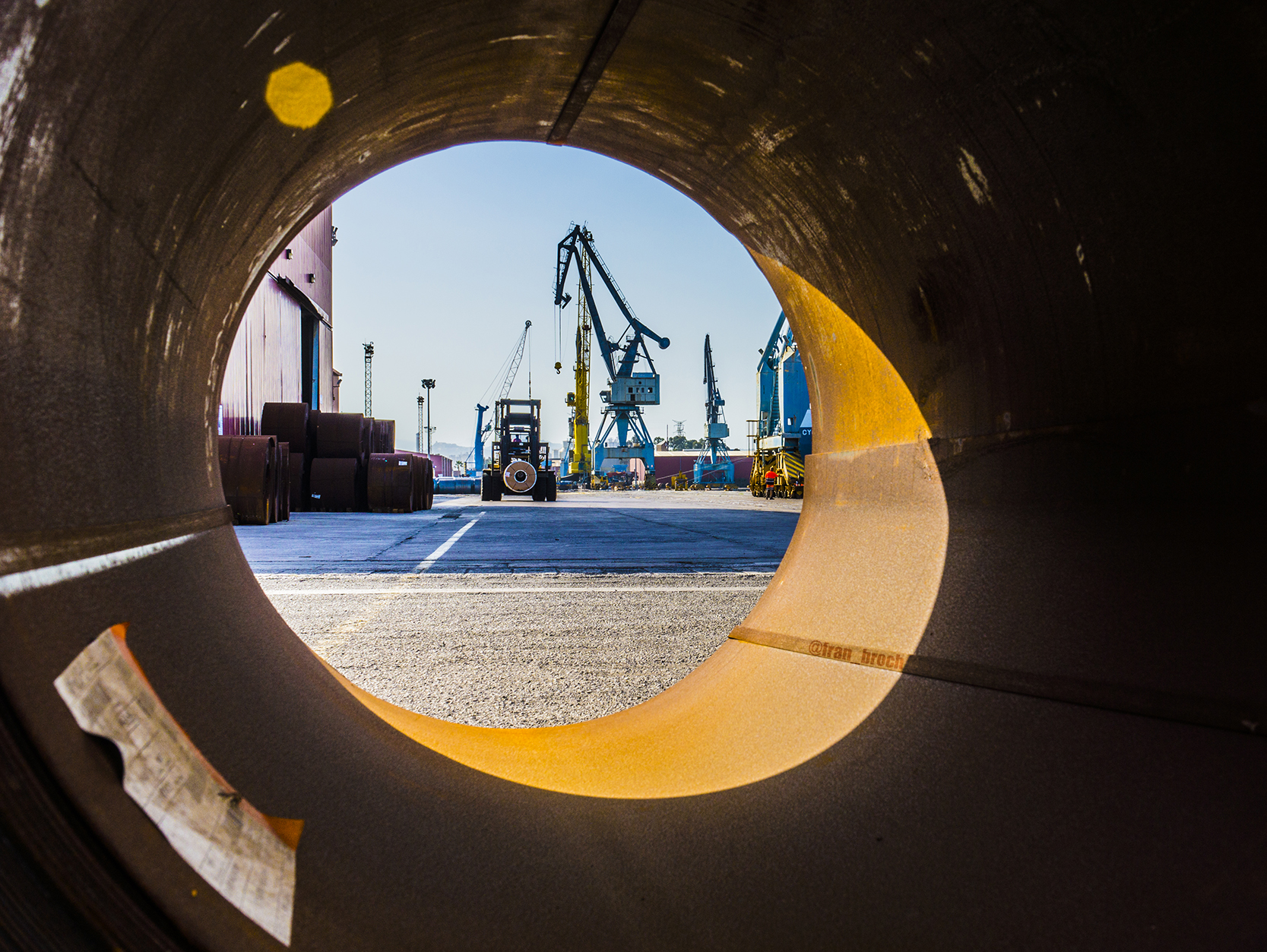
During decades, the linear economy — defined as the production and consumption model based on the sequence of extract, manufacture, use and discard (Ellen MacArthur Foundation, 2013) — effectively drove the generation of material wealth in industrialised countries. However, this model led to the exhaustion of natural resources and the widespread degradation of ecosystems, revealing its deep environmental and social limitations.
In response to this systemic crisis, the circular economy (CE) has emerged with renewed force as an alternative paradigm. The CE is defined as an economic system that minimises resource input and waste, emissions and energy leakage from the system, while mitigating negative impacts without jeopardising growth and prosperity (Geissdoerfer et al., 2018).
The circular economy offers a structural response to the great challenges of our time — climate change, biodiversity loss, waste accumulation and pollution — by decoupling economic growth from the consumption of finite resources.
Illustration 1. The butterfly diagram: visualising the circular economy
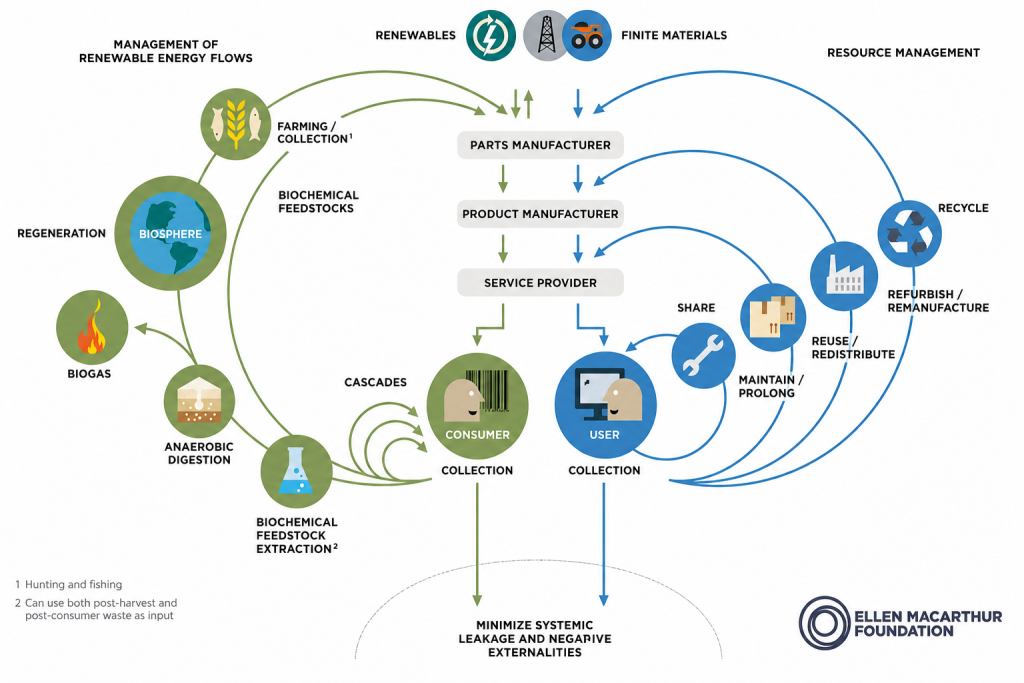
Source: Ellen MacArthur Foundation, Circular economy systems diagram (February 2019). Based on Braungart & McDonough, Cradle to Cradle (C2C).
The circular economy has become an increasingly relevant economic sector in the European Union. In 2022, the economic value of sectors linked to the circular economy reached €147 billion in the EU. At the same time, the circular material use rate was estimated at 11.5% in 2022, according to the European Environment Agency, demonstrating that, despite progress, Europe still operates predominantly under a linear economy. In terms of employment, Eurostat recorded approximately 4.4 million circular jobs in 2023, and the most recent estimates place financing needs for a circular economy in the EU at around €55 billion per year. Against this demand, European Investment Bank loans for circularity projects have grown steadily, reaching €3.8 billion in the 2019–2023 period.
The CE has consolidated itself as a comprehensive proposal aimed at transforming the foundations of the contemporary economic and productive system — one in which the European port system is not a peripheral actor. The CE represents both a challenge and an opportunity for the port sector.
Maritime transport moves approximately 74% of the European Union’s external trade and around 30% of internal freight transport, making it an essential component of the European market. In particular, EU-27 ports handled 3.4 billion tonnes of goods in 2023, with 90% of European external trade passing through maritime routes.
European ports operate today in an environment of unprecedented complexity, simultaneously facing pressures of a geopolitical, regulatory, technological and climate nature. The global tariff escalation, disruptions to strategic routes such as Suez — whose container traffic plummeted by nearly 70% in 2024 — or the volatility of the Strait of Hormuz demonstrate that European maritime logistics is particularly exposed to the shocks of an increasingly unstable global system.
Added to this is a rapidly accelerating regulatory environment (EU ETS, FuelEU Maritime) that demands major investment decisions within tight timeframes and with the permanent risk of technological obsolescence, compounded by the absence of consensus on which alternative fuel will lead the transition. In turn, climate change introduces a fundamental non-linear variable: annual damages from coastal flooding, currently estimated at €1.2 billion in the EU, could escalate to €814 billion by 2100 in the absence of protective measures. Added to this is the structural dependence on specific corridors, the concentration of suppliers in distant geographies and a bureaucracy that slows operational adaptation (Martínez et al., 2025).
It is precisely this confluence of difficulties that makes the circular economy a necessary strategy of structural resilience for twenty-first century ports.
The European Parliament, as well as the European port organisations — the European Federation of Inland Ports (EFIP) and the European Sea Ports Organisation (ESPO) — have highlighted the enormous potential of ports to play a key role in the context of the evolution towards the circular economy.
European ports are currently implementing and developing initiatives and projects that contribute to the CE (Barona et al. 2023), such as the shift to OPS supply to decarbonise maritime transport, clean water treatment facilities to protect the sea and comply with regulatory requirements, marine waste recovery, the reinforcement of reuse and recycling measures, repurposing containers or the shift to renewable energy sources.
Noteworthy is the role of Innovation Hubs, which act as magnets for entrepreneurs with circular economy solutions, offering them real infrastructure in which to test their technologies. These Hubs can be active catalysts of circular reindustrialisation, where innovation, shared infrastructure and public-private collaboration align with the objectives of the European Green Deal.
The main innovation and entrepreneurship Hubs linked to European ports, such as PortXL (Port of Rotterdam) and opentop (Port of Valencia), make it possible to develop and apply solutions that improve the competitiveness, sustainability and efficiency of the port sector, and to connect the world of entrepreneurship and research with industrial and logistics realities.
However, challenges in the transition towards a circular economy in European ports have been identified. From the scale of the initial investments required to the fragmentation in measurement models, technological uncertainty, disparities between ports and insufficient social engagement, the European port ecosystem faces a complex agenda that must be addressed.
Initial investments to implement CE strategies
The circular transition in European ports entails considerable investment requirements that condition the pace and depth of transformation. Port authorities must carefully estimate and assess the initial investments required for circular projects and their associated returns, also considering the link between sustainable finance and these projects as a central strategic element — an exercise that is especially complex given that many circular initiatives present slow, limited and uncertain returns (de Langen et al. 2020).
In 2024, the European Sea Ports Organisation (ESPO) published a study (de Langen, 2025) revealing that the investment needs of European port bodies amount to approximately €80 billion over the next 10 years, through to 2034. The study highlights that investments in sustainability and energy transition are becoming the second most important investment category for port authorities, prioritising the transition to alternative fuels, the electrification of operations and efficient resource management — building the transformation vectors towards the circular economy.
From a business model perspective, among the most relevant barriers identified in the port context are the high capital requirements with demonstrably limited returns, land availability and the need for specific support infrastructure for circular activities, such as electricity generation. The technology needed to close material cycles (pyrolysis plants, hydrogen infrastructure, industrial symbiosis systems) demands investment thresholds that exceed the individual capacity of most medium-sized ports, reinforcing the need for European financing instruments and risk-sharing models between public and private actors.
Heterogeneity in the application and monitoring of CE strategies in European ports
Measuring circular progress in European ports faces a challenge: the absence of a common, harmonised indicator framework specifically designed for the port environment. There are initiatives working on the development of transferable methodologies and shared reference frameworks that could lay the foundations for port circular monitoring at a European scale.
Monitoring plays a crucial role in enabling ports to assess the effectiveness of their CE strategies. By collecting and analysing such data, ports can streamline decision-making, demonstrate regulatory compliance and improve their performance.
However, the degree of progress in implementing CE strategies is markedly uneven among European ports, both in ambition and monitoring methodology.
In the ESPO Environmental Report 2025, compiled from data from 77 ports in 18 European countries, it is highlighted that the integration of circular economy principles into port management is advancing, albeit unevenly and with still significant measurement gaps. In terms of waste, 87% of ports monitor their port waste, as well as waste recycling (75%), and the carbon footprint indicator (78%).
However, the report itself reveals the paradox that defines the current moment: despite 100% of participating ports having formalised environmental improvement objectives and the ESPO Environmental Management Index (EMI) reaching its all-time high of 8.67 out of 10, methodological heterogeneity among ports persists, and the absence of a specific and harmonised circular indicator framework prevents this commitment from being translated into comparable, aggregable metrics to guide European port policy.
The EcoPorts PERS certification, the port sector’s specific environmental management standard — although not conceived as a circular economy indicator — lays the operational foundations of the circular transition in ports: requiring the identification of material, waste, water and energy flows, and fostering collaboration among stakeholder groups. By way of example, certified ports include Valencia, Rotterdam, North Sea Port, Oslo and Heraklion, among others.
The Flemish government has promoted the Circular Port Monitor, a tool that includes 12 indicators whose objective is to monitor the evolution of circularity over time within a port and to enable comparison between ports. The proposed indicators include: the percentage of CE commercial activities relevant to the port located in the port area; the number of circular projects located in the port area and the percentage of tenders including circular specifications.
Aditionally, it includes the percentage of circular start-ups in the port area using incubation services; the percentage of members of (circular) platforms in the port cluster; the percentage of circular cargo flows; the percentage of ship-generated waste that is separated; the percentage of the area in the port occupied by main CE activities relevant to the port; the percentage of employment from main circular activities in the port area; the percentage of non-recycled waste generated in the port area; the percentage of waste processed in the port area; and the percentage of secondary raw material consumption in the port area.
Application of new technologies and business models in European ports
The transition towards the CE in European ports requires both the adoption of disruptive technologies and the reconfiguration of traditional business models. Circular practices in ports foster innovation through new technologies, business models and alliances, in turn generating economic benefits such as cost savings, greater efficiency and new commercial opportunities. In this regard, digitalisation plays a central role.
Digital strategies act on several simultaneous fronts, including artificial intelligence, digital twins and blockchain.
Artificial intelligence and data analytics enable the real-time inventory and optimisation of industrial waste flows. Ports such as Rotterdam have adopted innovative digital tools, such as the Waste Profile Platform, developed by start-up geoFluxus (TU Delft), which allows companies in the port area to gain visibility over their waste flows, identifying opportunities to improve waste treatment and comparing different options based on three key factors: cost savings, sustainability and CO₂ emissions.
Digital twins are virtual replicas of the port system fed with real-time data that allow the impact of different circular strategies to be simulated before physical implementation, reducing investment risk and shortening learning cycles.
Blockchain, in turn, provides traceability and trust throughout complex value chains, guaranteeing transparency in supply chains and enabling the origin and sustainability credentials of raw materials and waste flows between multiple actors to be traced.
At the sectoral level, ESPO’s PortinSights platform integrates traffic, governance and environmental data from European ports into a single digital repository, building the knowledge Hub of the European port sector and laying the foundations for harmonised circular monitoring.
Finally, the Digital Product Passport opens the possibility for material flows passing through ports to be recorded with information on their composition, recoverability and recyclability, turning the port into a node of circular traceability within global supply chains.
In particular, the PORTWASTE system developed within the framework of the Portnet project is funded by the Ports 4.0 call and involves the Port of Palma, implementing the Digital Waste Passport to manage waste generated by ships entering and leaving ports. Each time a ship generates waste, it is recorded digitally via the Digital Passport.
Social dimension: citizens and the perceived value of port CE
The success of CE implementation is increasingly linked to the ability of public, private and academic actors to coordinate across institutional and sectoral boundaries — something particularly demanding in large industrial port Hubs given the scale and complexity of their ecosystems. Port authorities play a central role as active community builders, involving policymakers from different areas and levels of governance, as well as multiple stakeholders in circular projects.
However, current communication channels are insufficient to consolidate this commitment, so ports must strategically address both the mitigation of negative impacts and proactive community engagement to maintain social support and avoid disruptions to operations. This points to the need to design new communication and participation models — digital platforms, binding public consultations, citizen science programmes — that integrate society as an active agent, and not merely a recipient, of port CE strategies.
Conclusions
European ports operate in an environment of growing structural complexity. The confluence of geopolitical volatility, regulatory uncertainty, non-linear dynamics arising from climate change and the fragility of global logistics ecosystems configures a scenario in which the transition towards the circular economy is a competitive necessity and a long-term resilience imperative.
Although institutional recognition of the role of ports in the CE (supported by the European Parliament, ESPO and EFIP) is increasing, the actual adoption of circular strategies as an organisational axis remains heterogeneous and not yet mainstream. Moving forward requires, first and foremost, harmonising indicators at a European scale to enable comparison of results, guide public policies and attract financing linked to verifiable objectives; the use of digitalisation as a cross-cutting lever that articulates this transition; and the active involvement of society.
The circular economy in European ports is emerging as a true architecture of resilience, key to preserving its strategic relevance in an increasingly demanding global environment. In a system that penalises rigidity and rewards the capacity for adaptation and regeneration, this approach consolidates as an essential pillar for addressing the current and future challenges of the port sector.
References
- MacArthur, E., 2013. Towards the circular economy. Journal of industrial ecology, 2(1), pp.23-44.
- Geissdoerfer, M., Vladimirova, D. and Evans, S., 2018. Sustainable business model innovation: A review. Journal of cleaner production, 198, pp.401-416. ISSN 0959-6526, https://doi.org/10.1016/j.jclepro.2018.06.240.
- EUROPEAN ENVIRONMENT AGENCY 2024. Available at: https://www.eea.europa.eu/en/analysis/publications/europes-circular-economy-in-facts [Accessed 29-05-2026]
- EUROSTAT 2024. Available at: https://ec.europa.eu/eurostat/web/circular-economy/monitoring-framework [Accessed 29-05-2026]
- European Commission 2025. The EU Blue Economy Report 2025. Publications Office of the European Union. Luxembourg. Available at: https://op.europa.eu/webpub/mare/eu-blue-economy-report-2025/blue-economic-sectors/maritime-transport.html [Accessed 29-05-2026]
- EU Emissions Trading System (EU ETS) 2025. Available at: https://climate.ec.europa.eu/eu-action/carbon-markets/eu-emissions-trading-system-eu-ets_en [Accessed 28-05-2026]
- FuelEU Maritime 2025. Available at: https://transport.ec.europa.eu/transport-modes/maritime/decarbonising-maritime-transport-fueleu-maritime_en [Accessed 28-05-2026]
- United Nations Development Programme 2023. Available at: https://www.undp.org/es/comunicados-de-prensa/el-impacto-del-cambio-climatico-en-las-inundaciones-costeras-se-multiplicara-por-cinco-durante-este-siglo-poniendo-mas-de-70 [Accessed 29-05-2026]
- *Consult the downloadable document for the complete list of bibliographic references.
*Disclaimer: This English version has been generated with the support of AI-based translation tools. In case of discrepancies, the Spanish original prevails.