
Beyond the stadiums: the logistics of the 2026 World Cup
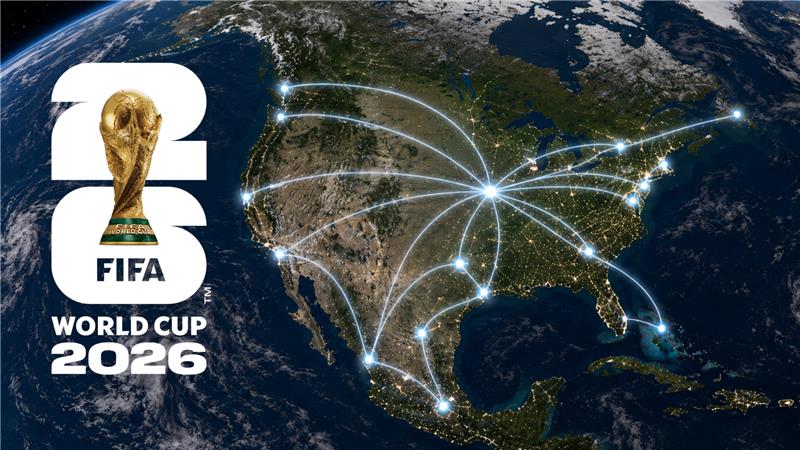
The FIFA 2026 World Cup is the largest edition in the history of the tournament, with 48 participating teams, 104 matches, and a shared organization among the United States, Canada, and Mexico. Its economic dimension reaches a scale that is difficult to compare with other international events. The socioeconomic analysis prepared by OpenEconomics for FIFA estimates a contribution of up to $40.9 billion to global GDP and the creation of approximately 824,000 full-time equivalent jobs, in addition to associated economic output of $80.1 billion.
Projected attendance stands at around 6.5 million spectators, while the social benefits derived from the event are valued at $8.28 billion (FIFA, World Trade Organization, & OpenEconomics, 2025). None of those figures stand on their own — they depend entirely on millions of people, thousands of tons of material, and hundreds of shipments crossing three borders without the chain breaking at any point. The simultaneous staging of the tournament in three countries turns that dependency into an unprecedented logistical coordination challenge.
Operating as a Single Network
Resolving that challenge requires, above all, a structure capable of sustaining it. FIFA (n.d.) identifies eight processes within tournament logistics: Material Operations, Customs & International Freight, Warehouse Operations, Distribution Operations, Venue Logistics Operations, PMA Logistics Operations, Central Logistics Operations, and Corporate Logistics. All of them are integrated under a Logistics Coordination Centre (LCC) that supports the 16 venues spread across Canada, the United States, and Mexico. The most interesting aspect of this approach is that the organization is not structured around geographic locations, but around processes.
This decision is significant because, in large-scale multinational operations, the main risks tend not to appear within a specific facility, but at the points where different functional areas interact. The structure defined by FIFA reflects a logic increasingly present in advanced supply chains, where competitive advantage depends less on optimizing individual activities and more on the ability to manage dependencies across multiple actors, facilities, and services.
The execution of that network falls on a single provider, Rock-it Cargo, a company operating since 1978 providing logistical support for events such as Formula 1, the US Open, the NFL, the NBA, and MLS, as well as broadcasting networks like Fox Sports, ESPN, and CBS (FIFA, n.d.).
With 32 offices on six continents, the company completes more than 10,000 logistical missions per year in over 100 countries (FIFA, n.d.) — an operational scale that explains why FIFA chose to centralize tournament logistics in a single actor with visibility across the entire network, rather than fragmenting it into independent contracts by venue or by country. That same centralization, however, also concentrates a high level of risk: a coordination failure at any of the points where the LCC connects customs, storage, and distribution is not contained in one venue, but propagates throughout the rest of the network.
Clearing Three Distinct Customs Regimes
Of the eight processes coordinated by the LCC, none tests that centralization more clearly than customs. It is the only one that depends, by definition, on three different national administrations — not a single operator.
Among the three host countries, only Canada and Mexico established a dedicated customs mechanism for the tournament. In Canada, the Canada Border Services Agency (CBSA) published a specific exemption order for the tournament, which allows the waiving of tariffs, surtaxes, and GST/HST on goods imported (temporarily or permanently) for exclusive use at the 2026 World Cup.
The order explicitly distinguishes between categories of goods: exhibition material and equipment temporarily imported by the organization, FIFA, its affiliates, sponsors, or suppliers is exempt from duty as long as it is used exclusively for the tournament. FIFA-certified sporting equipment donated to clubs, federations, or educational institutions at the end of the championship retains that exemption provided it is neither sold nor transferred during the two years following its importation (Canada Border Services Agency, 2025).
Meanwhile, Mexico established an equivalent mechanism through an Inter-Institutional Agreement published in the Diario Oficial de la Federación, which allows the temporary import of technical equipment, set design materials, and promotional items without payment of customs processing fees, through a simplified procedure valid until December 2026 for persons accredited by FIFA’s Mexican subsidiary (Secretaría de Hacienda y Crédito Público, 2025).
Scale of the Operation
The physical scale of that operation is reflected in the estimates Rock-it Cargo made public upon its recognition on the Sports Business Journal Power Players list. The company expects to deploy more than 5,000 trucks and vehicles, nearly 93,000 square meters (1 million square feet) of warehouse space, and the movement and storage of more than 450,000 kilograms (1 million pounds) of equipment across the tournament’s 16 venues (The Rock-It Company, 2026). To that volume of goods is added the dimension of people. U.S. Customs and Border Protection expects the arrival of more than 6 million international visitors for the tournament (U.S. Customs and Border Protection, 2026).
The Contrast with Qatar 2022
Qatar concentrated its eight venues within a single customs territory, with maximum distances of 75 kilometers between stadiums, which allowed it to sustain the entire logistical and mobility operation on a conventional urban transport network.
Throughout the tournament, the Doha Metro carried 17.4 million passengers and the Lusail Tram approximately 780,000, figures to which were added 5.6 million public bus journeys (Government Communications Office, State of Qatar, n.d.). Freight management followed an equally centralized logic. FIFA designated GWC as the official logistics provider for the tournament — a Qatar-based company with infrastructure of more than three million square meters, including the largest privately owned logistics center in the region (FIFA, 2020).
The 2026 World Cup triples the number of host countries, doubles the number of venues, and significantly increases the number of matches — from 64 to 104 (FIFA, 2023); a scale that makes it impossible to replicate Doha’s urban transport model. Travel between venues now requires domestic and international flights, and each of those flights, like each shipment of materials, crosses one of the three customs regimes.
The Leap to the 2030 World Cup: From Three Countries to Three Continents
In 2030 the challenge ceases to be cross-border and becomes intercontinental. The tournament will be played across 20 stadiums spread across 17 cities in Spain, Morocco, and Portugal, to which are added three centenary-phase matches in Argentina, Paraguay, and Uruguay before the competition moves to Europe and Africa (Público, 2024). Of those 20 stadiums, Spain will contribute 11, Morocco 6, and Portugal 3 (Royal Spanish Football Federation, n.d.) — a distribution to which are added 45 sub-venues or Team Base Camps spread across 16 Spanish autonomous communities for the training and accommodation of national teams (Royal Spanish Football Federation, n.d.).
Within that distribution, the most decisive infrastructure challenge falls on Morocco. The Grand Stade Hassan II, with a capacity of 115,000 spectators and a budget of 5 billion Moroccan dirhams (€478 million), is being built on more than 100 hectares located 38 kilometers from Casablanca, with structural construction already underway after the completion of groundwork (EFE, cited in El Faro de Melilla, 2025).
This situation transfers the greatest operational burden of the tournament to the node with the least margin for maneuver in the system. Spain operates on a network of stadiums, airports, and ports already integrated into the usual flow of large-scale sporting events, which gives it surplus capacity against logistical demand peaks.
Morocco, by contrast, must absorb the transport of technical equipment, the movement of delegations, and the provisioning of its venues without that buffer, depending on a piece that is still in an early stage of execution. This creates a tricontinental supply chain with an asymmetric distribution of contingency margin, in which a deviation from the schedule of that infrastructure does not represent an isolated risk, but a failure point capable of propagating to the transport, accommodation, and security planning of the entire Moroccan phase of the tournament — an exposure that is not replicated to the same magnitude at the Spanish and Portuguese nodes.
Conclusions
The trajectory from 2022 to 2026 to 2030 describes a curve of growing, non-linear logistical complexity. Qatar demonstrated that extreme geographic concentration allows an entire operation to be sustained on a conventional urban transport network.
2026 moves that operation to a trinational model where customs and air coordination replaces the metro as the critical variable, and where FIFA’s own process-based architecture acknowledges that risk lives in the interfaces, not in the facilities. 2030 adds an additional layer: three continents, six countries, and at least one main venue (the Grand Stade Hassan II) that is still under construction less than four years before the tournament. Each edition does not resolve the complexity of the previous one; it inherits it and adds a new dimension.
References
- Canada Border Services Agency. (2025). Customs Notice 25-30: Administration of FIFA Men’s World Cup 2026 Remission Order. https://www.cbsa-asfc.gc.ca/publications/cn-ad/cn25-30-eng.html
- EFE. (2025, February 21). Morocco builds the largest football stadium in the world for 2030. El Faro de Melilla. https://elfarodemelilla.es/marruecos-construye-el-estadio-de-futbol-mas-grande-del-mundo-para-2030/
- FIFA. (2020, September 21). GWC announced as Regional Supporter and Official Logistics Provider for FIFA World Cup Qatar 2022. https://inside.fifa.com/tournaments/mens/worldcup/qatar2022/media-releases/gwc-announced-as-regional-supporter-and-official-logistics-provider-for-fifa-wor
- FIFA. (2023, March 14). How the FIFA World Cup 26™ will work with 48 teams. https://www.fifa.com/en/articles/article-fifa-world-cup-2026-mexico-canada-usa-new-format-tournament-football-soccer
- FIFA. (n.d.). Logistics. FIFA World Cup 2026. Retrieved July 15, 2026, from https://www.fifa.com/en/tournaments/mens/worldcup/canadamexicousa2026/organisation/areas-in-focus/stadium-operations/logistics
- FIFA, World Trade Organization, & OpenEconomics. (2025, March). FIFA World Cup 2026 socioeconomic impact analysis. GoalEconomy. https://digitalhub.fifa.com/m/152f754a8e1b3727/original/FIFA-World-Cup-2026-Socioeconomic-impact-analysis.pdf
- Government Communications Office, State of Qatar. (n.d.). FIFA World Cup Qatar 2022: Our journey. Retrieved July 13, 2026, from https://www.gco.gov.qa/en/media-centre/major-events/fifa-qatar-2022/our-journey/
- Público. (2024, December 11). FIFA ratifies the 2030 World Cup in Spain, Morocco, and Portugal. https://www.publico.es/deportes/fifa-ratifica-mundial-2030-espana-marruecos-portugal.html
- Royal Spanish Football Federation. (n.d.). These will be the Spanish venues and sub-venues for the 2030 FIFA World Cup included in the dossier. rfef.es. Retrieved July 13, 2026, from https://rfef.es/es/noticias/estas-seran-las-sedes-y-las-subsedes-espanolas-del-mundial-2030-de-la-fifa-incluidos-en-el
- Secretaría de Hacienda y Crédito Público. (2025, August 6). Inter-Institutional Agreement granting administrative facilities for the temporary import of goods for the 2026 FIFA World Cup. Diario Oficial de la Federación. https://sidof.segob.gob.mx/notas/docFuente/5764897
- The Rock-It Company. (2026, March 30). Daniel Rosenthal and The Rock-It Company named FIFA World Cup 2026 power player. https://rockitcompany.com/daniel-rosenthal-and-the-rock-it-company-named-fifa-world-cup-2026-power-player/
- U.S. Customs and Border Protection. (2026, June 6). CBP Kicks in to Make World Cup Safe, Secure. https://www.cbp.gov/frontline/cbp-kicks-make-world-cup-safe-secure
*Disclaimer: This English version has been generated with the support of AI-based translation tools. In case of discrepancies, the Spanish original prevails.