
Towards enhanced security: unmanned vehicles and 5G for underwater port security
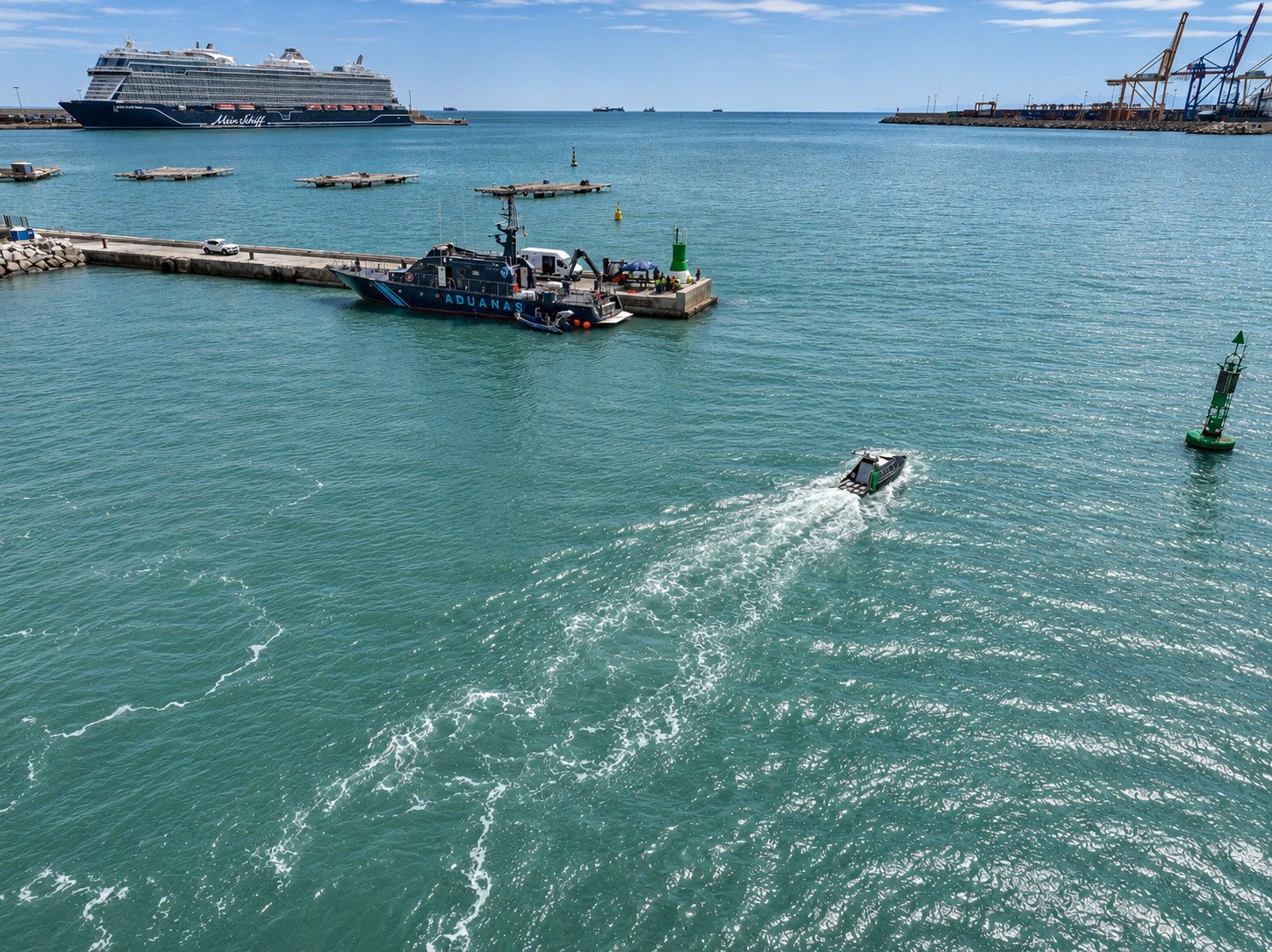
A high-potential alternative for strengthening underwater security in ports is the use of 5G-connected unmanned surface vehicles, capable of inspecting hulls, quay walls and seabeds in real time without exposing divers or emergency personnel. This is demonstrated by the article Towards Enhanced Valenciaport Security: Integration of Advanced Unmanned Vehicle Systems with 5G SA, published in the journal Drones and Autonomous Vehicles, based on trials carried out at the Port of Valencia.
Underwater security is one of the least visible and most critical areas of port protection. Drug trafficking networks use increasingly sophisticated concealment techniques, such as containers attached to ships’ hulls or semi-submersibles. In addition, submerged infrastructure requires periodic inspections to detect damage, sedimentation or unwanted objects. Traditional methods, such as diver inspections or fixed sensors, offer limited coverage and slow response times, and they expose personnel to risk.
In this context, unmanned aerial (UAV), surface (USV) and underwater (UUV) vehicles are becoming key tools for building a multi-domain situational awareness framework. Ports such as Singapore and Hamburg, and navies such as the Spanish Navy, are already adopting these platforms. The next step is to integrate them with communication networks capable of transmitting video, telemetry and sonar data with low latency and high reliability.
The work, developed by Fundación Valenciaport together with FAV Innovation and Technologies and Lemvos, focuses on Lemvos’s LM450 USV. It is a 4.8-metre vessel with twin-propeller propulsion, hybrid diesel-solar power and the capacity for missions of up to 30 days thanks to its integration with unmanned docking stations. Its AutomatePro controller offers a modular architecture that allows different sensor packages to be integrated depending on the mission, and continuously monitors power, navigation and computing resources. In the configuration evaluated, the vehicle carries a PTZ camera for surface surveillance and a Ping DSP 3DSS 3D side-scan sonar. This sonar generates three-dimensional point clouds of the underwater environment even in turbid waters, where optical sensors are no longer useful.
Connectivity is what makes remote operation possible. The USV was teleoperated over Fundación Valenciaport’s 5G SA n40 node, configured with different network slices. Full HD video, WebSocket telemetry and prioritised control commands were transmitted through it. During the trials, radio parameters (SINR, RSRP, RSRQ, PCI) were recorded to build a 5G coverage map of the port waters. This map was integrated into an immersive decision-support system built on the port’s digital twin, which allows the pilot to keep the vehicle within optimal coverage areas during critical missions.
Results at the Port of Valencia
The trials, carried out in the Xità basin and the service basin, validated four main capabilities.
- The first is 5G network performance. Average latency was around 16 ms, with no packet loss. Uplink throughput of around 24.5 Mbit/s and downlink throughput of around 130 Mbit/s were measured. Jitter remained below 1.6 ms. These values are sufficient for the real-time exchange of video, sonar data and telemetry.
- The second is emergency response: the USV launched rescue buoys and smart life jackets towards people in the water while streaming live Full HD video to operators.
- The third is seabed inspection: bathymetric surveys detected differences in sediment accumulation between basins and confirmed the absence of weighted objects.
- The fourth is the detection of objects attached to hulls. In a controlled test with the Customs vessel, the sonar detected, at a depth of around 6 metres, a 200 × 600 mm cylinder simulating a narcotics tube magnetically attached to a steel plate. Smaller objects were also detected, such as plastic boxes and 8 mm diameter ropes.
Most of the sonar KPIs were met or exceeded. The scan rate reached 50 m/min, twice the target, with room to reach 100 m/min. Results were transmitted to the operator in 200–2000 ms. The 22 m detection range was below the initial target, but its operational impact is minimal.
Concrete benefits for the port sector (Smart Ports)
The first benefit is reduced human risk. Underwater inspections and interventions in the water can be carried out remotely, without exposing divers or emergency personnel during the early stages of an incident.
The second is greater inspection coverage and frequency. A USV with an endurance of several days can continuously patrol quays, basins and ships’ hulls, rather than relying on one-off inspections. This increases the likelihood of detecting intrusions, illicit objects or structural damage to quay walls.
The third is underwater visibility in any conditions. The 3D sonar provides volumetric images that do not depend on water clarity or lighting, a decisive advantage in port waters, which are normally turbid. Point clouds also make targets easier to interpret and reduce the need for highly specialised operators.
The fourth is real-time response supported by 5G. The low latency and high bandwidth of the 5G SA network make it possible to teleoperate the vehicle with high-definition video and live sonar data. Control centres can therefore assess and act on a threat or an accident within seconds. Integrating coverage maps into the command interface reduces the operator’s cognitive load and ensures link continuity during critical missions.
Finally, the platform is scalable towards autonomy. Its modular architecture is ready to incorporate radar, AIS receivers, environmental sensors or additional sonars, as well as sensor fusion algorithms and neural networks for object segmentation and detection. This paves the way from today’s supervised operation to fully autonomous missions.
The port security of the future will not be limited to what happens on the quay: it will also require continuous monitoring of what happens below the surface. The results obtained at the Port of Valencia show that combining unmanned vehicles, advanced acoustic sensing and private 5G networks is technically feasible and operationally effective in real conditions. This approach strengthens ports’ ability to detect, assess and mitigate underwater threats, and leverages the Port Authority of Valencia’s 5G SA network deployment to move these use cases from the experimental phase into operation.
This work has been carried out within the framework of the Horizon Europe projects SMAUG and UnderSec.
References
Company, R., Higón, J. M., Gabarda, M., Laguna, Á., Pérez, F., García, Á., Severinsen, D., & Contorno, S. (2026). Towards enhanced Valenciaport security: Integration of advanced unmanned vehicle systems with 5G SA. Drones and Autonomous Vehicles, 3(3), 10023. https://doi.org/10.70322/dav.2026.10023
*Disclaimer: This English version has been generated with the support of AI-based translation tools. In case of discrepancies, the Spanish original prevails.