
The automotive industry in Europe or the need to move from plan to action
Introduction and key sector figures
The automotive industry in Europe has traditionally been, and continues to be, one of the main engines of the community’s industrial fabric and a key pillar of economic growth. Considering activities purely related to the production of vehicles and transport equipment (NACE 29 and 30), the sector generates 2.4 million jobs and accounts for around 12% of Industrial Value Added and 3.5% of the European Union’s total Gross Domestic Product, according to data published by the European Statistical Agency (EUROSTAT, 2026). For Spain, the second largest European producer after Germany, this figure stands at 2.9%.
However, the automotive sector is not limited to the mere assembly of vehicles, and if we consider its activity as a whole, its relevance multiplies, reaching 13.6 million jobs across the European Union and around 7% of its wealth. In Spain’s case, this impact is also evident and, according to information from the National Association of Automobile and Truck Manufacturers (ANFAC, 2026), its contribution to GDP reaches 7.4% and 9% of employment among the active population.It is also one of the most innovative sectors of the economy, with higher relative spending on R&D&I and higher levels of productivity, with a clearly export-oriented outlook that reinforces the European Union’s competitive position abroad.
The automotive sector is, therefore, a strategic sector of enormous importance that has, however, been exposed to major changes in recent years (or even decades) that have transformed the market’s configuration and jeopardized the competitiveness of European industry. The factors that have influenced the sector’s evolution are many and varied in intensity and impact, ranging from major fluctuations in demand, the maturity of certain segments, changes in mobility patterns, and the rise of automation in the industry, to geopolitical tensions and tariff and industrial wars.
Special mention should be made of everything related to the sector’s need for decarbonization, which has brought with it intense and uneven regulatory pressure and translated into a slow rollout of new propulsion methods as alternatives to traditional combustion. And lastly, but closely tied to all of the above, the emergence and consolidation of new players in the global market for vehicle production and sales stands out, along with its effects on global supply chains, highlighting above all the emergence of China as a global producer and driver of market growth.
The graph shown below perfectly illustrates this reality: in 2001, the bulk of world vehicle production was split among the major automotive giants, with Europe leading with 35% of total production, followed by North America with 28%, and, in third place, Japan and Korea with 22%. At that time, China played a very minor role, accounting for only 5% of production. In 2024, the latest available data, China had come to account for 34% of world production, while Europe, North America, and Japan and Korea saw their share fall to 19%, 17%, and 13%, respectively — practically half of what they represented at the turn of the century.
Graph 1. World vehicle production by origin, 2001 vs 2024 (% of world total)

Source: own elaboration based on data available in the ACEA Pocket Guide, various years
This transformation of China into an automotive power becomes even clearer when we look at the absolute figures behind it. In 2001, according to data from the International Organization of Motor Vehicle Manufacturers, world vehicle production stood at 56 million units, and at that time China barely exceeded 2 million of the total.
In 2024, the world produced 92.5 million vehicles, of which more than 31 million were manufactured in China, meaning that China has absorbed practically 85% of world production growth over these 25 years. The three traditional major blocs have not only lost market share but have also seen their absolute production decline over the period, with significant drops during the two major crises of the period (the 2008 financial crisis and the crisis stemming from the COVID-19 pandemic from 2020 onward).
The hegemony of the Chinese industry: key factors and the role of the electric vehicle
This role of China in the automotive industry cannot be explained without the introduction of the electric vehicle into the market and China’s firm commitment to this technology. In the 1980s, the government allowed foreign automotive companies access to the domestic market through joint ventures with local companies under strict operating and sales conditions.
While this allowed China to develop both an industry — with major companies already taking shape, such as SAIC or FAW — and a vehicle market of considerable size (the largest in the world), it was foreign companies that continued to hold leadership, both in the combustion segment and in the hybrid range, where countries such as Japan had the advantage.
Faced with this reality, China opted for a deliberate technological leapfrogging strategy: shifting the competition toward an emerging technology (the electric vehicle) in which all players were starting practically from scratch. The main architect of this strategy was Wan Gang, an engineer trained at Audi who returned to China in 2000 to lead the electric vehicle project under the 863 technology research program and who, later as Minister of Science and Technology between 2007 and 2018, had the institutional lever needed to elevate this commitment to the status of state policy (MIT Technology Review, 2023).
Indeed, Wan Gang has at times been dubbed the true visionary of the electric vehicle, ahead of Elon Musk himself (Bloomberg, 2024). This commitment was formalized in successive economic and industrial planning instruments, materialized through production and purchase subsidies, tax exemptions, minimum production ratios for electric vehicles, and the development of a charging network.
But the development of the Chinese industry was not limited to the mere production and assembly of vehicles; it also focused on full control of the supply chain, including raw materials, with batteries being the most critical element, accounting for 30% of the vehicle’s value on their own (Statista, 2024).
China does not have all the necessary raw materials within its own territory, but in terms of refining, it processes around 65% of the world’s lithium, more than 85% of battery-grade cobalt, and around 95% of graphite; at the intermediate stage its position is even stronger, producing more than 90% of the world’s cathodes, anodes, electrolytes, and separators, and accounting for around 80% of global cell manufacturing in 2024 (IEA, 2025).
Control over batteries thus translates into effective control over the final product itself, with leading Chinese companies such as CATL and BYD alone accounting for more than half of the global market. In fact, it is worth recalling that BYD started out in 1995 as a mobile-phone battery manufacturer and made the leap into the automotive industry in 2003. Today its electric car models are among the best-selling in the world, and it is a key supplier to many companies.
This high degree of vertical integration in the industry shortens innovation cycles and compresses costs, to the point that various industry analyses put the cost advantage of Chinese manufacturers over their Western counterparts in electric vehicle production at around 30% (AlixPartners, 2024). This has intensified domestic competition within the country, eroding margins in China’s own sector, but has also given its manufacturers unmatched price competitiveness in foreign markets, channeling into exports the surplus production capacity that the domestic market cannot absorb. It is worth noting that the automaker BYD owns its own fleet of vehicle-carrier ships to directly manage transport to end markets, which is the clearest example of this strategy of maximum control over the supply chain.
Global sales: China again
Chinese leadership cannot be explained by supply alone, since China not only manufactures a third of the world’s vehicles but is also the world’s largest market by demand: of the 95.3 million vehicles sold worldwide in 2024 (2.7% more than the previous year) according to the International Organization of Motor Vehicle Manufacturers (OICA, 2026), 31.4 million were registered in China — practically one in every three. In 2005, China’s share of world sales did not reach 9%, as reflected in the data shown in Graph 2.
The chart also shows an interesting trend among the two traditional major vehicle-producing powers, the European Union and the United States. Also in terms of sales, both markets have reduced their relative share of the global market, as already occurred with production. However, excluding periods of global crisis, the US market has held fairly stable absolute figures, while in the European case the market has been suffering a serious contraction in recent years.
Graph 2. Global car sales (2005-2025), units

Source: own elaboration based on data available from OICA
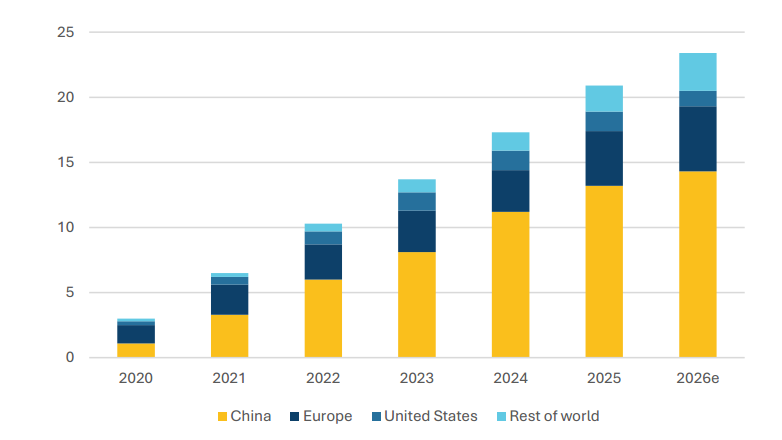
The leading position of the Chinese market becomes even more apparent when the analysis focuses on the electric segment. According to the latest edition of the IEA’s Global Electric Vehicle Outlook, the electric vehicle market reached new highs in 2025, growing 20% compared with 2024 to surpass 20 million sales, now representing 25% of total sales and consolidating a solid growth path that began in 2019. According to the same report, around 5% of the world’s vehicle fleet is now electrified, which displaced 1.2 million barrels of oil per day in 2025 (IEA, 2026).
Graph 3. Global electric vehicle sales (2020-2026), millions of units
Source: Global Electric Vehicle Outlook, 2026 IEA
Of these sales, 13.2 million units correspond to the Chinese market, and the estimate for 2026 is that it will reach 14.2 million, showing some slowdown in growth, although uptake in China is very high and electric vehicles accounted for nearly 55% of all car sales in the country.
In the United States, electric car sales remained relatively stable, at just under 10% of total car sales, although the removal of tax incentives for buying electric vehicles coincided with a drop in sales at the end of the year. Europe, meanwhile, recorded the strongest growth among the major markets, with sales rising by more than 30% to reach 28% of total car sales, driven by the tightening of the European Union’s CO₂ emissions standards for cars.
This dynamic market is supplied mainly by Chinese manufacturers, who accounted for 60% of global electric car sales in 2025, while European and North American manufacturers were each responsible for around 15% of global sales. In the coming years, growth prospects for this market are very high, and the IEA projects that the electric vehicle fleet could multiply sixfold by 2035, reaching 510 million units. Given these projections, the big question is: will China continue its market hegemony, or will the traditional major powers improve their competitive position?
The European industry: how to move from the Plan to Action
The current reality is that this dynamism shown by the electric vehicle at a global scale, in Europe’s case, is unfolding within an industry facing serious difficulties, as mentioned at the outset. The European Union market, which stood at around 10.6 million passenger cars in 2024, remains below its pre-pandemic levels and continues to show signs of weakness: in the first half of 2025 registrations fell again by 1.9% (ACEA, 2025). 76% of vehicles sold are produced by EU-based companies, but China’s weight is growing and it is now the origin of 7% of imports of finished vehicles, as well as part of the components needed by EU companies (ACEA, 2026).
The rapid growth of the Chinese industry, underpinned by a strong state support program, has raised numerous alarms within the industry, and in the European case, in October 2023 the European Commission opened, on its own initiative, an anti-subsidy investigation into battery electric vehicles manufactured in China.
After concluding that the entire value chain benefited from unfair public support, it imposed provisional countervailing duties in July 2024 and, finally, definitive duties in force since October 30, 2024, for a period of five years, on top of the general 10% tariff applicable to car imports. The rates were set based on each manufacturer’s level of cooperation with the investigation: 17.0% for BYD, 18.8% for Geely, and 35.3% for SAIC; 20.7% for other cooperating manufacturers, and 35.3% for those that did not cooperate. Tesla, which exports from its Shanghai plant, received an individual rate of 7.8% (European Commission, 2024).
In response, China took the dispute to the World Trade Organization (WTO, 2024) and opened retaliatory investigations into European products such as brandy, pork, and dairy, on which it went on to set duties of up to 42.7%. However, aware of the mutual costs of an escalation and of Europe’s dependence on external components, the Commission itself kept a negotiated channel open in parallel with the tariffs.
This basically consisted of establishing a minimum import price undertaking mechanism that would exempt from the surcharge any manufacturer committing not to sell below an agreed threshold. The Commission published guidance for submitting these undertakings in January 2026 and accepted the first one in February 2026, from Volkswagen Anhui (European Commission, 2026).
However, this type of measure is bound to have a limited effect in a market with such a competitiveness gap between suppliers, and it is therefore there that all EU efforts should focus: on actively restoring the competitiveness of Europe’s automotive industry. In this regard, throughout 2025 the European Commission has been working on a more far-reaching structural response, which resulted in the Action Plan for the automotive sector, presented by the Commission on March 5, 2025 (European Commission, 2025), structured around four pillars to address the current complex situation. This plan later found its legislative implementation in the “Automotive Package” of December 2025, which relaxed the 2035 zero-emissions target, replacing it with a 90% reduction.
The automotive sector’s Action Plan is structured around four general pillars, the content and specific actions of which will need to be further defined:
- Innovation and digitalization, the plan aims to ensure Europe does not miss out on autonomous and connected driving, with the creation of a European Alliance for Connected and Autonomous Vehicles to jointly develop software, chips, and hardware.
- Clean mobility, proposes stimulating demand for zero-emission vehicles through social leasing schemes aimed at lower-income households and greater electrification of corporate fleets.
- Competitiveness and resilience of the supply chain, the most relevant instrument is a “Battery Booster” that mobilizes €1.8 billion from the Innovation Fund to support European battery manufacturing, in connection with the Critical Raw Materials Act adopted in 2024 to reduce dependence on a single supplier, and the RESourceEU plan, approved in December 2025, through which the Commission aims to reduce dependence on a single country for rare earth extraction from the current 95% to 42% (European Commission / Council, 2025).
- Support for workers, strengthens funds for professional retraining and for supporting the sector’s employment transition.
Another piece that could be key in this scheme is the so-called Industrial Accelerator Act (IAA), the European Commission’s proposal aiming to revitalize EU industry, bringing it to a 20% share of GDP by 2035 (European Commission, 2026). Currently that share stands at 14% and has been on a declining trend for years.
Without claiming to be exhaustive, the IAA would be structured around three pillars: the simplification and digitalization of administrative authorization procedures through a “one-stop shop” system; the creation of markets for “made in the EU” products within the framework of public procurement; and, lastly, conditions on foreign direct investment in strategic sectors exceeding €100 million, which will be subject to certain conditions to ensure it generates added value in Europe, local jobs, and technology transfer.
As mentioned at the beginning of the article, the automotive sector is key to European industry, and will therefore also be one of the sectors most affected by this proposal, which will need to be defined quickly and effectively to address the two current challenges: reviving European industry while also completing the transition to the electric vehicle — all by 2035.
ACEA, the European industry association itself, has backed the objectives of the regulation but has recently warned that it will only work if the benefits of manufacturing in Europe genuinely offset the higher costs involved, and if local-content rules and battery targets are realistic and aligned with the actual pace of European production rollout.
China’s presence in Europe: in search of balance
Precisely while the European industry continues to define its plans to reduce dependence on China and gain ground in the production of electric vehicles and their components, Asian companies are also adapting their strategies and, in response to EU trade and industrial policy, are choosing to set up operations within EU territory.
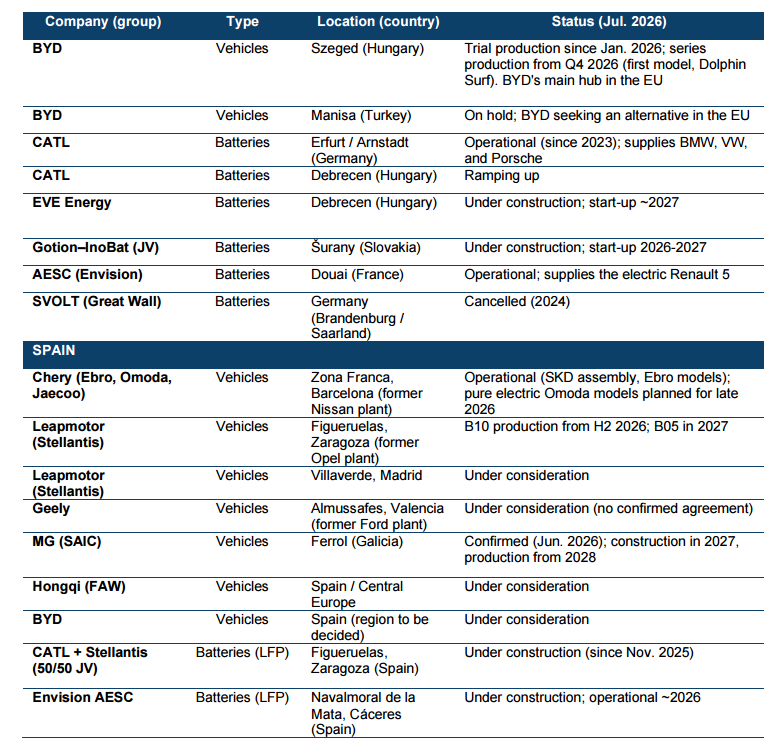
The table below shows a compilation of the main publicly known projects by Chinese companies in the electric vehicle field. In this way, companies would avoid the tariffs or price restrictions recently imposed by the European Commission. The rapid adoption of the aforementioned IAA would be desirable to provide a uniform, reliable legal framework for all these foreign-company projects established in the EU.
Table 1. List of Chinese electric vehicle company projects in Europe
Source: own elaboration based on European Commission; ACEA; electrive; Automotive News; S&P Global
Mobility; La Tribuna de Automoción; corporate press releases
As shown in the table, Spain, as the EU’s second-largest car producer, plays a prominent role in this new electric vehicle industry map taking shape in Europe. This prominence, however, carries both an opportunity and a risk in equal measure, and how it is managed will determine whether the arrival of Chinese capital translates into industrial fabric and skilled jobs, or remains limited to low-value-added final assembly. The sector is well aware of this and has, quite swiftly, put together — through ANFAC — the Spain Auto 2030 Plan, a roadmap to reindustrialize the automotive sector and accelerate electrification without losing jobs or competitiveness (ANFAC, 2025).
The Plan sets out 25 measures across three pillars — industry, market, and innovation — with quantified targets for 2035: raising the sector’s added value from €85 billion to €120 billion, preserving the 1.9 million jobs, increasing production from 2.4 to 2.7 million vehicles — already almost fully electrified — and building, from scratch, a national battery manufacturing capacity of 200 GWh.
It is worth remembering that Spain is not only home to foreign-capital projects; initiatives such as PowerCo’s Gigafactory in Sagunto, or the new models being developed at plants such as Martorell or Pamplona, represent a reality that is already putting the principles of this policy into practice. Thus, while Europe’s Automotive Plan still has a great deal of work ahead to be fleshed out, Spain’s Auto 2030 Plan seems closer to the industry and features more concrete measures that will likely deserve dedicated attention in a future PHAROS 39.0 publication.
Conclusions
The European automotive industry is at a turning point. Although it remains a strategic sector because of its weight in employment, GDP, innovation, and export capacity, its relative position has weakened in the face of China’s advance, which has gone from being a secondary player to concentrating a central share of world production, domestic demand, and, especially, the electric vehicle value chain.
This transformation is not solely a matter of the size of the Chinese market, but the result of a sustained industrial strategy based on public support, vertical integration, control over critical raw materials, dominance in batteries, and a strong capacity for cost reduction.
The electric vehicle has accelerated this competitive reconfiguration. The technological transition has opened a window of opportunity for new leaders, and China has managed to seize it faster than Europe, consolidating advantages in costs, scale, batteries, components, and the availability of processed raw materials. For the European Union, the challenge is not only to protect its market against unfair practices, but to rebuild its own industrial capabilities in the most critical links of the value chain, from batteries and semiconductors to software, charging infrastructure, and new mobility models.
Tariff measures and price undertakings can help correct specific imbalances, but they are no substitute for a substantive industrial policy. The European Action Plan for the automotive sector, the strengthening of strategic autonomy in raw materials, the push for European battery manufacturing, and the future direction of the Industrial Accelerator Act all point in the right direction, provided they translate into agile instruments, sufficient funding, realistic rules, and effective coordination between regulation, private investment, and demand incentives.
The relationship with China will need to be managed from a complex balance: avoiding excessive dependencies and unfair competition, while not closing the door to investments that generate added value, local jobs, technology transfer, and effective integration into the European industrial chain.
In this context, Spain starts from a relevant position as the EU’s second-largest producer, but its continuity as an industrial platform will depend on its ability to attract investment, accelerate the electrification of production, strengthen the supplier ecosystem, and improve the adoption of electric vehicles in the domestic market. In this regard, ANFAC’s Auto 2030 Plan lays a solid foundation on which to build this path.
Ultimately, the future of the European automotive industry will depend on its ability to move from a defensive reaction to an active industrial strategy, capable of combining decarbonization, competitiveness, technological autonomy, and job protection. The transition to the electric vehicle is not just a change of product, but a complete redefinition of global industrial power, and Europe will need to act quickly if it wants to retain a leading role in this new configuration.
References
- International Organization of Motor Vehicle Manufacturers. 2026. Statistics. Available at: https://oica.net/es/estad%C3%ADsticas-de-producci%C3%B3n/ [Accessed 15-06-2026]
- European Statistical Agency, EUROSTAT. 2026. Statistics. Available at: https://ec.europa.eu/eurostat/databrowser/view/nama_10_a64/default/table?lang=en [Accessed 15-06-2026]
- National Association of Automobile and Truck Manufacturers (ANFAC). 2026. Annual Report 2024. Available at: https://anfac.com/informe2024/ [Accessed 15-06-2026]
- National Association of Automobile and Truck Manufacturers (ANFAC). 2026. Spain Auto 2030 Plan. Available at: https://anfac.com/categorias_publicaciones/plan-espana-auto-2030/ [Accessed 15-06-2026]
- MIT Technological Review. 2023. How did China come to dominate the world of electric cars? Available at: https://www.technologyreview.com/2023/02/21/1068880/how-did-china-dominate-electric-cars-policy/ [Accessed 15-06-2026]
- YUEYUAN SELINA XUE, WEI WEI, MARK GREEVEN, IMD. 2024. China’s automotive odyssey: From joint ventures to global EV dominance. Available at: https://www.imd.org/ibyimd/asian-hub/chinas-automotive-odyssey-from-joint-ventures-to-global-ev-dominance/ [Accessed 15-06-2026]
- *Consult the downloadable document for the complete list of bibliographic references.
*Disclaimer: This English version has been generated with the support of AI-based translation tools. In case of discrepancies, the Spanish original prevails.