
The energy transition at the heart of the EU’s new Port Strategy: an integrated vision with unresolved issues
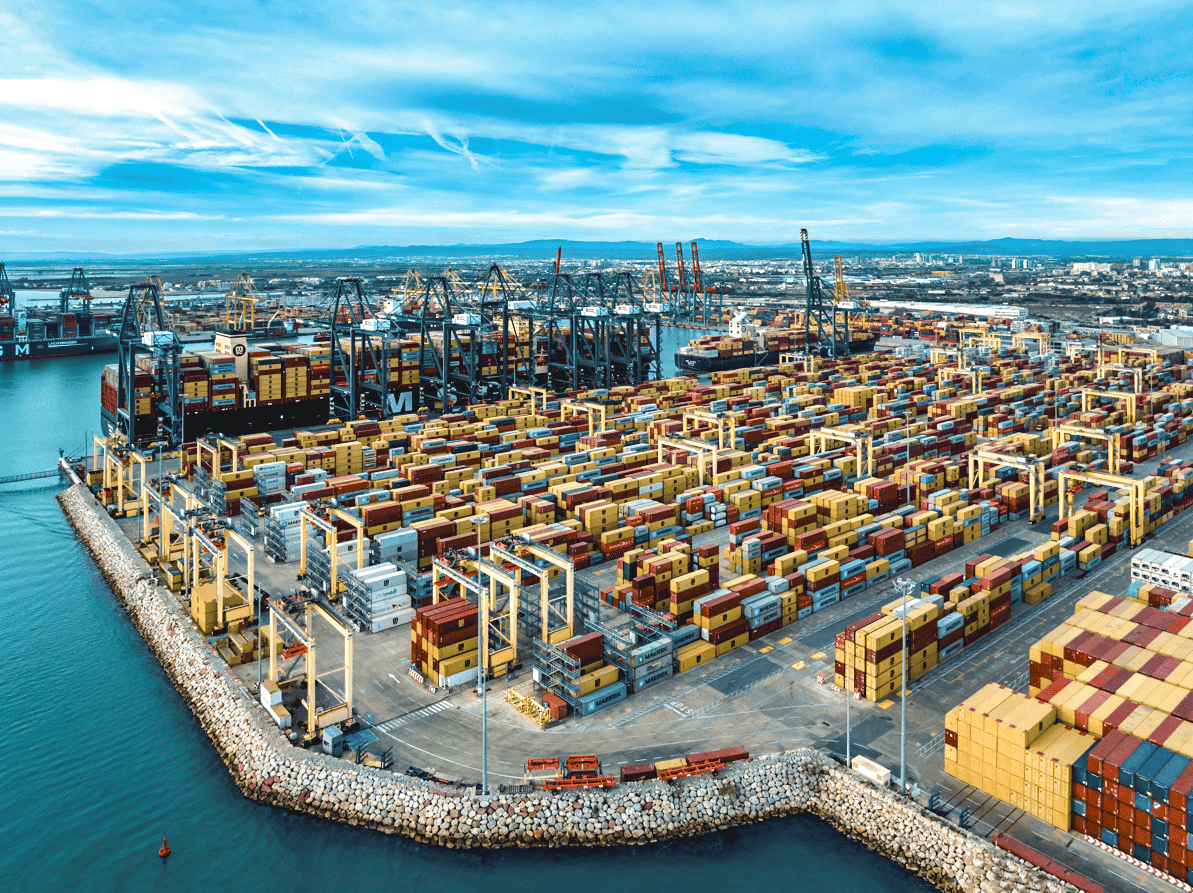
At a time shaped by an increasingly uncertain geopolitical landscape, devastating armed conflicts, shifts in trade patterns, the reconfiguration of global supply chains, the climate emergency, and intensifying international competition, the importance of the maritime and port sector in the European Union (EU) has been clearly underscored by the publication on 4 March of the EU Port Strategy and the EU Maritime Industrial Strategy. These documents are closely interlinked and have been conceived as complementary strategic frameworks to strengthen the competitiveness, sustainability, security and resilience of the European maritime-port sector.
The energy transition lies at the heart of both strategies, which explicitly recognise that ports, maritime transport and the shipbuilding industry are part of a single ecosystem, and that the sector’s energy transition cannot be addressed through isolated instruments or through regulation alone. However, the extent to which these strategies succeed in translating that systemic vision into operational and enabling measures remains open to debate and is the focus of this analysis.
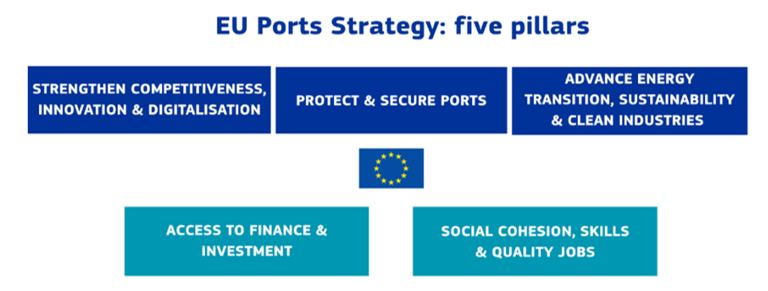
This article examines how the energy transition is incorporated into these strategies and is structured around the five pillars defined in the EU Port Strategy: strengthening competitiveness, innovation and digitalisation; protecting and ensuring security in ports; advancing the energy transition, sustainability and clean industries; improving access to finance and investment; and promoting social cohesion, training and quality employment.
Ilustration 1. The five pillars of the European Union Port Strategy
Source: European Commission 2026b.
1. Strengthening competitiveness, innovation and digitalisation
The European Union Maritime Industrial Strategy (European Commission 2026a) places competitiveness at the centre of its approach, recognising that Europe’s leadership in shipbuilding, equipment, maritime transport and related technologies is coming under increasing pressure from high structural costs, regulatory fragmentation and international competition strongly supported by active industrial policies.
The Commission advocates strengthening Europe’s industrial capabilities through innovation, decarbonisation and digitalisation, but stresses that these objectives will only be achievable if predictable framework conditions are established, access to adequate financing is facilitated, and the administrative burden that hampers long-term investment is reduced. In this context, competitiveness is not conceived as an isolated objective, but rather as the outcome of aligning climate ambition, industrial policy and economic security, so as to prevent the energy transition from resulting in a loss of activity, employment or strategic autonomy for Europe’s maritime ecosystem.
For its part, the European Port Strategy (European Commission 2026b) is grounded in recognition of the central role played by ports in the Union’s economy. Beyond their traditional function as logistics nodes, the document acknowledges that ports are evolving into multifunctional hubs, combining logistics, industrial, energy and innovation activities, and that they must remain competitive across all these areas.
Under the pillar on competitiveness, innovation and digitalisation, the strategy notes that the competitiveness of European ports is shaped not only by cost factors such as energy and labour, but also by non-economic factors, particularly the diversity of applicable rules and regulatory frameworks.
The existence of uneven legal regimes and intensive investment strategies pursued by third countries creates risks for a level playing field, including the diversion of traffic to non-EU ports. To address these challenges, the Commission plans to update the maritime ETS and revise the FuelEU Maritime Regulation, taking into account their impact on port competitiveness.
This issue has become a major talking point, particularly in Spain, one of the countries most exposed to vessel diversions caused by the inclusion of maritime transport in the EU ETS, as highlighted by the EU ETS Observatory of Puertos del Estado (Puertos del Estado 2025). A regulation designed to reduce emissions offers little support for climate mitigation if, in practice, it increases emissions by extending sailing distances and requiring additional handling operations to move the same volume of cargo.
The Strategy (European Commission 2026b) states that it will continue supporting the sector through investments that help to “strengthen sustainability, competitiveness, connectivity and resilience” and sets out clear principles for prioritising investment in ports in third countries, promoting fair and non-discriminatory access to markets, strengthening coherence in international negotiations, and ensuring reciprocity in concessions and public procurement.
The Strategy (European Commission 2026b) cites Global Gateway as one example, as it promotes European investment in projects of mutual interest in third countries, including alternative fuels. In this regard, one issue still left unaddressed by the Strategy is the significant variation in the national legal frameworks applicable to European port authorities.
While some in Northern Europe, such as the Port of Rotterdam, are able to invest directly in third countries, as demonstrated by its 30 per cent stake in the Port of Pecém in Brazil, this type of operation is not feasible for the Spanish port authorities or those of other Southern European countries. Greater legal alignment at European level would expand their capacity to act and would contribute to a genuine level playing field.
This first pillar also highlights the importance of bringing innovation to EU ports. The European Commission will promote the EU’s technological leadership in the use of alternative fuels, electrification, equipment design and adaptation, energy efficiency and digitalisation, and it specifically refers to the need to continue the Horizon Europe programme during the 2028–2034 budgetary period and to build on the achievements of the Zero Emission Waterborne Transport Partnership (ZEWT), with a view to strengthening and expanding innovation and achieving scalability in decarbonisation, digitalisation, automation and circularity across the maritime-port system.
The Strategy (European Commission 2026b) summarises the needs identified in this first pillar in three main actions (flagship actions):
- Applying guiding principles for EU funding and investment in ports in third countries
- Drawing up guidance for Member States with criteria for assessing foreign investments in ports, in line with the EU’s international commitments
- Supporting the digital and green transformation of European ports through innovation, promoting the scalability, replication and uptake of innovative port equipment and technologies.
From an analytical perspective, regulatory and port governance alignment at European level, together with measures for the effective empowerment of port authorities, are key for ports to be able to lead decarbonisation, integrate clean energy solutions and act as genuine energy hubs serving maritime transport and the associated industrial ecosystems, including cooperation with third countries. Strong budgetary support through innovation programmes such as Horizon Europe and the extension of the Zero Emission Waterborne Transport Partnership (ZEWT) in the 2028–2034 budgetary period are of significant relevance.
2. Protecting and ensuring security in ports
The European Port Strategy (European Commission 2026b) devotes one of its five pillars to the protection and security of ports, specifically addressing internal security, digital autonomy for economic security and cybersecurity, as well as the need to strengthen the climate resilience of the port system.
As regards this latter factor, climate change and environmental degradation significantly increase risks for ports and logistics networks, affecting navigability, the integrity of infrastructure, and the safety and reliability of operations. In this context, the European Commission will promote in 2026 an Integrated European Climate Resilience Framework, while Member States will be required to develop and implement national adaptation strategies. Given their vulnerability and strategic relevance, the need is underlined for ports to draw up specific climate resilience plans, integrating “resilience by design” criteria both into new infrastructure and into the modernisation of existing infrastructure.
Alongside climate risks, the Strategy highlights the growing exposure of ports to accidental and deliberate threats, which requires strengthening the resilience of the European transport system as a whole. To this end, it underlines the importance of redundancy and alternative connections in the TEN-T network, the inclusion of ports in the implementation of the Directive on the resilience of critical entities, and the improvement of rail and inland waterway interoperability.
It also addresses emerging risks such as interference with satellite navigation systems, the protection of critical infrastructure, and the management of essential goods linked to military mobility and security of supply, highlighting the key role of ports, especially small and medium-sized ones, in preparedness, coordination and response to short- and medium-term disruptions.
Although climate resilience is not included among the five main flagship actions defined for this pillar, the annex dedicated to this pillar reiterates the European Commission’s commitment to publishing the Integrated European Climate Resilience Framework in 2026, and states that the European Maritime Space Coordinator (EMS), a project integrated into the Trans-European Transport Network (TEN-T), will be responsible for facilitating the planning of maritime and hinterland connectivity resilience, in coordination with the other European Transport Corridor Coordinators. It also invites the Member States and the public and private companies that make up our sector to:
- Developing climate resilience plans and sharing good practices
- Protecting and strengthening vulnerable infrastructure, superstructure and equipment
- Ensuring sufficient redundancy and capacity to absorb short- and medium-term disruptions in logistics chains and in the supply of critical goods, allowing the most vulnerable military mobility nodes to reach adequate operational levels.
3. Advancing the energy transition, sustainability and clean industries
At this point, it is worth recalling that the Port and Maritime Industrial Strategies (European Commission 2026a, 2026b) have been supported by two high-level reports as conceptual and political catalysts: the Draghi Report and the Letta Report, named after their respective well-known authors, which have contributed decisively to placing European competitiveness and the energy transition at the centre of the strategic debate.
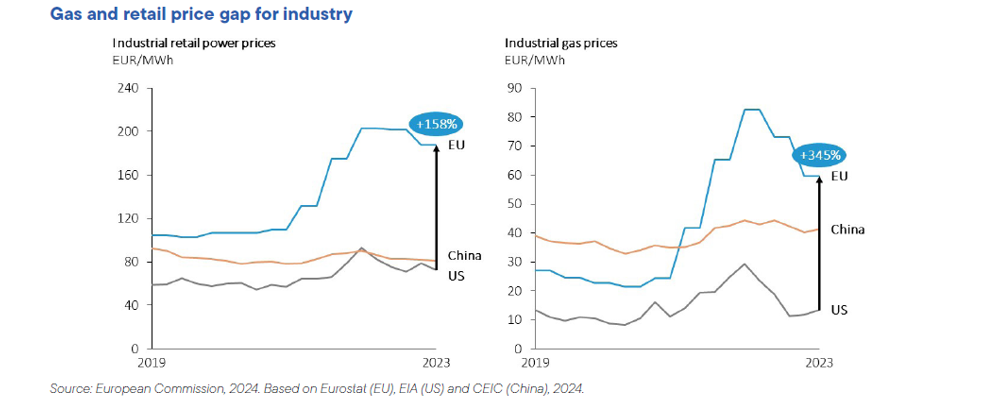
The first of these, the 2024 Draghi Report (The Future of European Competitiveness: A Competitiveness Strategy for Europe) (Draghi 2024a), made clear that energy prices and electrification are fundamental factors for the competitiveness of the European Union, especially in relation to rivals such as the United States and China. Draghi showed that electricity and gas prices in the EU are significantly higher than in the United States and China, reaching levels between 2 and 3 times higher in the EU, which increases the cost of European industrial production and reduces the competitiveness of its firms in global markets.
Ilustration 2. Differences in industrial gas and electricity prices in the EU, China and the United States
Source: Draghi 2024b, p. 05.
To address this disadvantage, Draghi (2024a) proposed profound reforms of the European energy market, including mechanisms such as long-term contracts (Power Purchase Agreements (PPAs) and contracts for difference) to stabilise and reduce the cost of renewable energy. He also highlights that the fragmentation of demand prevents the size of the European market from being used to negotiate better conditions.
Draghi underlines the need to take advantage of the transition towards clean sources with low marginal costs (renewables and nuclear) in order to reduce energy prices in the long term and improve competitiveness. He also argues that the electrification of key sectors will be both a decarbonisation tool and a means of lowering energy costs and strengthening Europe’s industrial position.
In summary, it is necessary to modify the structure of the European energy market so that electrification and the adoption of clean energy go hand in hand with lower prices and stability for European industries, which would in turn strengthen the EU’s global competitiveness.
The second stimulus behind both strategies is Enrico Letta’s report “Much More Than a Market – Speed, Security, Solidarity” (Letta 2024), which sets out that energy is a key factor for European competitiveness and once again stresses the need to advance market integration and reduce fragmentation. The Letta Report presents the integration of the European energy market as a condition for solid and sustainable competitiveness. According to this well-known economist, a more integrated energy market promotes greater efficiency, better investment conditions, more stable prices and a greater capacity to respond to crises, all of which strengthen the EU’s competitive position in the global context.
The EU Port Strategy (European Commission 2026b) recognises that ports are becoming key enablers of the energy transition, as they concentrate a significant share of trade in energy products and are evolving into energy and industrial hubs. Port electrification, in particular onshore power supply for ships at berth (OPS), is identified as a central pillar of decarbonisation, although its deployment remains uneven and constrained by grid capacity limitations.
To address this, the Commission envisages new measures in the forthcoming Electrification Action Plan, together with greater price transparency and improved demand forecasting. Strengthening the capacity and planning of electricity grids, accelerating permitting procedures, and recognising overriding public interest for certain energy infrastructures are decisive in this regard.
At the same time, the Strategy underlines the role of ports as multi-fuel production and supply platforms, promoting the deployment of renewable and low-carbon fuels through harmonised regulatory frameworks, coordinated investments, and European certification and traceability systems.
The Strategy (European Commission 2026b) summarises the needs identified in this second pillar in three main actions (flagship actions):
- Accelerating permitting procedures and establishing faster assessments for strategic port projects in the fields of energy, recycling and decarbonisation, through the European Grids Package and the Environmental Omnibus.
- Accelerating the electrification of ports, ensuring timely and non-discriminatory access to electricity grids.
- Promoting partnerships for energy cooperation in and around port areas, with the aim of advancing the sustainable use of energy, including hydrogen.
An outstanding issue is the need to translate these urgent flagship actions into national regulation. In practice, port electrification, the deployment of OPS, the production of clean marine fuels and the development of associated infrastructure continue to face lengthy, fragmented and poorly coordinated processes in Spain and other EU countries, especially where different levels of government are involved.
The Alianza Net-Zero MAR, an association whose objective is to accelerate the decarbonisation of the Spanish maritime-port sector, proposes the recognition of ports as priority areas for access to grid capacity, the explicit inclusion of electrification infrastructure, alternative fuels, and CO₂ capture and storage within permitting acceleration mechanisms, and the treatment of port microgrids and energy hubs as strategic infrastructure, on the same level as other basic investments in the port system.
4. Access to finance and investment
The European Port Strategy underlines that financing for port projects linked to the energy transition requires a combination of European, national and private resources, supported by predictable regulatory frameworks and risk-reduction mechanisms. Among the main bottlenecks identified are access to secure financing, rising costs and lengthy and complex permitting procedures, which directly affect electrification, OPS and alternative fuel projects. Since 2014, the EU has supported port projects in areas such as energy, sustainability and innovation, mobilising close to EUR 10 billion for deployment and more than EUR 200 million for R&D.
Looking ahead to the next Multiannual Financial Framework 2028–2034, instruments such as the Connecting Europe Facility (CEF3), the future European Competitiveness Fund and Horizon Europe will continue to support investment in port energy infrastructure, electrification, clean technologies and innovative solutions. In addition, the Innovation Fund, financed through EU ETS revenues, will launch in 2027 a specific call for the maritime sector that may benefit projects in ports.
The European Investment Bank (EIB) Group will continue to support initiatives on decarbonisation, offshore renewable energy, alternative fuels and climate resilience, with particular attention to small and medium-sized ports, which are expected to play a key role in the energy transition and digitalisation of the European port system.
It is noteworthy that this pillar does not include flagship actions within the central body of the Strategy, although a series of actions and guidelines are set out in Annex 3. Specifically, the Commission undertakes to apply the financing principles detailed in Annex 1 of the Strategy (European Commission 2026b) across all financial instruments, including relevant actions to support innovation in ports under Horizon Europe 2028–2034. In addition, it will prioritise support for the development of onshore power supply for ships at berth (OPS) in ports through a call known as Reflow under the CEF mechanism in 2026.
It also states that it will optimise the use of the funds available under the current Multiannual Financial Framework to support the priorities of the Strategy, request EIB Advisory, through JASPERS, to provide capacity-building support, specifically for small and medium-sized TEN-T ports, and work with national promotional banks and institutions and private financial actors to identify additional financing solutions for maritime and inland ports and their operators.
The Commission invites the EIB to continue providing financing and technical support to the sector and to maintain an active dialogue with the Commission, the Member States, co-financiers and industry, invites Member States and regions to promote the development of their ports according to local needs and circumstances, and finally invites sector stakeholders to adopt innovative and forward-looking strategies, integrating cutting-edge technologies and innovative sustainable practices.
In both the port and maritime industrial spheres, financing emerges as one of the most decisive factors for the success of the strategies. Although the Commission refers to instruments such as CEF, Horizon Europe or InvestEU, the strategies do not specify the creation of dedicated mechanisms specifically tailored to the maritime-port sector.
An outstanding issue is therefore the clear definition of a direct aid instrument for the deployment of decarbonisation projects in the maritime transport sector, which should be included in the EU budget for the 2028–2034 period. As the sector has been calling for at all the congresses, workshops and forums in which it has participated since 2024, the most recent being the First National Congress of the Port Sector organised by Puertos del Estado in Valencia from 3 to 5 March 2026, EU ETS Maritime revenues should return to the sector, financing decarbonisation projects in maritime transport and ports.
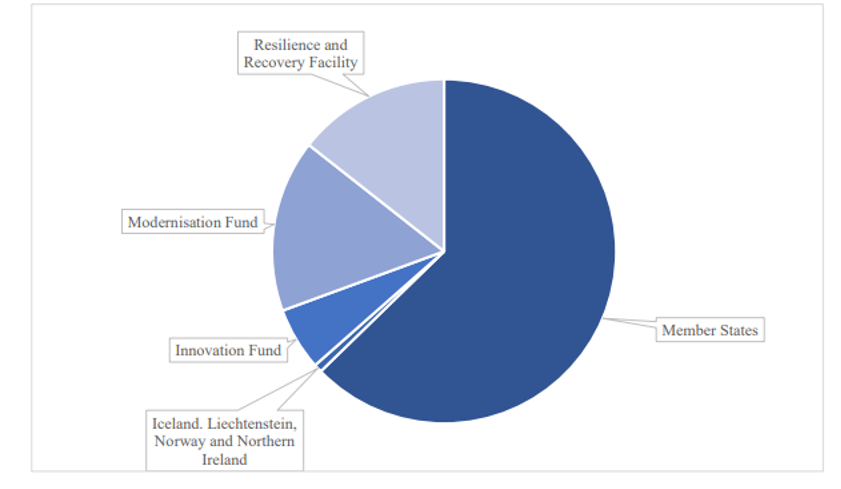
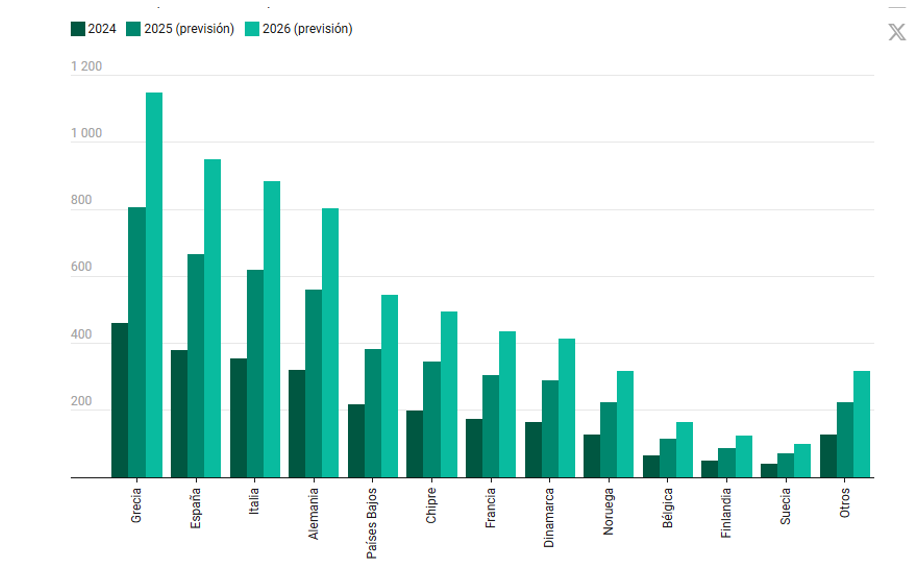
It should be recalled that the maritime transport sector will pay more than EUR 38 billion between 2024 and 2029 (valuing the emission allowance for one tonne of CO2e, or European Union Allowance, EUA, at EUR 70), a figure that could rise to EUR 43.6 billion if the average price of the EUA were to stand at EUR 80. Most of these payments are managed by the Member States, as shown in the following graph.
Graph 1. Distribution of ETS payments in 2024 among national budgets, the Innovation Fund, the Modernisation Fund and the Recovery and Resilience Facility
Source: European Commision 2025, p. 23.
The European Commission has reserved 20 million emission allowances from the Innovation Fund to support the decarbonisation of maritime transport. At EUR 70 per EUA, this allocation is equivalent to approximately EUR 1.4 billion up to 2030, representing around 3.7% of the total revenue linked to this sector. This Fund may support highly innovative projects in the maritime field, including renewable and low-carbon fuels, energy efficiency and new propulsion technologies, electrification and zero-emission solutions, and associated port infrastructure.
In Spain, on 18 November 2025, the Council of Ministers approved the National Action Plan for the Decarbonisation of Maritime Transport (Ministry of Transport and Sustainable Mobility 2025), which provides for EUR 250 million in aid for 2026–2030, financed through EU ETS Maritime revenues.
The plan will support the renewal and construction of low-emission ships and the development of pilot projects using renewable fuels such as ammonia or methanol, in line with the National Maritime Strategy 2025–2050 and European legislation, including the Fit for 55 package and the FuelEU Maritime Regulation. ANAVE (2025) highlights that the amounts envisaged represent only around 5% of the revenue expected from the maritime ETS in Spain up to 2030, estimated at more than EUR 5 billion.
Graph 2. Revenue from maritime transport emission allowances in EEA countries (EUR million) (2024–2026)
Source: ANAVE 2025.
Although the inclusion of the maritime sector in the Innovation Fund and the launch of the Decarbonisation Plan constitute very positive steps forward, the sector’s energy transition requires more robust, stable and simplified direct aid instruments. These instruments must be capable of supporting integrated projects that coherently bring together clean energy production, port infrastructure and ship adaptation, and that are aimed at ensuring the effective and large-scale deployment of decarbonisation solutions.
5. Social cohesion, training and quality employment
The fifth and final pillar of the Strategy (European Commission 2026b) recognises the role of ports as key enablers of the energy transition and sustainability, especially in islands, remote and outermost regions, where they are essential for territorial cohesion and economic development. The European Commission plans to continue supporting these regions through the Cohesion Funds and the Connecting Europe Facility for Transport (CEF-T), and invites the Member States to support investments in clean energy, clean fuels, safety and sustainability improvements, with particular attention to small and medium-sized ports.
Within the framework of the future Strategies for Coastal Communities and Islands, the Commission will incorporate measures aimed at strengthening the economic, environmental and social contribution of ports, underlining the need to balance port development, environmental impact and urban quality of life, especially in densely populated areas.
In relation to the energy transition, this pillar highlights the importance of ensuring adequate safety conditions and training for the introduction of alternative, renewable and low- or zero-carbon fuels in ports. The Commission will support, through Horizon Europe, research and the development of guidelines for the safe handling of these fuels in port areas, and will draw up specific guidance and training materials for their operational deployment.
It is also recognised that the transition towards more sustainable ports requires a qualified workforce undergoing continuous training, capable of accompanying the energy, technological and environmental transformations of the port sector and the associated blue economy.
Among the five main actions (flagship actions), the preparation of guidelines on the safe handling of alternative fuels in ports is explicitly included, as well as specific support for small and medium-sized ports, which play a relevant role in the territorial deployment of decarbonisation solutions.
Conclusions: from strategic vision to implementation
It is a major step forward that the new EU Port Strategy and the Maritime Industrial Strategy (European Commission 2026a, 2026b) recognise the maritime-port system as an essential pillar of the European economy and society, and highlight the close interdependence between ports, maritime transport and the shipbuilding industry. Both strategies share macro-level objectives and converge in placing the energy transition at the centre of their approach, moving towards a more integrated framework in which competitiveness, decarbonisation and economic security are addressed jointly. Nevertheless, a significant gap remains between the strategic ambition expressed and the real capacity for implementation on the ground.
One of the main challenges identified is the translation of European priorities into national regulatory and administrative frameworks, especially in critical areas such as port electrification, the development of energy communities in ports, the deployment of OPS, infrastructure for alternative fuels, generation from renewable sources, or the strengthening of grid capacity. Without faster permitting procedures, harmonised legal frameworks and effective recognition of the overriding public interest of these infrastructures, the pace of the transition will remain insufficient to meet climate and competitiveness objectives.
In terms of financing, the strategies rightly recognise the key role of instruments such as CEF, Horizon Europe, the Innovation Fund and EIB support, but what is missing is a dedicated and structural mechanism of direct aid for deployment. The scale of the investment required calls for more robust, stable and accessible instruments, capable of supporting integrated projects that connect clean energy production, port infrastructure and fleet adaptation, and that allow decarbonisation solutions to be scaled up beyond pilot projects or first deployments.
Ultimately, the success of the energy transition of the European maritime-port system will depend on the ability to move from strategy to implementation, by strengthening the empowerment of port authorities, aligning regulatory frameworks, introducing faster permitting procedures and ensuring sufficient and well-targeted financing. European ports are expected to play a central role as energy, industrial and logistics hubs; turning this vision into reality will require bold political decisions, regulatory coherence and a budgetary commitment commensurate with the strategic relevance of the sector for the future of the European Union.
References
- ASOCIACIÓN DE NAVIEROS ESPAÑOLES (ANAVE). 2025. The Maritime Transport Decarbonisation Plan will allocate EUR 250 million from the ETS to the energy transition until 2030. Available at: https://anave.es/el-plan-de-descarbonizacion-del-transporte-maritimo-destinara-250-me-del-ets-a-la-transicion-energetica-hasta-2030/ [Accessed: 05/03/2026].
- DRAGHI, M. 2024a. The future of European competitiveness. Part A: A competitiveness strategy for Europe. Brussels: European Commission. Available at: https://commission.europa.eu/document/download/97e481fd-2dc3-412d-be4c-f152a8232961_en [Accessed: 05/03/2026]. https://doi.org/10.2872/9356120
- DRAGHI, M. 2024b. The future of European competitiveness. Part B: In-depth analysis and recommendations. Brussels: European Commission. Available at: https://commission.europa.eu/document/download/ec1409c1-d4b4-4882-8bdd-3519f86bbb92_en [Accessed: 09/03/2026].
- European Commission. 2024. The Future of European Competitiveness: In-depth analysis and recommendations. Report by Mario Draghi. Brussels, 9 September 2024. Available at: https://commission.europa.eu/document/download/ec1409c1-d4b4-4882-8bdd-3519f86bbb92_en?filename=The%20future%20of%20European%20competitiveness_%20In-depth%20analysis%20and%20recommendations_0.pdf
- European Commission. 2025. Report on the functioning of the European carbon market in 2024. COM(2025) 735 final. Brussels. Available at: https://climate.ec.europa.eu/document/download/ddc1b1de-652b-49ed-8f15-d9fa8badd39f_en?filename=com_2025_735_en.pdf [Accessed: 05/03/2026].
- European Commission. 2026a. Communication on the EU Industrial Maritime Strategy. Communication from the Commission to the European Parliament, the Council, the European Economic and Social Committee and the Committee of the Regions. COM(2026) 111 final, Brussels, 4 March 2026.Available at: https://transport.ec.europa.eu/document/download/2cda36ec-b5fc-4cc9-9091-a8014ba8177e_en?filename=communication_on_EU_industrial_maritime_strategy_3.pdf [Accessed: 05/03/2026].
- *Consult the downloadable document for the complete list of bibliographic references.
*Disclaimer: This English version has been generated with the support of AI-based translation tools. In case of discrepancies, the Spanish original prevails.